Pearson Edexcel · A-Level · English Literature
Course version: 9ET0 · Version from Sept 2015
Poetry – Section B: Specified Poetry Pre- or Post-1900 – Post-1900 – The…
Full specification wording
Component 3: Poetry – Section B: Specified Poetry Pre- or Post-1900 – Post-1900 – The Movement – The Oxford Book of Twentieth Century English Verse, editor Philip Larkin with foreword by Andrew Motion (OUP, 1973): Your Attention Please
Peter Porter’s 'Your Attention Please' is a chilling dramatic monologue presented as a public broadcast warning of an imminent nuclear strike.
Checked against the Pearson Edexcel 9ET0 specification (opens in a new tab) on .
- Point 16 of 18
- 4 key terms
Study notes
From the checked teaching notes for this specification point.
The idea
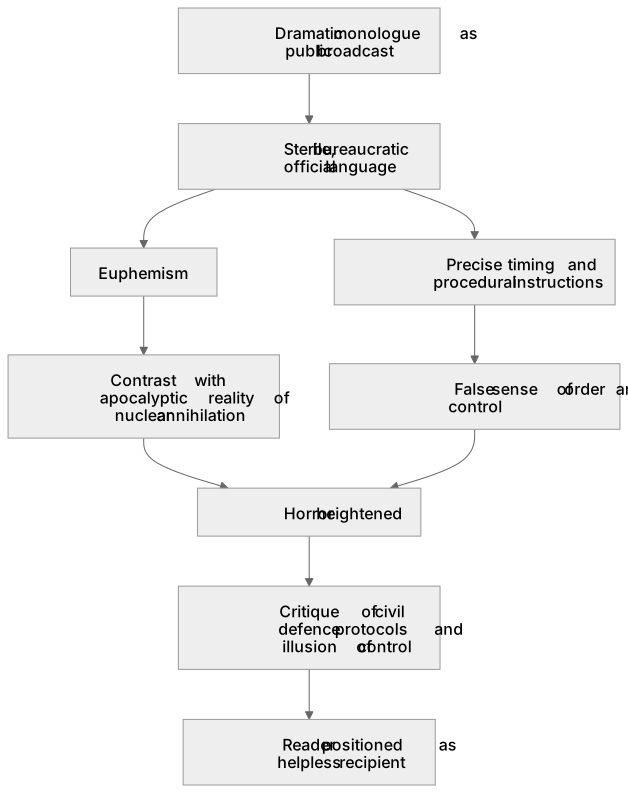
Peter Porter’s 'Your Attention Please' is a chilling dramatic monologue presented as a public broadcast warning of an imminent nuclear strike. The poem captures the intense Cold War paranoia of the era, contrasting the apocalyptic reality of mass destruction with the sterile, bureaucratic language of the government announcement. The poem critiques the illusion of control offered by civil defence protocols, exposing the absurdity of attempting to manage human annihilation through administrative procedures and exposing the vulnerability of the public in the atomic age.
What earns the marks
- Analyse the dramatic monologue form and its function as a chilling, impersonal public service announcement.
- Evaluate the contrast between the bureaucratic, euphemistic language and the apocalyptic reality of nuclear annihilation.
- Explore the use of precise, procedural details (such as timings and instructions) to create a false sense of order and control.
- Discuss the poem's context within Cold War paranoia and the public's anxiety regarding government civil defence policies.
Common mistakes and how to put them right
Treating the poem as a genuine historical broadcast.
Put it right: Analyse it as a satirical dramatic monologue designed to critique government bureaucracy.
Focusing only on the narrative of the attack.
Put it right: Examine the specific linguistic choices, such as euphemisms, that create the chilling tone.
Ignoring the psychological impact on the implied listener.
Put it right: Discuss how the poem positions the reader as the helpless recipient of the broadcast.
Exam tips
- Contrast the sterile tone of the speaker with the emotional terror the poem evokes in the reader to highlight Porter's satirical method.
- Connect the poem to the historical context of the Cold War and the publication of government survival pamphlets like 'Protect and Survive'.
- Use this poem to discuss the broader Movement theme of confronting uncomfortable contemporary realities without romanticism.
Try the lesson
The start of the Component 3: Poetry – Section B: Specified Poetry Pre- or Post-1900 – Post-1900 – The Movement – The Oxford Book of Twentieth Century English Verse, editor Philip Larkin with foreword by Andrew Motion (OUP, 1973): Your Attention Please lesson, made from checked teaching notes for this specification point.
Have a go first
In Peter Porter's poem 'Your Attention Please', what format does the speaker use to deliver the message to the audience?
Listen
Peter Porter’s 'Your Attention Please' is a chilling dramatic monologue presented as a public broadcast warning of an imminent nuclear strike. The poem captures the intense Cold War paranoia of the era, contrasting the apocalyptic reality of mass destruction with the sterile, bureaucratic language of the government announcement. The poem critiques the illusion of control offered by civil defence protocols, exposing the absurdity of attempting to manage human annihilation through administrative procedures and exposing the vulnerability of the public in the atomic age. A strong answer earns marks for these points. Analyse the dramatic monologue form and its function as a chilling, impersonal public service announcement. Evaluate the contrast between the bureaucratic, euphemistic language and the apocalyptic reality of nuclear annihilation. Explore the use of precise, procedural details (such as timings and instructions) to create a false sense of order and control. Discuss the poem's context within Cold War paranoia and the public's anxiety regarding government civil defence policies. A common slip: Treating the poem as a genuine historical broadcast. Instead, analyse it as a satirical dramatic monologue designed to critique government bureaucracy. Exam tip: Contrast the sterile tone of the speaker with the emotional terror the poem evokes in the reader to highlight Porter's satirical method.
See it
Key words
Say what each word means before you turn the card.
Cold War paranoia
Try answering aloud or in your head before turning the card.
Bureaucracy and control
Try answering aloud or in your head before turning the card.
Nuclear annihilation
Try answering aloud or in your head before turning the card.
The illusion of safety
Try answering aloud or in your head before turning the card.
See every definition
- Cold War paranoia
- The intense anxiety of the era that the poem captures, set against the apocalyptic reality of mass destruction.
- Bureaucracy and control
- Detached officialdom and administrative procedures that the poem critiques, exposing the absurdity of attempting to manage human annihilation.
- Nuclear annihilation
- The apocalyptic reality of mass destruction contrasted with the sterile language of the government announcement.
- The illusion of safety
- The false sense of control offered by civil defence protocols, which the poem critiques as absurd in the atomic age.
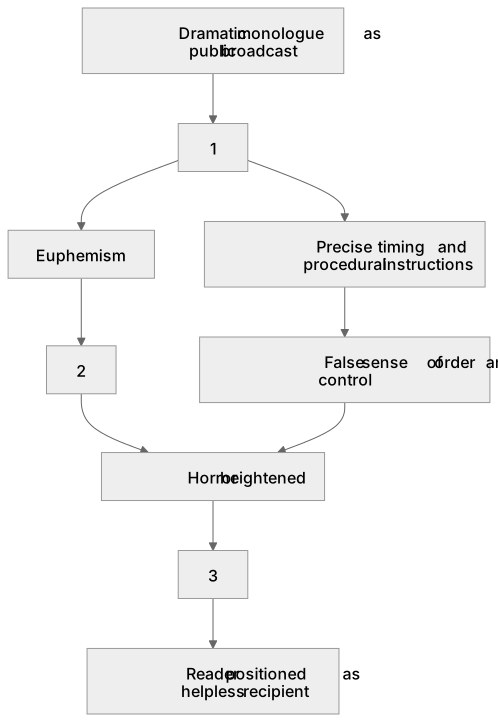
Label the diagram
Some boxes have lost their names. Pick the right name for each number.
1Box 1
2Box 2
3Box 3
There is more to this lesson
The full lesson goes on to check your understanding and help you earn the marks. Create a free account to carry on, with your progress saved.
A week of Premium from your first lesson · Then the free plan continues · No card, no charge
Test your understanding of Component 3: Poetry – Section B: Specified Poetry Pre- or Post-1900 – Post-1900 – The Movement – The Oxford Book of Twentieth Century English Verse, editor Philip Larkin with foreword by Andrew Motion (OUP, 1973): Your Attention Please
Active recall beats re-reading. Take an instant quiz now to test what you’ve learned and lock it into long-term memory.
A week of Premium from your first lesson · Then the free plan continues · No card, no charge