Pearson Edexcel · A-Level · English Literature
Course version: 9ET0 · Version from Sept 2015
Poetry – Section B: Specified Poetry Pre- or Post-1900 – Pre-1900 –…
Full specification wording
Component 3: Poetry – Section B: Specified Poetry Pre- or Post-1900 – Pre-1900 – Metaphysical Poetry – John Donne Selected Poems (Penguin Classics, 2006): The Canonization
'The Canonization' opens in medias res with a dramatic outburst ('For God's sake hold your tongue, and let me love'), establishing a defensive posture against societal criticism.
Checked against the Pearson Edexcel 9ET0 specification (opens in a new tab) on .
- Point 5 of 22
- 4 key terms
Study notes
From the checked teaching notes for this specification point.
The idea
'The Canonization' opens in medias res with a dramatic outburst ('For God's sake hold your tongue, and let me love'), establishing a defensive posture against societal criticism. Donne constructs a complex metaphysical conceit elevating secular love to the status of religious martyrdom. The speaker argues their love harms no one, contrasting their private devotion with the public world of commerce and politics. Through vivid imagery of the eagle, the dove, and the mythical phoenix, Donne illustrates how the lovers are consumed and resurrected by passion, achieving unified perfection. Ultimately, the speaker claims their love will be immortalised in poetry, serving as a sacred pattern for future lovers to worship, thus completing their 'canonization'.
What earns the marks
- Analyse the dramatic, colloquial opening and its function in establishing the conflict between private love and public duty.
- Evaluate the central conceit that equates passionate, secular lovers with religious saints and martyrs.
- Examine the use of the phoenix imagery to represent the transformative, unifying, and potentially sexual nature of their love.
- Discuss the self-reflexive nature of the poem, where the speaker claims the poem itself will become the 'urn' that immortalises their love.
Common mistakes and how to put them right
Reading the religious imagery as purely literal.
Put it right by explaining how Donne uses religious terminology as a metaphysical conceit to elevate secular love.
Overlooking the satirical elements in the second stanza.
Put it right by analysing how the speaker mocks Petrarchan tropes, such as sighs causing storms, to prove their love is harmless.
Ignoring the significance of the stanza structure.
Put it right by noting how the first and last lines of each stanza end with the word 'love', framing the entire argument.
Exam tips
- Contrast the defensive, aggressive tone of the first stanza with the triumphant, reverent tone of the final stanza.
- Link the poem's religious conceit to the post-Reformation context, noting how Catholic ideas of sainthood are repurposed for secular romance.
- Use the phoenix metaphor to discuss Donne's fascination with paradox, specifically how death and resurrection function as both spiritual and sexual puns.
Try the lesson
The start of the Component 3: Poetry – Section B: Specified Poetry Pre- or Post-1900 – Pre-1900 – Metaphysical Poetry – John Donne Selected Poems (Penguin Classics, 2006): The Canonization lesson, made from checked teaching notes for this specification point.
Have a go first
In the opening stanza of John Donne's 'The Canonization', what does the speaker demand that the addressee do?
Listen
The Canonization' opens in medias res with a dramatic outburst ('For God's sake hold your tongue, and let me love'), establishing a defensive posture against societal criticism. Donne constructs a complex metaphysical conceit elevating secular love to the status of religious martyrdom. The speaker argues their love harms no one, contrasting their private devotion with the public world of commerce and politics. Through vivid imagery of the eagle, the dove, and the mythical phoenix, Donne illustrates how the lovers are consumed and resurrected by passion, achieving unified perfection. Ultimately, the speaker claims their love will be immortalised in poetry, serving as a sacred pattern for future lovers to worship, thus completing their 'canonization'. A strong answer earns marks for these points. Analyse the dramatic, colloquial opening and its function in establishing the conflict between private love and public duty. Evaluate the central conceit that equates passionate, secular lovers with religious saints and martyrs. Examine the use of the phoenix imagery to represent the transformative, unifying, and potentially sexual nature of their love. Discuss the self-reflexive nature of the poem, where the speaker claims the poem itself will become the 'urn' that immortalises their love. A common slip: Reading the religious imagery as purely literal. Instead, explaining how Donne uses religious terminology as a metaphysical conceit to elevate secular love. Exam tip: Contrast the defensive, aggressive tone of the first stanza with the triumphant, reverent tone of the final stanza.
See it
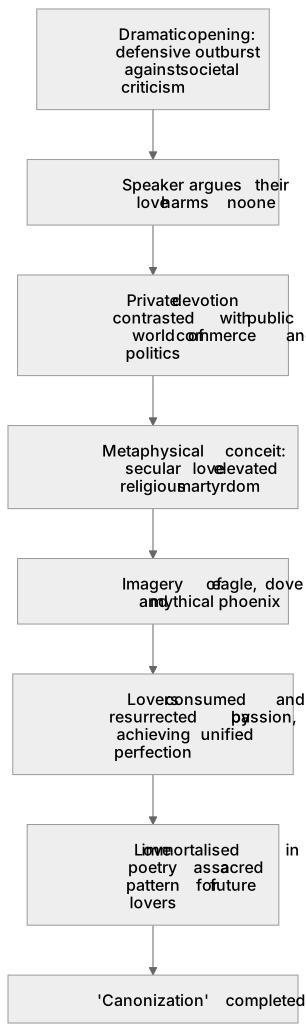
Put it in order
Put these steps in the order they happen.
- 1. Imagery of eagle, dove and mythical phoenix
- 2. 'Canonization' completed
- 3. Lovers consumed and resurrected by passion, achieving unified perfection
- 4. Dramatic opening: defensive outburst against societal criticism
- 5. Speaker argues their love harms no one
- 6. Love immortalised in poetry as a sacred pattern for future lovers
- 7. Private devotion contrasted with public world of commerce and politics
- 8. Metaphysical conceit: secular love elevated to religious martyrdom
Key words
Say what each word means before you turn the card.
Sacred and Profane Love
Try answering aloud or in your head before turning the card.
Art and Immortality
Try answering aloud or in your head before turning the card.
Public versus Private Worlds
Try answering aloud or in your head before turning the card.
Paradox and Transformation
Try answering aloud or in your head before turning the card.
See every definition
- Sacred and Profane Love
- The poem elevates secular love to the status of religious martyrdom, equating passionate lovers with religious saints and martyrs.
- Art and Immortality
- The speaker claims the poem itself will become the 'urn' that immortalises their love, serving as a sacred pattern for future lovers to worship.
- Public versus Private Worlds
- The speaker contrasts their private devotion with the public world of commerce and politics, establishing a conflict between private love and public duty.
- Paradox and Transformation
- Through phoenix imagery, Donne shows the lovers consumed and resurrected by passion, with death and resurrection functioning as both spiritual and sexual puns.
Label the diagram
Some boxes have lost their names. Pick the right name for each number.
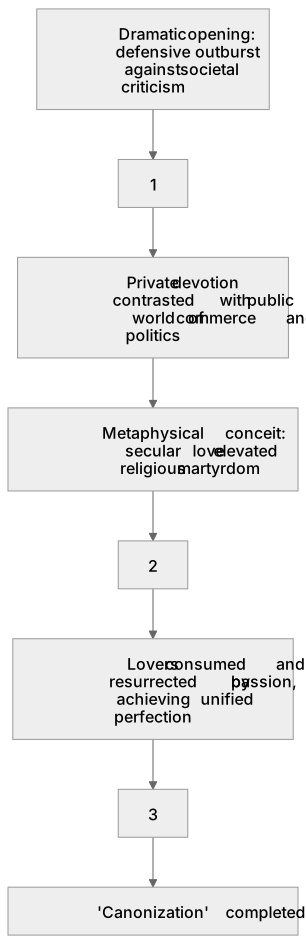
1Box 1
2Box 2
3Box 3
There is more to this lesson
The full lesson goes on to check your understanding and help you earn the marks. Create a free account to carry on, with your progress saved.
A week of Premium from your first lesson · Then the free plan continues · No card, no charge
Test your understanding of Component 3: Poetry – Section B: Specified Poetry Pre- or Post-1900 – Pre-1900 – Metaphysical Poetry – John Donne Selected Poems (Penguin Classics, 2006): The Canonization
Active recall beats re-reading. Take an instant quiz now to test what you’ve learned and lock it into long-term memory.
A week of Premium from your first lesson · Then the free plan continues · No card, no charge