Pearson Edexcel · A-Level · English Literature
Course version: 9ET0 · Version from Sept 2015
Poetry – Section B: Specified Poetry Pre- or Post-1900 – Pre-1900 –…
Full specification wording
Component 3: Poetry – Section B: Specified Poetry Pre- or Post-1900 – Pre-1900 – Metaphysical Poetry – John Donne Selected Poems (Penguin Classics, 2006): The Sun Rising
In 'The Sun Rising', Donne subverts the traditional aubade by directly addressing and insulting the sun, personifying it as a 'Busy old fool'.
Checked against the Pearson Edexcel 9ET0 specification (opens in a new tab) on .
- Point 4 of 22
- 4 key terms
Study notes
From the checked teaching notes for this specification point.
The idea
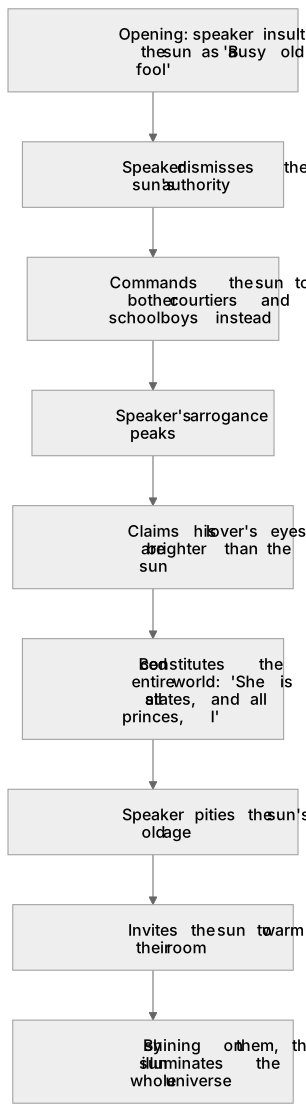
In 'The Sun Rising', Donne subverts the traditional aubade by directly addressing and insulting the sun, personifying it as a 'Busy old fool'. The poem explores the tension between the macrocosm of the external world and the microcosm of the lovers' bedroom. Initially, the speaker dismisses the sun's authority, commanding it to bother courtiers and schoolboys instead. As the poem progresses, the speaker's arrogance peaks, claiming his lover's eyes are brighter than the sun and that their bed constitutes the entire world ('She is all states, and all princes, I'). Ultimately, the speaker pities the sun's old age and invites it to warm their room, arguing that by shining on them, it illuminates the whole universe. This metaphysical conceit elevates romantic love above temporal and spatial boundaries.
What earns the marks
- Analyse the use of the aubade form and how Donne subverts it through his colloquial, aggressive opening.
- Evaluate the metaphysical conceit comparing the lovers' bedroom to the entire universe, focusing on the microcosm versus macrocosm dynamic.
- Explore the personification of the sun as an intrusive, aging figure losing its cosmic authority to the power of love.
- Discuss the shifting tone across the three stanzas, moving from irritation to grandiose triumph and final accommodation.
Common mistakes and how to put them right
Assuming the poem is purely romantic without acknowledging the speaker's arrogance and underlying anxiety about time.
Put it right by exploring the defensive nature of the speaker's hyperbole.
Misinterpreting the historical context of 'Indias of spice and mine'.
Put it right by linking the line to 17th-century exploration and the commodification of the external world compared to the pricelessness of the lover.
Ignoring the structural progression of the stanzas.
Put it right by tracing how the speaker's argument develops logically from dismissing the sun to absorbing its power.
Exam tips
- Compare the microcosm and macrocosm conceit in this poem with similar spatial metaphors in 'The Good Morrow'.
- Quote the opening line 'Busy old fool, unruly sun' to demonstrate Donne's characteristic abrupt, dramatic openings in medias res.
- Analyse the use of lists and imperatives in the first stanza to highlight the speaker's attempt to control time and the external world.
Try the lesson
The start of the Component 3: Poetry – Section B: Specified Poetry Pre- or Post-1900 – Pre-1900 – Metaphysical Poetry – John Donne Selected Poems (Penguin Classics, 2006): The Sun Rising lesson, made from checked teaching notes for this specification point.
Have a go first
In John Donne's 'The Sun Rising', how does the speaker initially address the sun?
Listen
In 'The Sun Rising', Donne subverts the traditional aubade by directly addressing and insulting the sun, personifying it as a 'Busy old fool'. The poem explores the tension between the macrocosm of the external world and the microcosm of the lovers' bedroom. Initially, the speaker dismisses the sun's authority, commanding it to bother courtiers and schoolboys instead. As the poem progresses, the speaker's arrogance peaks, claiming his lover's eyes are brighter than the sun and that their bed constitutes the entire world ('She is all states, and all princes, I'). Ultimately, the speaker pities the sun's old age and invites it to warm their room, arguing that by shining on them, it illuminates the whole universe. This metaphysical conceit elevates romantic love above temporal and spatial boundaries. A strong answer earns marks for these points. Analyse the use of the aubade form and how Donne subverts it through his colloquial, aggressive opening. Evaluate the metaphysical conceit comparing the lovers' bedroom to the entire universe, focusing on the microcosm versus macrocosm dynamic. Explore the personification of the sun as an intrusive, aging figure losing its cosmic authority to the power of love. Discuss the shifting tone across the three stanzas, moving from irritation to grandiose triumph and final accommodation. A common slip: Assuming the poem is purely romantic without acknowledging the speaker's arrogance and underlying anxiety about time. Instead, exploring the defensive nature of the speaker's hyperbole. Exam tip: Compare the microcosm and macrocosm conceit in this poem with similar spatial metaphors in 'The Good Morrow'.
See it
Key words
Say what each word means before you turn the card.
Microcosm and Macrocosm
Try answering aloud or in your head before turning the card.
The Power of Love
Try answering aloud or in your head before turning the card.
Time and Mortality
Try answering aloud or in your head before turning the card.
Authority and Rebellion
Try answering aloud or in your head before turning the card.
See every definition
- Microcosm and Macrocosm
- The tension between the external world and the lovers' bedroom, with the bed constituting the entire world.
- The Power of Love
- Romantic love elevated above temporal and spatial boundaries through the metaphysical conceit.
- Time and Mortality
- The speaker's underlying anxiety about time, explored through the defensive nature of his hyperbole.
- Authority and Rebellion
- The speaker dismissing the sun's authority, commanding it to bother courtiers and schoolboys instead.
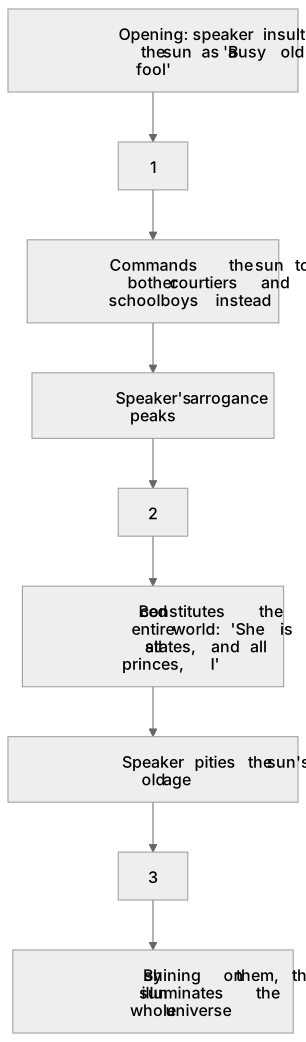
Label the diagram
Some boxes have lost their names. Pick the right name for each number.
1Box 1
2Box 2
3Box 3
There is more to this lesson
The full lesson goes on to check your understanding and help you earn the marks. Create a free account to carry on, with your progress saved.
A week of Premium from your first lesson · Then the free plan continues · No card, no charge
Test your understanding of Component 3: Poetry – Section B: Specified Poetry Pre- or Post-1900 – Pre-1900 – Metaphysical Poetry – John Donne Selected Poems (Penguin Classics, 2006): The Sun Rising
Active recall beats re-reading. Take an instant quiz now to test what you’ve learned and lock it into long-term memory.
A week of Premium from your first lesson · Then the free plan continues · No card, no charge