Pearson Edexcel · A-Level · English Literature
Course version: 9ET0 · Version from Sept 2015
Poetry – Section B: Specified Poetry Pre- or Post-1900 – Pre-1900 –…
Full specification wording
Component 3: Poetry – Section B: Specified Poetry Pre- or Post-1900 – Pre-1900 – Metaphysical Poetry – Metaphysical Poetry, editor Colin Burrow (Penguin, 2006): The Definition of Love
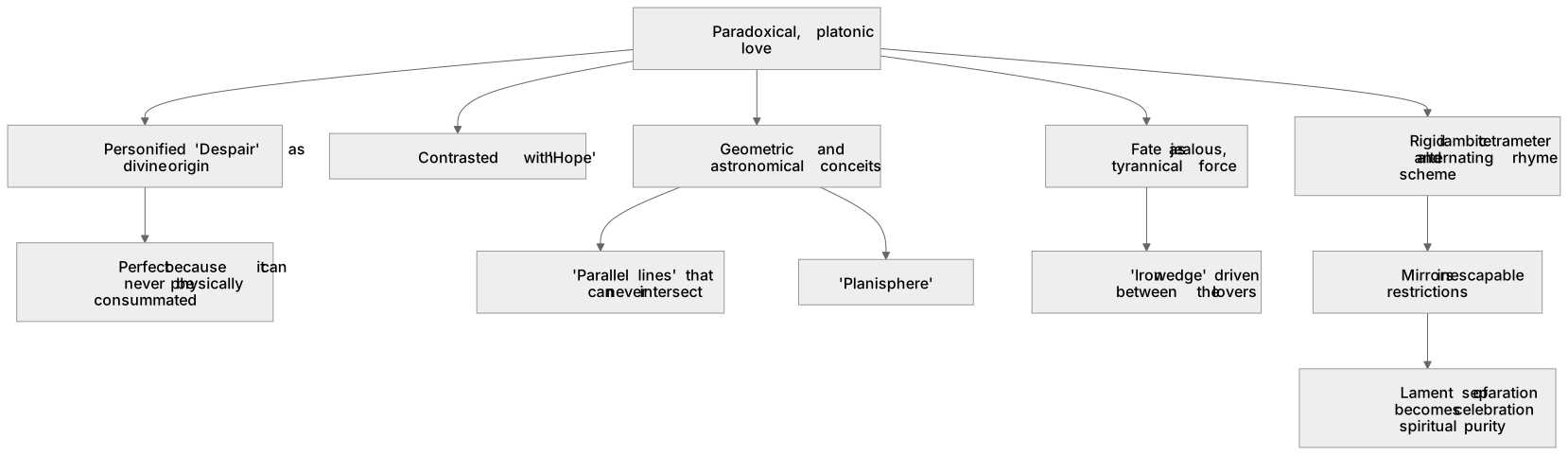
In ‘The Definition of Love’, Andrew Marvell explores a paradoxical, platonic love that is perfect precisely because it can never be physically consummated.
Checked against the Pearson Edexcel 9ET0 specification (opens in a new tab) on .
- Point 21 of 23
- 4 key terms
Study notes
From the checked teaching notes for this specification point.
The idea
In ‘The Definition of Love’, Andrew Marvell explores a paradoxical, platonic love that is perfect precisely because it can never be physically consummated. The speaker personifies ‘Despair’ as the divine origin of this love, contrasting it with ‘Hope’. Marvell employs striking geometric and astronomical conceits to articulate this separation, famously comparing the lovers to ‘parallel lines’ that, though infinite and perfect, can never intersect. Fate is depicted as a jealous, tyrannical force driving an ‘iron wedge’ between them.
What earns the marks
- Analyse the personification of Fate as a jealous, restrictive force that actively prevents the lovers' union.
- Evaluate the use of geometric and astronomical conceits, particularly the 'parallel lines' and the 'planisphere', to illustrate perfect but impossible love.
- Examine the paradoxical argument that the love is divine and perfect specifically because it is born of 'Despair' and cannot be physically realised.
- Discuss how the strict iambic tetrameter and regular stanzaic structure mirror the inescapable, rigid laws of Fate described in the poem.
Common mistakes and how to put them right
Reading the poem as a standard lament about a breakup.
Put it right: Interpret it as a philosophical meditation on the nature of a perfect, platonic love that transcends physical union.
Misunderstanding the 'parallel lines' conceit as a negative image.
Put it right: Recognise that parallel lines represent infinite perfection and alignment, even though they cannot meet.
Overlooking the role of 'Despair'.
Put it right: Analyse how Despair is elevated to a divine, creative force ('magnanimous Despair') that makes this transcendent love possible.
Exam tips
- Contrast the platonic, spiritual focus of this poem with the urgent, physical demands of Marvell's 'To His Coy Mistress'.
- Analyse the semantic field of geometry and physics to show how Marvell uses rational, scientific language to explain an emotional state.
- Explore how the poem subverts traditional love poetry by celebrating impossibility and separation rather than union.
Try the lesson
The start of the Component 3: Poetry – Section B: Specified Poetry Pre- or Post-1900 – Pre-1900 – Metaphysical Poetry – Metaphysical Poetry, editor Colin Burrow (Penguin, 2006): The Definition of Love lesson, made from checked teaching notes for this specification point.
Have a go first
In Andrew Marvell's 'The Definition of Love', which geometric concept is used to illustrate the impossibility of the lovers ever uniting?
Listen
In ‘The Definition of Love’, Andrew Marvell explores a paradoxical, platonic love that is perfect precisely because it can never be physically consummated. The speaker personifies ‘Despair’ as the divine origin of this love, contrasting it with ‘Hope’. Marvell employs striking geometric and astronomical conceits to articulate this separation, famously comparing the lovers to ‘parallel lines’ that, though infinite and perfect, can never intersect. Fate is depicted as a jealous, tyrannical force driving an ‘iron wedge’ between them. A strong answer earns marks for these points. Analyse the personification of Fate as a jealous, restrictive force that actively prevents the lovers' union. Evaluate the use of geometric and astronomical conceits, particularly the 'parallel lines' and the 'planisphere', to illustrate perfect but impossible love. Examine the paradoxical argument that the love is divine and perfect specifically because it is born of 'Despair' and cannot be physically realised. Discuss how the strict iambic tetrameter and regular stanzaic structure mirror the inescapable, rigid laws of Fate described in the poem. A common slip: Reading the poem as a standard lament about a breakup. Instead, interpret it as a philosophical meditation on the nature of a perfect, platonic love that transcends physical union. Exam tip: Contrast the platonic, spiritual focus of this poem with the urgent, physical demands of Marvell's 'To His Coy Mistress'.
See it
Key words
Say what each word means before you turn the card.
Platonic Love and Spirituality
Try answering aloud or in your head before turning the card.
Fate and Destiny
Try answering aloud or in your head before turning the card.
Separation and Impossibility
Try answering aloud or in your head before turning the card.
Reason versus Emotion
Try answering aloud or in your head before turning the card.
See every definition
- Platonic Love and Spirituality
- A perfect love that is spiritual rather than physical, celebrated here precisely because it can never be physically consummated.
- Fate and Destiny
- A jealous, tyrannical force that drives an 'iron wedge' between the lovers and actively prevents their union.
- Separation and Impossibility
- The condition of the lovers, illustrated through geometric and astronomical conceits such as 'parallel lines' that can never intersect.
- Reason versus Emotion
- The use of rational, scientific language, including the semantic field of geometry and physics, to explain an emotional state.
Label the diagram
Some boxes have lost their names. Pick the right name for each number.
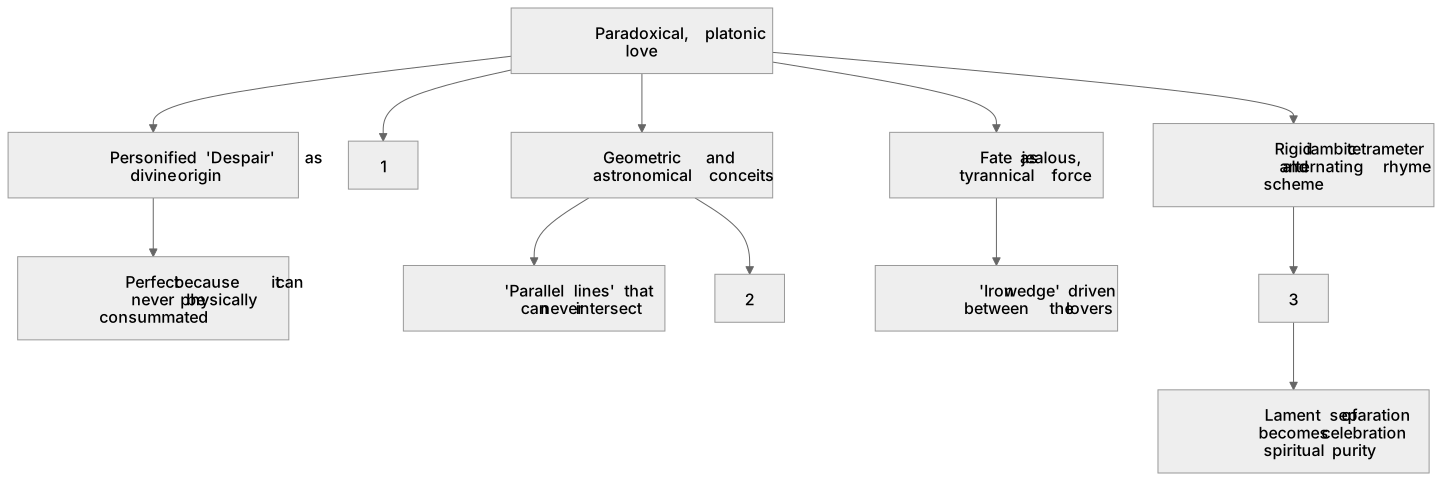
1Box 1
2Box 2
3Box 3
There is more to this lesson
The full lesson goes on to check your understanding and help you earn the marks. Create a free account to carry on, with your progress saved.
A week of Premium from your first lesson · Then the free plan continues · No card, no charge
Test your understanding of Component 3: Poetry – Section B: Specified Poetry Pre- or Post-1900 – Pre-1900 – Metaphysical Poetry – Metaphysical Poetry, editor Colin Burrow (Penguin, 2006): The Definition of Love
Active recall beats re-reading. Take an instant quiz now to test what you’ve learned and lock it into long-term memory.
A week of Premium from your first lesson · Then the free plan continues · No card, no charge