Pearson Edexcel · A-Level · English Literature
Course version: 9ET0 · Version from Sept 2015
Poetry – Section B: Specified Poetry Pre- or Post-1900 – Pre-1900 –…
Full specification wording
Component 3: Poetry – Section B: Specified Poetry Pre- or Post-1900 – Pre-1900 – Metaphysical Poetry – Metaphysical Poetry, editor Colin Burrow (Penguin, 2006): A Hymn to God the Father
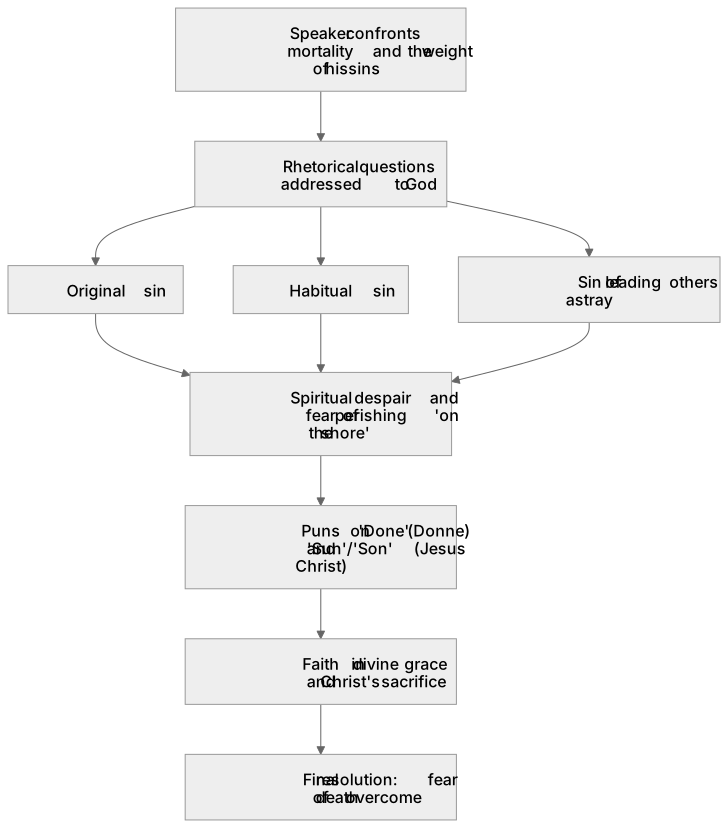
In ‘A Hymn to God the Father’, John Donne confronts his mortality and the weight of his sins, blending theological anxiety with metaphysical wit.
Checked against the Pearson Edexcel 9ET0 specification (opens in a new tab) on .
- Point 13 of 23
- 4 key terms
Study notes
From the checked teaching notes for this specification point.
The idea
In ‘A Hymn to God the Father’, John Donne confronts his mortality and the weight of his sins, blending theological anxiety with metaphysical wit. The poem is structured around rhetorical questions addressed to God, categorising the speaker's transgressions into original sin, habitual sin, and the sin of leading others astray. The poem traces a journey from spiritual despair and the fear of perishing 'on the shore' to a final resolution where faith in divine grace and Christ's sacrifice overcomes the fear of death, demonstrating a deeply personal negotiation with the divine.
What earns the marks
- Analyse the structural repetition of 'Wilt thou forgive...' and the refrain 'When thou hast done, thou hast not done' to show the speaker's persistent anxiety.
- Evaluate the use of puns on 'Done' (Donne) and 'Sun' (Son of God) as a metaphysical technique to blend personal identity with theological salvation.
- Examine the progression of sins described in each stanza, moving from original sin to personal, habitual sins, and finally the sin of fear.
- Discuss the shift in tone in the final stanza, where the promise of the 'Sun' brings resolution and eliminates the speaker's fear of death.
Common mistakes and how to put them right
Treating the puns on 'done' and 'sun' as mere comedic wordplay.
Put it right: Analyse these puns as serious, complex metaphysical conceits that intertwine the poet's identity with divine salvation.
Misinterpreting the 'sin of fear' as a minor issue.
Put it right: Recognise that for Donne, doubting God's grace (the sin of fear) is the ultimate spiritual crisis that must be resolved.
Ignoring the hymn form.
Put it right: Discuss how the poem's regular stanzaic structure and rhyme scheme reflect its intended purpose as a musical piece of worship and confession.
Exam tips
- Contrast the quiet, contemplative tone of this hymn with the aggressive, violent demands seen in Donne's Holy Sonnets.
- Use the pun on 'Sun/Son' to explore how metaphysical poets use linguistic ambiguity to express complex religious truths.
- Track the changing use of pronouns to demonstrate the shifting dynamic between the individual sinner and the forgiving God.
Try the lesson
The start of the Component 3: Poetry – Section B: Specified Poetry Pre- or Post-1900 – Pre-1900 – Metaphysical Poetry – Metaphysical Poetry, editor Colin Burrow (Penguin, 2006): A Hymn to God the Father lesson, made from checked teaching notes for this specification point.
Have a go first
In John Donne's 'A Hymn to God the Father', which word is repeatedly used as a pun to represent both the speaker's own surname and the concept of an action being finished?
Listen
In ‘A Hymn to God the Father’, John Donne confronts his mortality and the weight of his sins, blending theological anxiety with metaphysical wit. The poem is structured around rhetorical questions addressed to God, categorising the speaker's transgressions into original sin, habitual sin, and the sin of leading others astray. The poem traces a journey from spiritual despair and the fear of perishing 'on the shore' to a final resolution where faith in divine grace and Christ's sacrifice overcomes the fear of death, demonstrating a deeply personal negotiation with the divine. A strong answer earns marks for these points. Analyse the structural repetition of 'Wilt thou forgive... and the refrain 'When thou hast done, thou hast not done' to show the speaker's persistent anxiety. Evaluate the use of puns on 'Done' (Donne) and 'Sun' (Son of God) as a metaphysical technique to blend personal identity with theological salvation. Examine the progression of sins described in each stanza, moving from original sin to personal, habitual sins, and finally the sin of fear. Discuss the shift in tone in the final stanza, where the promise of the 'Sun' brings resolution and eliminates the speaker's fear of death. A common slip: Treating the puns on 'done' and 'sun' as mere comedic wordplay. Instead, Analyse these puns as serious, complex metaphysical conceits that intertwine the poet's identity with divine salvation. Exam tip: Contrast the quiet, contemplative tone of this hymn with the aggressive, violent demands seen in Donne's Holy Sonnets.
See it
Key words
Say what each word means before you turn the card.
Sin and forgiveness
Try answering aloud or in your head before turning the card.
Mortality and fear of death
Try answering aloud or in your head before turning the card.
Grace and salvation
Try answering aloud or in your head before turning the card.
The relationship between humanity and God
Try answering aloud or in your head before turning the card.
See every definition
- Sin and forgiveness
- The poem traces a progression of sins, from original sin to habitual sins and the sin of leading others astray, alongside the speaker's search for divine forgiveness.
- Mortality and fear of death
- The speaker confronts his mortality and moves from spiritual despair and the fear of perishing 'on the shore' to a resolution in which the fear of death is overcome.
- Grace and salvation
- Faith in divine grace and Christ's sacrifice overcomes the fear of death, resolving the speaker's deeply personal negotiation with the divine.
- The relationship between humanity and God
- The poem is structured around rhetorical questions addressed to God, through which the individual sinner seeks forgiveness from the forgiving God.
Label the diagram
Some boxes have lost their names. Pick the right name for each number.
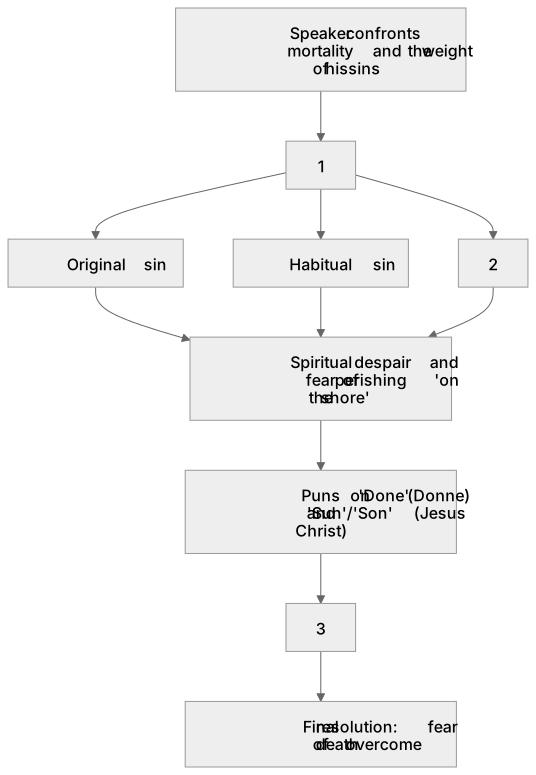
1Box 1
2Box 2
3Box 3
There is more to this lesson
The full lesson goes on to check your understanding and help you earn the marks. Create a free account to carry on, with your progress saved.
A week of Premium from your first lesson · Then the free plan continues · No card, no charge
Test your understanding of Component 3: Poetry – Section B: Specified Poetry Pre- or Post-1900 – Pre-1900 – Metaphysical Poetry – Metaphysical Poetry, editor Colin Burrow (Penguin, 2006): A Hymn to God the Father
Active recall beats re-reading. Take an instant quiz now to test what you’ve learned and lock it into long-term memory.
A week of Premium from your first lesson · Then the free plan continues · No card, no charge