Pearson Edexcel · A-Level · English Literature
Course version: 9ET0 · Version from Sept 2015
Poetry – Section B: Specified Poetry Pre- or Post-1900 – Pre-1900 –…
Full specification wording
Component 3: Poetry – Section B: Specified Poetry Pre- or Post-1900 – Pre-1900 – Metaphysical Poetry – Metaphysical Poetry, editor Colin Burrow (Penguin, 2006): Redemption George Herbert
George Herbert’s ‘Redemption’ is an allegorical sonnet employing a legal conceit to explore the transition from the Old Testament covenant of law to the New Testament covenant of grace.
Checked against the Pearson Edexcel 9ET0 specification (opens in a new tab) on .
- Point 14 of 23
- 4 key terms
Study notes
From the checked teaching notes for this specification point.
The idea
George Herbert’s ‘Redemption’ is an allegorical sonnet employing a legal conceit to explore the transition from the Old Testament covenant of law to the New Testament covenant of grace. The speaker acts as a tenant seeking a new lease from a ‘rich Lord’ (God), representing humanity’s need for salvation. The poem’s structure mirrors this spiritual journey: the octave details a futile search for the Lord in heavenly manors, while the sestet shifts to earth, culminating in the discovery of the Lord among ‘thieves and murderers’. This dramatic volta highlights the humility of Christ’s crucifixion. The final line, where the dying Lord grants the suit, powerfully encapsulates the Christian doctrine of redemption through divine sacrifice.
What earns the marks
- Analyse the extended metaphor (conceit) of the landlord and tenant to represent the relationship between God and humanity.
- Evaluate the structural use of the sonnet form, particularly how the volta shifts the setting from a heavenly search to an earthly discovery.
- Explore the contrast between the expected majesty of God and the gritty reality of the crucifixion depicted as 'ragged noise and mirth'.
- Discuss the significance of legal and commercial terms such as 'suit', 'lease' and 'cancel' in conveying theological ideas about covenant, obligation and grace.
Common mistakes and how to put them right
Assuming the poem is a literal narrative about a property dispute.
Put it right: Read the poem as a religious allegory where the landlord represents God and the lease represents the covenant.
Ignoring the specific sonnet structure.
Put it right: Analyse how Herbert adapts the traditional sonnet form to fit a theological narrative rather than romantic love.
Misinterpreting the ending as a defeat.
Put it right: Recognise that the Lord's death is the ultimate victory in Christian theology, as it grants the 'suit' of redemption.
Exam tips
- Compare the use of everyday, commercial language in 'Redemption' with the more elevated, abstract language of other metaphysical poets.
- Focus on the spatial movement in the poem, from the high 'manor' in heaven to the low, earthly setting of the crucifixion.
- Link the poem's themes of grace and sacrifice to the broader context of seventeenth-century Anglican theology.
Try the lesson
The start of the Component 3: Poetry – Section B: Specified Poetry Pre- or Post-1900 – Pre-1900 – Metaphysical Poetry – Metaphysical Poetry, editor Colin Burrow (Penguin, 2006): Redemption George Herbert lesson, made from checked teaching notes for this specification point.
Have a go first
In George Herbert's poem 'Redemption', what allegorical role does the speaker adopt to represent his relationship with God?
Listen
George Herbert’s ‘Redemption’ is an allegorical sonnet employing a legal conceit to explore the transition from the Old Testament covenant of law to the New Testament covenant of grace. The speaker acts as a tenant seeking a new lease from a ‘rich Lord’ (God), representing humanity’s need for salvation. The poem’s structure mirrors this spiritual journey: the octave details a futile search for the Lord in heavenly manors, while the sestet shifts to earth, culminating in the discovery of the Lord among ‘thieves and murderers’. This dramatic volta highlights the humility of Christ’s crucifixion. The final line, where the dying Lord grants the suit, powerfully encapsulates the Christian doctrine of redemption through divine sacrifice. A strong answer earns marks for these points. Analyse the extended metaphor (conceit) of the landlord and tenant to represent the relationship between God and humanity. Evaluate the structural use of the sonnet form, particularly how the volta shifts the setting from a heavenly search to an earthly discovery. Explore the contrast between the expected majesty of God and the gritty reality of the crucifixion depicted as 'ragged noise and mirth'. Discuss the significance of legal and commercial terms such as 'suit', 'lease' and 'cancel' in conveying theological ideas about covenant, obligation and grace. A common slip: Assuming the poem is a literal narrative about a property dispute. Instead, read the poem as a religious allegory where the landlord represents God and the lease represents the covenant. Exam tip: Compare the use of everyday, commercial language in 'Redemption' with the more elevated, abstract language of other metaphysical poets.
See it
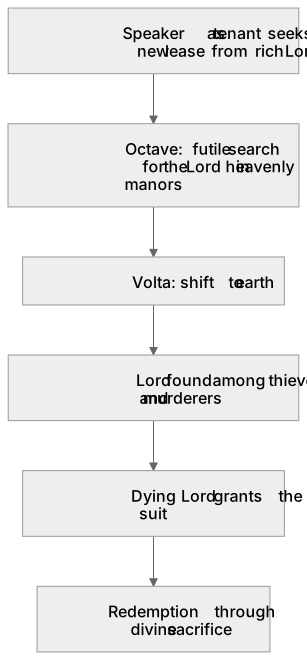
Put it in order
Put these steps in the order they happen.
- 1. Volta: shift to earth
- 2. Octave: futile search for the Lord in heavenly manors
- 3. Speaker as tenant seeks new lease from rich Lord
- 4. Redemption through divine sacrifice
- 5. Dying Lord grants the suit
- 6. Lord found among thieves and murderers
Key words
Say what each word means before you turn the card.
Conceit
Try answering aloud or in your head before turning the card.
Volta
Try answering aloud or in your head before turning the card.
Old versus New Covenant
Try answering aloud or in your head before turning the card.
Humility versus majesty
Try answering aloud or in your head before turning the card.
See every definition
- Conceit
- An extended metaphor, here the landlord and tenant, used to represent the relationship between God and humanity.
- Volta
- A turn in the sonnet that shifts the setting from a heavenly search to an earthly discovery.
- Old versus New Covenant
- The transition from the Old Testament covenant of law to the New Testament covenant of grace.
- Humility versus majesty
- The contrast between the expected majesty of God and the gritty reality of the crucifixion.
Label the diagram
Some boxes have lost their names. Pick the right name for each number.
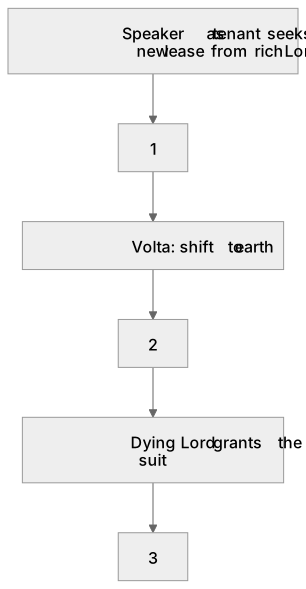
1Box 1
2Box 2
3Box 3
There is more to this lesson
The full lesson goes on to check your understanding and help you earn the marks. Create a free account to carry on, with your progress saved.
A week of Premium from your first lesson · Then the free plan continues · No card, no charge
Test your understanding of Component 3: Poetry – Section B: Specified Poetry Pre- or Post-1900 – Pre-1900 – Metaphysical Poetry – Metaphysical Poetry, editor Colin Burrow (Penguin, 2006): Redemption George Herbert
Active recall beats re-reading. Take an instant quiz now to test what you’ve learned and lock it into long-term memory.
A week of Premium from your first lesson · Then the free plan continues · No card, no charge