Pearson Edexcel · A-Level · English Literature
Course version: 9ET0 · Version from Sept 2015
Poetry – Section B: Specified Poetry Pre- or Post-1900 – Pre-1900 –…
Full specification wording
Component 3: Poetry – Section B: Specified Poetry Pre- or Post-1900 – Pre-1900 – Metaphysical Poetry – Metaphysical Poetry, editor Colin Burrow (Penguin, 2006): The Collar
George Herbert’s ‘The Collar’ dramatises a profound crisis of faith and the human struggle against religious discipline.
Checked against the Pearson Edexcel 9ET0 specification (opens in a new tab) on .
- Point 15 of 23
- 4 key terms
Study notes
From the checked teaching notes for this specification point.
The idea
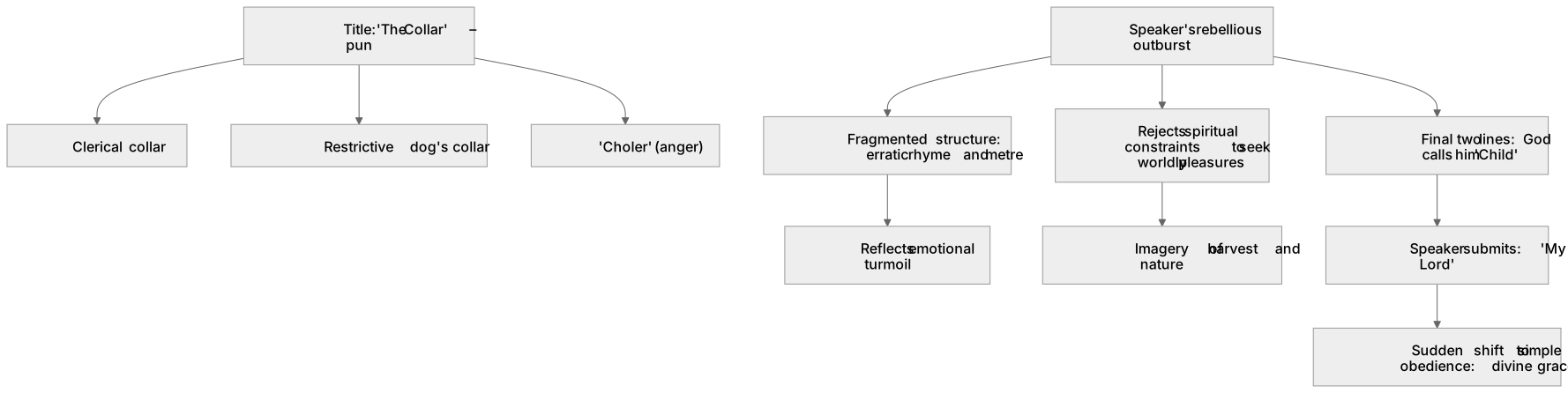
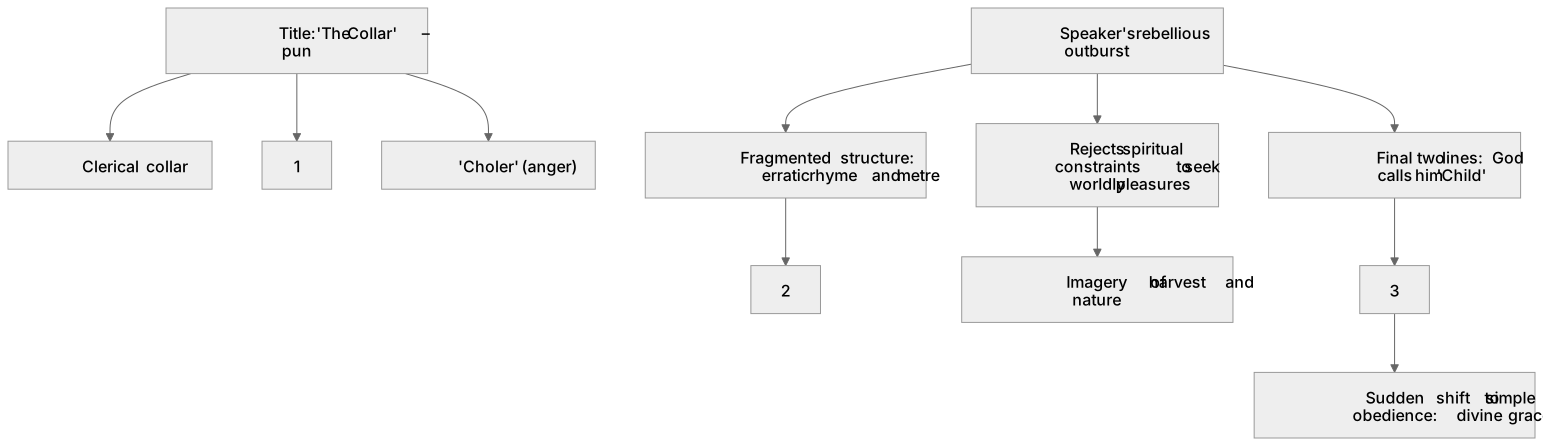
George Herbert’s ‘The Collar’ dramatises a profound crisis of faith and the human struggle against religious discipline. The title functions as a pun, suggesting a clerical collar, a restrictive dog’s collar, and ‘choler’ (anger). The poem features a fragmented structure with erratic rhyme and metre, reflecting the speaker’s rebellious outburst and emotional turmoil as he rejects spiritual constraints to seek worldly pleasures. However, this chaotic rebellion is abruptly resolved in the final two lines. Hearing the gentle voice of God calling him ‘Child’, the speaker immediately submits, replying ‘My Lord’. This sudden shift from complex, angry rebellion to simple obedience highlights the overwhelming, restorative power of divine grace.
What earns the marks
- Analyse the use of irregular metre and rhyme to mirror the speaker's internal chaos and rebellion against religious strictures.
- Evaluate the significance of the title's multiple meanings, including clerical collar, physical restraint, and choler or anger.
- Explore the imagery of harvest and nature used to represent the worldly pleasures the speaker feels he is missing.
- Discuss the dramatic impact of the final two lines and how the sudden resolution contrasts with the preceding structural and emotional chaos.
Common mistakes and how to put them right
Treating the poem as a permanent rejection of faith.
Put it right: Recognise that the entire rebellion is framed by the ultimate submission to God at the end.
Ignoring the formal features of the poem.
Put it right: Explicitly link the erratic line lengths and unpredictable rhyme scheme to the speaker's emotional state.
Misinterpreting the voice at the end as merely an internal realisation.
Put it right: Understand that the voice represents a direct, divine intervention that quells the speaker's anger.
Exam tips
- Contrast the complex, rhetorical questioning of the speaker with the simple, monosyllabic exchange between God and the speaker at the poem's conclusion.
- Compare 'The Collar' with other poems in the anthology that deal with doubt or the struggle of faith, such as John Donne's Holy Sonnets.
- Use the concept of the conceit to explain how Herbert uses the physical idea of a collar to explore abstract spiritual restriction.
Try the lesson
The start of the Component 3: Poetry – Section B: Specified Poetry Pre- or Post-1900 – Pre-1900 – Metaphysical Poetry – Metaphysical Poetry, editor Colin Burrow (Penguin, 2006): The Collar lesson, made from checked teaching notes for this specification point.
Have a go first
What is the central conflict depicted in George Herbert's poem "The Collar"?
Listen
George Herbert’s ‘The Collar’ dramatises a profound crisis of faith and the human struggle against religious discipline. The title functions as a pun, suggesting a clerical collar, a restrictive dog’s collar, and ‘choler’ (anger). The poem features a fragmented structure with erratic rhyme and metre, reflecting the speaker’s rebellious outburst and emotional turmoil as he rejects spiritual constraints to seek worldly pleasures. However, this chaotic rebellion is abruptly resolved in the final two lines. Hearing the gentle voice of God calling him ‘Child’, the speaker immediately submits, replying ‘My Lord’. This sudden shift from complex, angry rebellion to simple obedience highlights the overwhelming, restorative power of divine grace. A strong answer earns marks for these points. Analyse the use of irregular metre and rhyme to mirror the speaker's internal chaos and rebellion against religious strictures. Evaluate the significance of the title's multiple meanings, including clerical collar, physical restraint, and choler or anger. Explore the imagery of harvest and nature used to represent the worldly pleasures the speaker feels he is missing. Discuss the dramatic impact of the final two lines and how the sudden resolution contrasts with the preceding structural and emotional chaos. A common slip: Treating the poem as a permanent rejection of faith. Instead, recognise that the entire rebellion is framed by the ultimate submission to God at the end. Exam tip: Contrast the complex, rhetorical questioning of the speaker with the simple, monosyllabic exchange between God and the speaker at the poem's conclusion.
See it
Key words
Say what each word means before you turn the card.
Rebellion and submission
Try answering aloud or in your head before turning the card.
The burden of faith
Try answering aloud or in your head before turning the card.
Divine grace and love
Try answering aloud or in your head before turning the card.
Freedom versus restriction
Try answering aloud or in your head before turning the card.
See every definition
- Rebellion and submission
- The speaker's angry rejection of spiritual constraints, abruptly resolved when he hears God's gentle voice and immediately replies 'My Lord'.
- The burden of faith
- The human struggle against religious discipline that the poem dramatises as a profound crisis of faith.
- Divine grace and love
- The overwhelming, restorative power shown when God calls the speaker 'Child' and the speaker submits.
- Freedom versus restriction
- The speaker's wish to reject spiritual constraints and seek worldly pleasures, set against the restraint suggested by the title's collar.
Label the diagram
Some boxes have lost their names. Pick the right name for each number.
1Box 1
2Box 2
3Box 3
There is more to this lesson
The full lesson goes on to check your understanding and help you earn the marks. Create a free account to carry on, with your progress saved.
A week of Premium from your first lesson · Then the free plan continues · No card, no charge
Test your understanding of Component 3: Poetry – Section B: Specified Poetry Pre- or Post-1900 – Pre-1900 – Metaphysical Poetry – Metaphysical Poetry, editor Colin Burrow (Penguin, 2006): The Collar
Active recall beats re-reading. Take an instant quiz now to test what you’ve learned and lock it into long-term memory.
A week of Premium from your first lesson · Then the free plan continues · No card, no charge