Pearson Edexcel · A-Level · English Literature
Course version: 9ET0 · Version from Sept 2015
Poetry – Section B: Specified Poetry Pre- or Post-1900 – Pre-1900 –…
Full specification wording
Component 3: Poetry – Section B: Specified Poetry Pre- or Post-1900 – Pre-1900 – Metaphysical Poetry – Metaphysical Poetry, editor Colin Burrow (Penguin, 2006): Song (‘Go and catch a falling star’)
John Donne's 'Song (Go and catch a falling star)' is a cynical poem that challenges the Petrarchan idealisation of women by asserting the impossibility of finding a woman who is both beautiful and…
Checked against the Pearson Edexcel 9ET0 specification (opens in a new tab) on .
- Point 3 of 23
- 4 key terms
Study notes
From the checked teaching notes for this specification point.
The idea
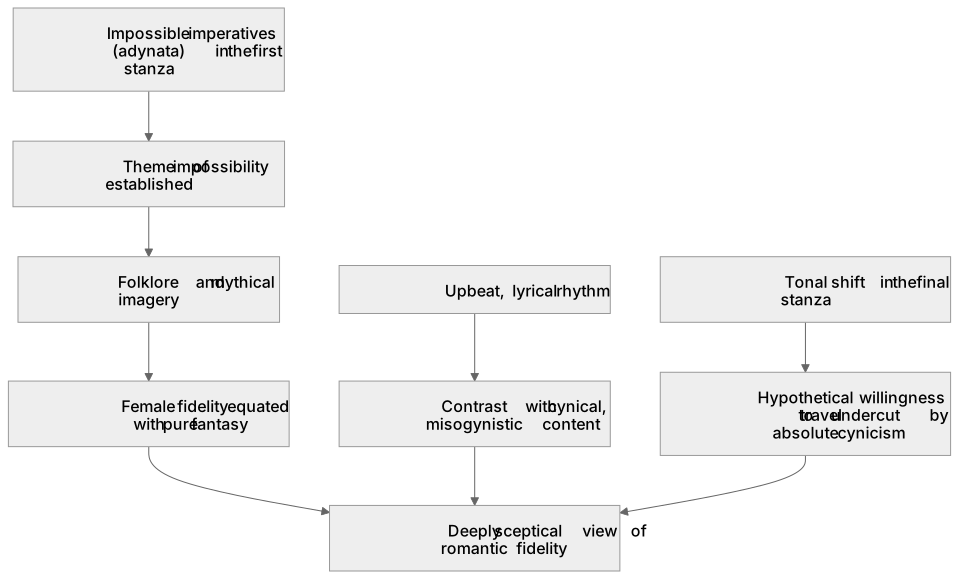
John Donne's 'Song (Go and catch a falling star)' is a cynical poem that challenges the Petrarchan idealisation of women by asserting the impossibility of finding a woman who is both beautiful and faithful. The speaker issues a series of impossible imperatives ('catch a falling star', 'get with child a mandrake root') to illustrate that female constancy is a mythical fantasy. The use of a lively, song-like trochaic metre contrasts sharply with the cynical subject matter. Responses should explore how Donne subverts traditional romantic tropes, using metaphysical wit and folklore to construct a deeply sceptical view of romantic fidelity.
What earns the marks
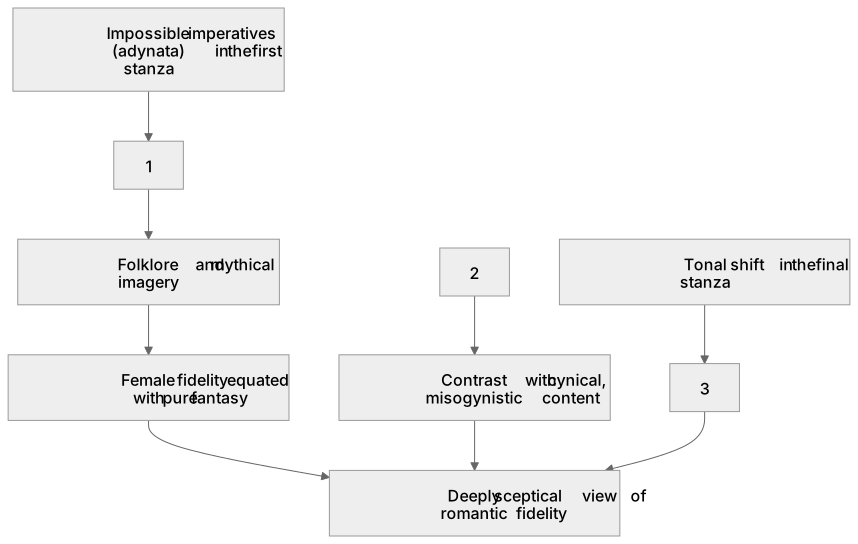
- Analyse the use of impossible imperatives (adynata) in the first stanza to establish the theme of impossibility.
- Evaluate the contrast between the upbeat, lyrical rhythm and the cynical, misogynistic content of the poem.
- Explore the use of folklore and mythical imagery to equate female fidelity with pure fantasy.
- Discuss the tonal shift in the final stanza, where the speaker's hypothetical willingness to travel is undercut by absolute cynicism.
Common mistakes and how to put them right
Treating the poem as a sincere romantic lyric.
Put it right: Identify the poem as a satirical and cynical subversion of traditional romantic poetry.
Misunderstanding the 'mandrake root' reference.
Put it right: Explain that the mandrake root, which resembles a human form, is used to highlight the impossibility of the speaker's demands.
Ignoring the structural elements of the poem.
Put it right: Analyse how the short, abrupt lines at the end of each stanza reinforce the speaker's blunt, dismissive attitude.
Exam tips
- Contrast the cynical tone of this poem with the celebratory, reciprocal love depicted in Donne's 'The Good Morrow'.
- Examine the effect of the rhyming triplets at the end of each stanza in delivering the speaker's punchlines.
- Contextualise the poem's attitude towards women within the broader spectrum of Renaissance poetry and anti-Petrarchan conventions.
Try the lesson
The start of the Component 3: Poetry – Section B: Specified Poetry Pre- or Post-1900 – Pre-1900 – Metaphysical Poetry – Metaphysical Poetry, editor Colin Burrow (Penguin, 2006): Song (‘Go and catch a falling star’) lesson, made from checked teaching notes for this specification point.
Have a go first
What is the central assertion made by the speaker in John Donne's 'Song' ('Go and catch a falling star') regarding women?
Listen
John Donne's 'Song (Go and catch a falling star)' is a cynical poem that challenges the Petrarchan idealisation of women by asserting the impossibility of finding a woman who is both beautiful and faithful. The speaker issues a series of impossible imperatives ('catch a falling star', 'get with child a mandrake root') to illustrate that female constancy is a mythical fantasy. The use of a lively, song-like trochaic metre contrasts sharply with the cynical subject matter. Responses should explore how Donne subverts traditional romantic tropes, using metaphysical wit and folklore to construct a deeply sceptical view of romantic fidelity. A strong answer earns marks for these points. Analyse the use of impossible imperatives (adynata) in the first stanza to establish the theme of impossibility. Evaluate the contrast between the upbeat, lyrical rhythm and the cynical, misogynistic content of the poem. Explore the use of folklore and mythical imagery to equate female fidelity with pure fantasy. Discuss the tonal shift in the final stanza, where the speaker's hypothetical willingness to travel is undercut by absolute cynicism. A common slip: Treating the poem as a sincere romantic lyric. Instead, Identify the poem as a satirical and cynical subversion of traditional romantic poetry. Exam tip: Contrast the cynical tone of this poem with the celebratory, reciprocal love depicted in Donne's 'The Good Morrow'.
See it
Key words
Say what each word means before you turn the card.
Cynicism and Scepticism
Try answering aloud or in your head before turning the card.
Female Inconstancy
Try answering aloud or in your head before turning the card.
Myth and Folklore
Try answering aloud or in your head before turning the card.
Anti-Petrarchanism
Try answering aloud or in your head before turning the card.
See every definition
- Cynicism and Scepticism
- A deeply sceptical view of romantic fidelity, expressed through a cynical poem that challenges the Petrarchan idealisation of women.
- Female Inconstancy
- The idea that female constancy is a mythical fantasy, since the speaker asserts the impossibility of finding a woman who is both beautiful and faithful.
- Myth and Folklore
- The use of folklore and mythical imagery to equate female fidelity with pure fantasy.
- Anti-Petrarchanism
- A subversion of traditional romantic tropes, challenging the Petrarchan idealisation of women through metaphysical wit.
Label the diagram
Some boxes have lost their names. Pick the right name for each number.
1Box 1
2Box 2
3Box 3
There is more to this lesson
The full lesson goes on to check your understanding and help you earn the marks. Create a free account to carry on, with your progress saved.
A week of Premium from your first lesson · Then the free plan continues · No card, no charge
Test your understanding of Component 3: Poetry – Section B: Specified Poetry Pre- or Post-1900 – Pre-1900 – Metaphysical Poetry – Metaphysical Poetry, editor Colin Burrow (Penguin, 2006): Song (‘Go and catch a falling star’)
Active recall beats re-reading. Take an instant quiz now to test what you’ve learned and lock it into long-term memory.
A week of Premium from your first lesson · Then the free plan continues · No card, no charge