Pearson Edexcel · A-Level · English Literature
Course version: 9ET0 · Version from Sept 2015
Poetry – Section B: Specified Poetry Pre- or Post-1900 – Pre-1900 – The…
Full specification wording
Component 3: Poetry – Section B: Specified Poetry Pre- or Post-1900 – Pre-1900 – The Romantic Period – English Romantic Verse, editor David Wright (Penguin Classics, 1973): Lines Inscribed upon a Cup Formed from a Skull George Gordon, Lord Byron
George Gordon, Lord Byron’s darkly satirical poem subverts traditional memento mori conventions by transforming a symbol of death into a vessel for hedonistic celebration.
Checked against the Pearson Edexcel 9ET0 specification (opens in a new tab) on .
- Point 6 of 16
- 4 key terms
Study notes
From the checked teaching notes for this specification point.
The idea
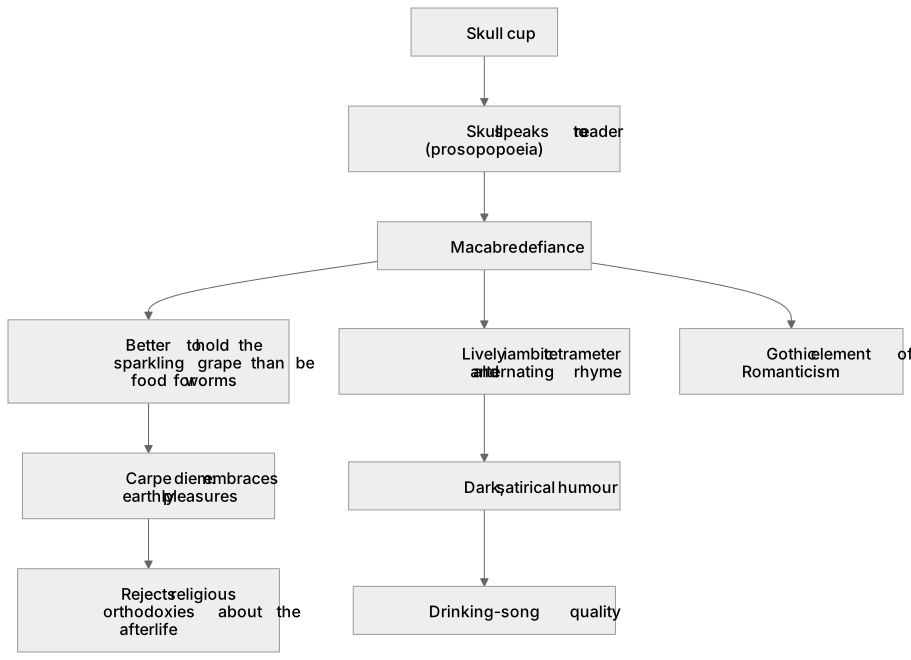
George Gordon, Lord Byron’s darkly satirical poem subverts traditional memento mori conventions by transforming a symbol of death into a vessel for hedonistic celebration. The speaker, adopting the persona of the skull itself, addresses the reader with a tone of macabre defiance, arguing that it is better to hold the sparkling grape than to be food for worms. The text highlights the Gothic elements of Romanticism, challenging religious orthodoxies about the afterlife and instead promoting a carpe diem philosophy that embraces earthly pleasures and physical utility after death.
What earns the marks
- Analyse the use of prosopopoeia as the skull speaks directly to the reader, subverting expectations of the dead.
- Evaluate the contrast between the lively iambic tetrameter and the morbid subject matter to create a tone of dark, satirical humour.
- Explore the poem's rejection of traditional Christian views on death in favour of a hedonistic, carpe diem philosophy.
- Connect the poem's macabre imagery to the broader Gothic sub-strand of the Romantic movement.
Common mistakes and how to put them right
Reading the poem as a solemn or terrifying meditation on death.
Put it right: Identify the satirical, defiant, and darkly humorous tone that celebrates life's pleasures.
Confusing the speaker with Byron himself.
Put it right: Acknowledge that the speaker is the personified skull, even if it reflects Byronic attitudes.
Overlooking the structural regularity.
Put it right: Analyse how the strict alternating rhyme scheme and rhythmic bounce contribute to the poem's drinking-song quality.
Exam tips
- Contrast the poem's irreverent treatment of mortality with the more reverent or fearful approaches found in other Romantic texts.
- Focus on the juxtaposition of life-affirming imagery, such as wine and revelry, with the physical realities of decay.
- Discuss how the physical object of the skull cup serves as a literal and metaphorical vessel for Byronic rebellion.
Try the lesson
The start of the Component 3: Poetry – Section B: Specified Poetry Pre- or Post-1900 – Pre-1900 – The Romantic Period – English Romantic Verse, editor David Wright (Penguin Classics, 1973): Lines Inscribed upon a Cup Formed from a Skull George Gordon, Lord Byron lesson, made from checked teaching notes for this specification point.
Have a go first
In Lord Byron's 'Lines Inscribed upon a Cup Formed from a Skull', who is the speaker of the poem?
Listen
George Gordon, Lord Byron’s darkly satirical poem subverts traditional memento mori conventions by transforming a symbol of death into a vessel for hedonistic celebration. The speaker, adopting the persona of the skull itself, addresses the reader with a tone of macabre defiance, arguing that it is better to hold the sparkling grape than to be food for worms. The text highlights the Gothic elements of Romanticism, challenging religious orthodoxies about the afterlife and instead promoting a carpe diem philosophy that embraces earthly pleasures and physical utility after death. A strong answer earns marks for these points. Analyse the use of prosopopoeia as the skull speaks directly to the reader, subverting expectations of the dead. Evaluate the contrast between the lively iambic tetrameter and the morbid subject matter to create a tone of dark, satirical humour. Explore the poem's rejection of traditional Christian views on death in favour of a hedonistic, carpe diem philosophy. Connect the poem's macabre imagery to the broader Gothic sub-strand of the Romantic movement. A common slip: Reading the poem as a solemn or terrifying meditation on death. Instead, Identify the satirical, defiant, and darkly humorous tone that celebrates life's pleasures. Exam tip: Contrast the poem's irreverent treatment of mortality with the more reverent or fearful approaches found in other Romantic texts.
See it
Key words
Say what each word means before you turn the card.
Mortality and Death
Try answering aloud or in your head before turning the card.
Hedonism and Rebellion
Try answering aloud or in your head before turning the card.
The Gothic
Try answering aloud or in your head before turning the card.
Transience of Life
Try answering aloud or in your head before turning the card.
See every definition
- Mortality and Death
- The poem transforms a symbol of death into a vessel for hedonistic celebration, subverting traditional memento mori conventions.
- Hedonism and Rebellion
- A carpe diem philosophy that embraces earthly pleasures and physical utility after death, challenging religious orthodoxies about the afterlife.
- The Gothic
- A sub-strand of the Romantic movement to which the poem's macabre imagery connects, highlighting Gothic elements of Romanticism.
- Transience of Life
- A carpe diem philosophy promoting earthly pleasures, expressed through the speaker's argument that it is better to hold the sparkling grape than to be food for worms.
Label the diagram
Some boxes have lost their names. Pick the right name for each number.
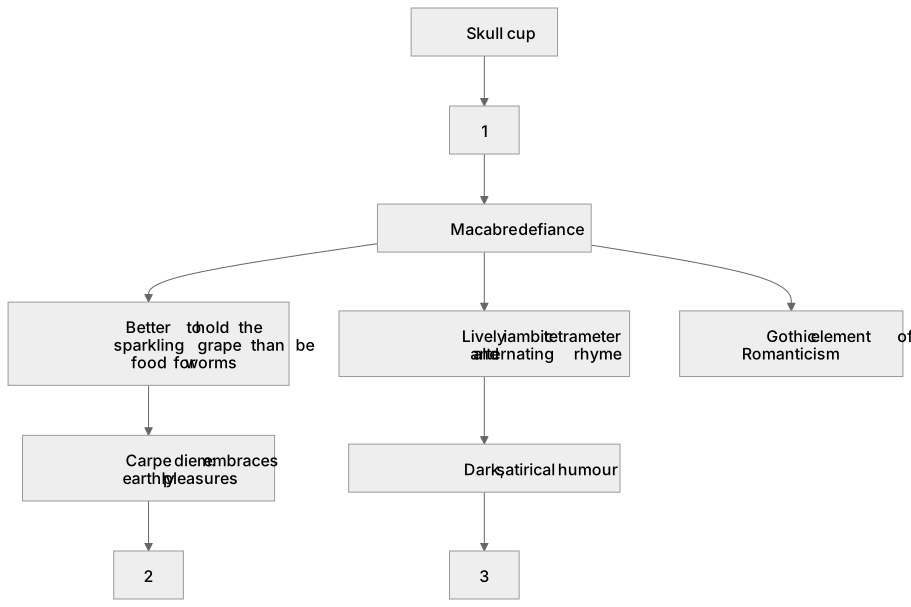
1Box 1
2Box 2
3Box 3
There is more to this lesson
The full lesson goes on to check your understanding and help you earn the marks. Create a free account to carry on, with your progress saved.
A week of Premium from your first lesson · Then the free plan continues · No card, no charge
Test your understanding of Component 3: Poetry – Section B: Specified Poetry Pre- or Post-1900 – Pre-1900 – The Romantic Period – English Romantic Verse, editor David Wright (Penguin Classics, 1973): Lines Inscribed upon a Cup Formed from a Skull George Gordon, Lord Byron
Active recall beats re-reading. Take an instant quiz now to test what you’ve learned and lock it into long-term memory.
A week of Premium from your first lesson · Then the free plan continues · No card, no charge