Pearson Edexcel · A-Level · English Literature
Course version: 9ET0 · Version from Sept 2015
Poetry – Section B: Specified Poetry Pre- or Post-1900 – Pre-1900 – The…
Full specification wording
Component 3: Poetry – Section B: Specified Poetry Pre- or Post-1900 – Pre-1900 – The Romantic Period – English Romantic Verse, editor David Wright (Penguin Classics, 1973): So We’ll Go no more A Roving
Byron’s lyric poem explores the physical and emotional exhaustion resulting from a life of hedonism, marking a transition from youthful exuberance to mature acceptance of mortality.
Checked against the Pearson Edexcel 9ET0 specification (opens in a new tab) on .
- Point 7 of 16
- 4 key terms
Study notes
From the checked teaching notes for this specification point.
The idea
Byron’s lyric poem explores the physical and emotional exhaustion resulting from a life of hedonism, marking a transition from youthful exuberance to mature acceptance of mortality. Written in 1817, the three-stanza structure uses an ABAB rhyme scheme to create a rhythmic, almost lullaby-like quality that contrasts with the restless energy of his past. The central metaphor of the sword outwearing its sheath illustrates how the spirit's desires eventually overwhelm the physical body's endurance.
What earns the marks
- Analyse the use of the ABAB rhyme scheme and its contribution to the poem's melancholic, rhythmic pacing.
- Evaluate the central metaphor of the sword and sheath as a representation of the soul outlasting the physical body.
- Discuss the significance of the moon imagery in representing the continuation of desire despite physical exhaustion.
- Connect the poem's themes of aging and hedonism to Byron's own biographical context and the broader Romantic movement.
Common mistakes and how to put them right
Treating the poem solely as a literal account of a night out.
Put it right: Analyse the poem as an extended metaphor for aging and the exhaustion of a hedonistic lifestyle.
Ignoring the structural regularity of the poem.
Put it right: Discuss how the strict ABAB rhyme scheme and alternating meter create a sense of inevitability and weariness.
Misinterpreting 'the heart must pause to breathe' as literal illness.
Put it right: Explain this line as a metaphor for emotional exhaustion and the necessity of spiritual rest.
Exam tips
- Compare the melancholic tone of this poem with the more exuberant expressions of youth found in other Romantic works.
- Use the metaphor of the sword and sheath to anchor your discussion of the mind-body dualism in Byron's work.
- Link the repetition of 'no more' to the poem's overarching theme of finality and the passage of time.
Try the lesson
The start of the Component 3: Poetry – Section B: Specified Poetry Pre- or Post-1900 – Pre-1900 – The Romantic Period – English Romantic Verse, editor David Wright (Penguin Classics, 1973): So We’ll Go no more A Roving lesson, made from checked teaching notes for this specification point.
Have a go first
What is the central reason given by the speaker in Lord Byron's "So We'll Go no more A Roving" for ceasing their nocturnal wanderings?
Listen
Byron’s lyric poem explores the physical and emotional exhaustion resulting from a life of hedonism, marking a transition from youthful exuberance to mature acceptance of mortality. Written in 1817, the three-stanza structure uses an ABAB rhyme scheme to create a rhythmic, almost lullaby-like quality that contrasts with the restless energy of his past. The central metaphor of the sword outwearing its sheath illustrates how the spirit's desires eventually overwhelm the physical body's endurance. A strong answer earns marks for these points. Analyse the use of the ABAB rhyme scheme and its contribution to the poem's melancholic, rhythmic pacing. Evaluate the central metaphor of the sword and sheath as a representation of the soul outlasting the physical body. Discuss the significance of the moon imagery in representing the continuation of desire despite physical exhaustion. Connect the poem's themes of aging and hedonism to Byron's own biographical context and the broader Romantic movement. A common slip: Treating the poem solely as a literal account of a night out. Instead, Analyse the poem as an extended metaphor for aging and the exhaustion of a hedonistic lifestyle. Exam tip: Compare the melancholic tone of this poem with the more exuberant expressions of youth found in other Romantic works.
See it
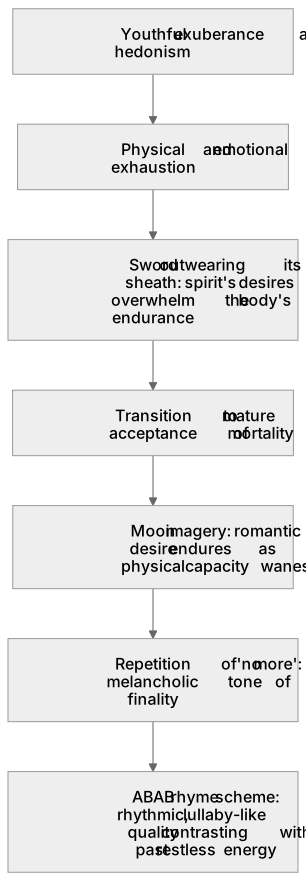
Put it in order
Put these steps in the order they happen.
- 1. ABAB rhyme scheme: rhythmic, lullaby-like quality contrasting with past restless energy
- 2. Repetition of 'no more': melancholic tone of finality
- 3. Sword outwearing its sheath: spirit's desires overwhelm the body's endurance
- 4. Moon imagery: romantic desire endures as physical capacity wanes
- 5. Youthful exuberance and hedonism
- 6. Physical and emotional exhaustion
- 7. Transition to mature acceptance of mortality
Key words
Say what each word means before you turn the card.
Hedonism and exhaustion
Try answering aloud or in your head before turning the card.
Aging and mortality
Try answering aloud or in your head before turning the card.
The passage of time
Try answering aloud or in your head before turning the card.
Mind versus body
Try answering aloud or in your head before turning the card.
See every definition
- Hedonism and exhaustion
- A life of hedonism leads to physical and emotional exhaustion, marking a transition from youthful exuberance to mature acceptance of mortality.
- Aging and mortality
- The poem explores aging and mortality as the physical body's endurance wanes while the spirit's desires continue.
- The passage of time
- The repetition of 'no more' establishes a melancholic tone of finality linked to the passage of time.
- Mind versus body
- The central metaphor of the sword outwearing its sheath illustrates how the spirit's desires eventually overwhelm the physical body's endurance.
Label the diagram
Some boxes have lost their names. Pick the right name for each number.
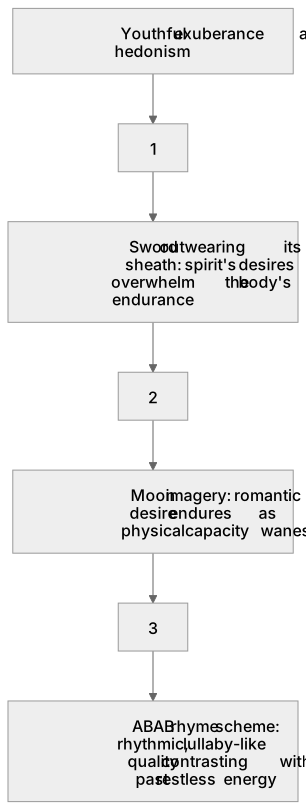
1Box 1
2Box 2
3Box 3
There is more to this lesson
The full lesson goes on to check your understanding and help you earn the marks. Create a free account to carry on, with your progress saved.
A week of Premium from your first lesson · Then the free plan continues · No card, no charge
Test your understanding of Component 3: Poetry – Section B: Specified Poetry Pre- or Post-1900 – Pre-1900 – The Romantic Period – English Romantic Verse, editor David Wright (Penguin Classics, 1973): So We’ll Go no more A Roving
Active recall beats re-reading. Take an instant quiz now to test what you’ve learned and lock it into long-term memory.
A week of Premium from your first lesson · Then the free plan continues · No card, no charge