Pearson Edexcel · A-Level · English Literature
Course version: 9ET0 · Version from Sept 2015
Poetry – Section B: Specified Poetry Pre- or Post-1900 – Pre-1900 – The…
Full specification wording
Component 3: Poetry – Section B: Specified Poetry Pre- or Post-1900 – Pre-1900 – The Romantic Period – English Romantic Verse, editor David Wright (Penguin Classics, 1973): Ode: Intimations of Immortality
William Wordsworth’s complex Pindaric ode explores the philosophical concept of pre-existence and the inevitable loss of childhood innocence as humans mature.
Checked against the Pearson Edexcel 9ET0 specification (opens in a new tab) on .
- Point 5 of 16
- 2 key terms
Study notes
From the checked teaching notes for this specification point.
The idea
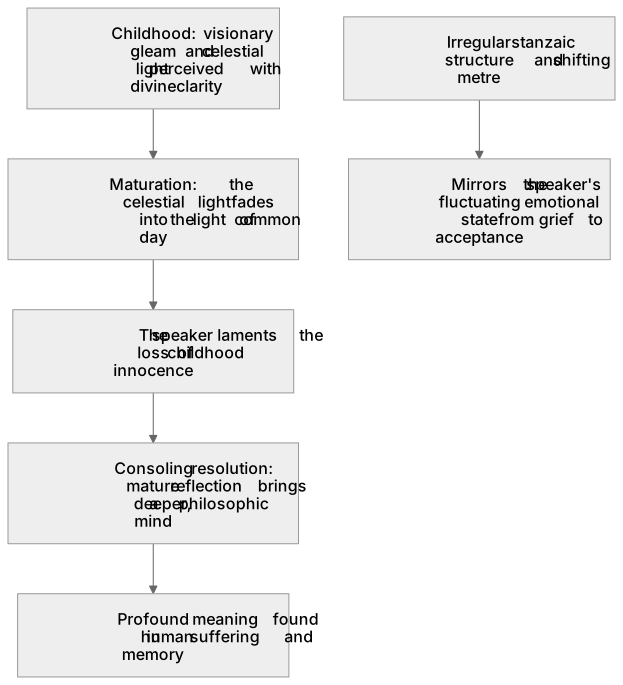
William Wordsworth’s complex Pindaric ode explores the philosophical concept of pre-existence and the inevitable loss of childhood innocence as humans mature. The speaker laments that the visionary gleam of nature, once perceived with divine clarity in youth, fades into the light of common day during adulthood. However, the poem ultimately offers a consoling resolution: while the celestial light is lost, mature reflection brings a deeper, philosophic mind capable of finding profound meaning in human suffering and memory.
What earns the marks
- Analyse the use of the Pindaric ode form and how its irregular structure reflects the speaker's emotional journey.
- Evaluate the motif of light, such as the celestial light and visionary gleam, as a metaphor for divine connection and childhood innocence.
- Explore the philosophical concept of anamnesis, or Platonic pre-existence, and how it shapes the poem's narrative of loss and compensation.
- Compare the poem's treatment of nature and memory with other Romantic works in the anthology.
Common mistakes and how to put them right
Assuming the poem ends in total despair over the loss of youth.
Put it right: Recognise that the conclusion offers philosophical consolation and a mature appreciation of nature.
Treating the poem as a simple autobiographical recount.
Put it right: Analyse it as a broader philosophical exploration of the human soul's journey from divine origin to earthly existence.
Ignoring the structural shifts in the ode.
Put it right: Connect the irregular rhyme schemes and varying line lengths to the speaker's shifting psychological states.
Exam tips
- Link the concept of the philosophic mind to Wordsworth's broader Romantic belief in the restorative power of memory.
- Use specific quotations regarding light and vision to demonstrate how the speaker's perception of nature changes over time.
- Contrast the joyful imagery of the pastoral landscape in the early stanzas with the speaker's internal sense of alienation.
Try the lesson
The start of the Component 3: Poetry – Section B: Specified Poetry Pre- or Post-1900 – Pre-1900 – The Romantic Period – English Romantic Verse, editor David Wright (Penguin Classics, 1973): Ode: Intimations of Immortality lesson, made from checked teaching notes for this specification point.
Have a go first
In Wordsworth's 'Ode: Intimations of Immortality', what is the central philosophical concept regarding the human soul?
Listen
William Wordsworth’s complex Pindaric ode explores the philosophical concept of pre-existence and the inevitable loss of childhood innocence as humans mature. The speaker laments that the visionary gleam of nature, once perceived with divine clarity in youth, fades into the light of common day during adulthood. However, the poem ultimately offers a consoling resolution: while the celestial light is lost, mature reflection brings a deeper, philosophic mind capable of finding profound meaning in human suffering and memory. A strong answer earns marks for these points. Analyse the use of the Pindaric ode form and how its irregular structure reflects the speaker's emotional journey. Evaluate the motif of light, such as the celestial light and visionary gleam, as a metaphor for divine connection and childhood innocence. Explore the philosophical concept of anamnesis, or Platonic pre-existence, and how it shapes the poem's narrative of loss and compensation. Compare the poem's treatment of nature and memory with other Romantic works in the anthology. A common slip: Assuming the poem ends in total despair over the loss of youth. Instead, Recognise that the conclusion offers philosophical consolation and a mature appreciation of nature. Exam tip: Link the concept of the philosophic mind to Wordsworth's broader Romantic belief in the restorative power of memory.
See it
Key words
Say what each word means before you turn the card.
Childhood and Innocence
Try answering aloud or in your head before turning the card.
Loss and Consolation
Try answering aloud or in your head before turning the card.
See every definition
- Childhood and Innocence
- The state in youth in which nature is perceived with divine clarity, before its visionary gleam fades during adulthood.
- Loss and Consolation
- The lament for the lost celestial light, resolved by the philosophical consolation of a mature appreciation of nature.
Label the diagram
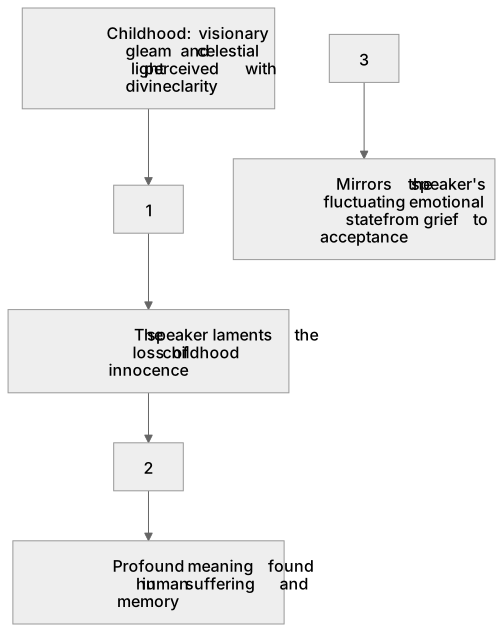
Some boxes have lost their names. Pick the right name for each number.
1Box 1
2Box 2
3Box 3
There is more to this lesson
The full lesson goes on to check your understanding and help you earn the marks. Create a free account to carry on, with your progress saved.
A week of Premium from your first lesson · Then the free plan continues · No card, no charge
Test your understanding of Component 3: Poetry – Section B: Specified Poetry Pre- or Post-1900 – Pre-1900 – The Romantic Period – English Romantic Verse, editor David Wright (Penguin Classics, 1973): Ode: Intimations of Immortality
Active recall beats re-reading. Take an instant quiz now to test what you’ve learned and lock it into long-term memory.
A week of Premium from your first lesson · Then the free plan continues · No card, no charge