Pearson Edexcel · A-Level · English Literature
Course version: 9ET0 · Version from Sept 2015
Poetry – Section B: Specified Poetry Pre- or Post-1900 – Pre-1900 – The…
Full specification wording
Component 3: Poetry – Section B: Specified Poetry Pre- or Post-1900 – Pre-1900 – The Romantic Period – English Romantic Verse, editor David Wright (Penguin Classics, 1973): Ode on Melancholy
Keats's 'Ode on Melancholy' explores the intrinsic link between joy, beauty, and sorrow.
Checked against the Pearson Edexcel 9ET0 specification (opens in a new tab) on .
- Point 15 of 16
- 4 key terms
Study notes
From the checked teaching notes for this specification point.
The idea
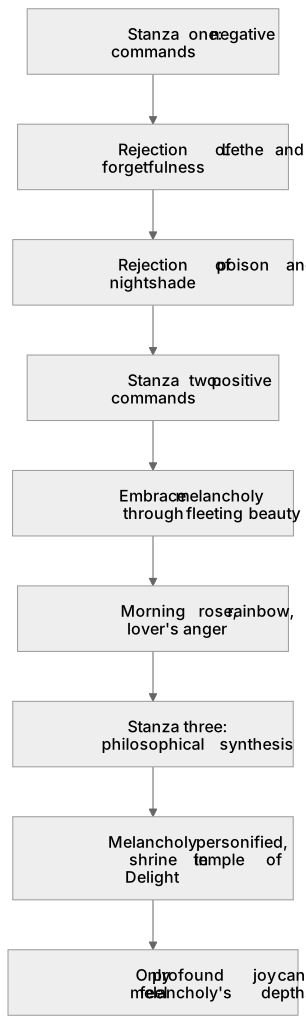
Keats's 'Ode on Melancholy' explores the intrinsic link between joy, beauty, and sorrow. The speaker advises against seeking forgetfulness through Lethe or suicide (poison/nightshade) when melancholy strikes. Instead, one should embrace the emotion by observing fleeting beauty—a morning rose, a rainbow, or a lover's anger. The final stanza personifies Melancholy, placing her shrine in the 'very temple of Delight,' arguing that only those capable of experiencing profound joy can truly feel the depths of melancholy. The poem uses rich sensory imagery and a tripartite stanzaic structure to argue that suffering is a necessary condition for appreciating transient beauty.
What earns the marks
- Analyse Keats's use of classical allusions (Lethe, Proserpine, Psyche) to establish the temptation of oblivion and escape.
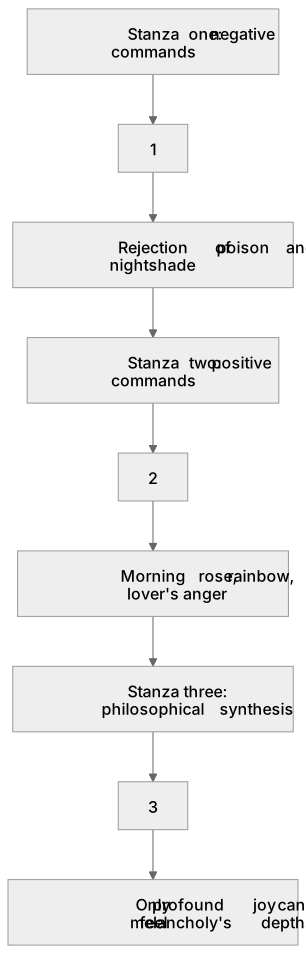
- Evaluate the structural progression across the three stanzas: rejection of despair, embrace of natural beauty, and the philosophical synthesis of joy and sorrow.
- Explore the personification of Melancholy, Beauty, and Joy, noting how capitalisation elevates these abstract concepts to divine or mythological status.
- Discuss the sensory imagery used to depict transient beauty, such as the 'morning rose', the 'rainbow of the salt sand-wave', and 'globèd peonies'.
Common mistakes and how to put them right
Assuming the poem encourages depression or despair.
Put it right: Recognise that the poem advocates for fully experiencing melancholy as a necessary pathway to appreciating transient beauty and joy.
Ignoring the structural shift between stanzas.
Put it right: Trace the argument from the negative commands in stanza one to the positive commands in stanza two, culminating in the philosophical conclusion of stanza three.
Misinterpreting the lover's anger as promoting toxic relationships.
Put it right: Understand that feeding on the lover's 'peerless eyes' during her anger is an example of finding intense, fleeting beauty in passionate emotion.
Exam tips
- Compare the treatment of transience in this ode with other Romantic poems, focusing on how Keats links sorrow directly to the fading of beauty.
- Quote specific sensory phrases like 'globèd peonies' to demonstrate Keats's tactile and visual poetic style.
- Analyse the impact of the imperative verbs in the first stanza ('No, no, go not') to show how the speaker urgently guides the reader's emotional response.
Try the lesson
The start of the Component 3: Poetry – Section B: Specified Poetry Pre- or Post-1900 – Pre-1900 – The Romantic Period – English Romantic Verse, editor David Wright (Penguin Classics, 1973): Ode on Melancholy lesson, made from checked teaching notes for this specification point.
Have a go first
In the opening stanza of John Keats's 'Ode on Melancholy', what specific action does the speaker explicitly advise the reader to avoid when experiencing deep sorrow?
Listen
Keats's 'Ode on Melancholy' explores the intrinsic link between joy, beauty, and sorrow. The speaker advises against seeking forgetfulness through Lethe or suicide (poison/nightshade) when melancholy strikes. Instead, one should embrace the emotion by observing fleeting beauty—a morning rose, a rainbow, or a lover's anger. The final stanza personifies Melancholy, placing her shrine in the 'very temple of Delight,' arguing that only those capable of experiencing profound joy can truly feel the depths of melancholy. The poem uses rich sensory imagery and a tripartite stanzaic structure to argue that suffering is a necessary condition for appreciating transient beauty. A strong answer earns marks for these points. Analyse Keats's use of classical allusions (Lethe, Proserpine, Psyche) to establish the temptation of oblivion and escape. Evaluate the structural progression across the three stanzas: rejection of despair, embrace of natural beauty, and the philosophical synthesis of joy and sorrow. Explore the personification of Melancholy, Beauty, and Joy, noting how capitalisation elevates these abstract concepts to divine or mythological status. Discuss the sensory imagery used to depict transient beauty, such as the 'morning rose', the 'rainbow of the salt sand-wave', and 'globèd peonies'. A common slip: Assuming the poem encourages depression or despair. Instead, Recognise that the poem advocates for fully experiencing melancholy as a necessary pathway to appreciating transient beauty and joy. Exam tip: Compare the treatment of transience in this ode with other Romantic poems, focusing on how Keats links sorrow directly to the fading of beauty.
See it
Key words
Say what each word means before you turn the card.
The transience of beauty and joy
Try answering aloud or in your head before turning the card.
The duality and interdependence of joy and sorrow
Try answering aloud or in your head before turning the card.
Nature as a source of profound emotional resonance
Try answering aloud or in your head before turning the card.
The intensity of human sensory experience
Try answering aloud or in your head before turning the card.
See every definition
- The transience of beauty and joy
- The fleeting quality of beauty and joy, which the poem argues suffering is a necessary condition for appreciating.
- The duality and interdependence of joy and sorrow
- The intrinsic link between joy, beauty and sorrow, with Melancholy's shrine placed in the 'very temple of Delight'.
- Nature as a source of profound emotional resonance
- The use of natural things such as a morning rose or a rainbow to embrace melancholy by observing fleeting beauty.
- The intensity of human sensory experience
- The rich sensory imagery through which the poem depicts transient beauty and passionate emotion.
Label the diagram
Some boxes have lost their names. Pick the right name for each number.
1Box 1
2Box 2
3Box 3
There is more to this lesson
The full lesson goes on to check your understanding and help you earn the marks. Create a free account to carry on, with your progress saved.
A week of Premium from your first lesson · Then the free plan continues · No card, no charge
Test your understanding of Component 3: Poetry – Section B: Specified Poetry Pre- or Post-1900 – Pre-1900 – The Romantic Period – English Romantic Verse, editor David Wright (Penguin Classics, 1973): Ode on Melancholy
Active recall beats re-reading. Take an instant quiz now to test what you’ve learned and lock it into long-term memory.
A week of Premium from your first lesson · Then the free plan continues · No card, no charge