Pearson Edexcel · A-Level · English Literature
Course version: 9ET0 · Version from Sept 2015
Poetry – Section B: Specified Poetry Pre- or Post-1900 – Pre-1900 – The…
Full specification wording
Component 3: Poetry – Section B: Specified Poetry Pre- or Post-1900 – Pre-1900 – The Romantic Period – English Romantic Verse, editor David Wright (Penguin Classics, 1973): Ode on a Grecian Urn
In ‘Ode on a Grecian Urn’, Keats employs ekphrasis to meditate on the complex relationship between art, time, and human experience.
Checked against the Pearson Edexcel 9ET0 specification (opens in a new tab) on .
- Point 14 of 16
- 4 key terms
Study notes
From the checked teaching notes for this specification point.
The idea
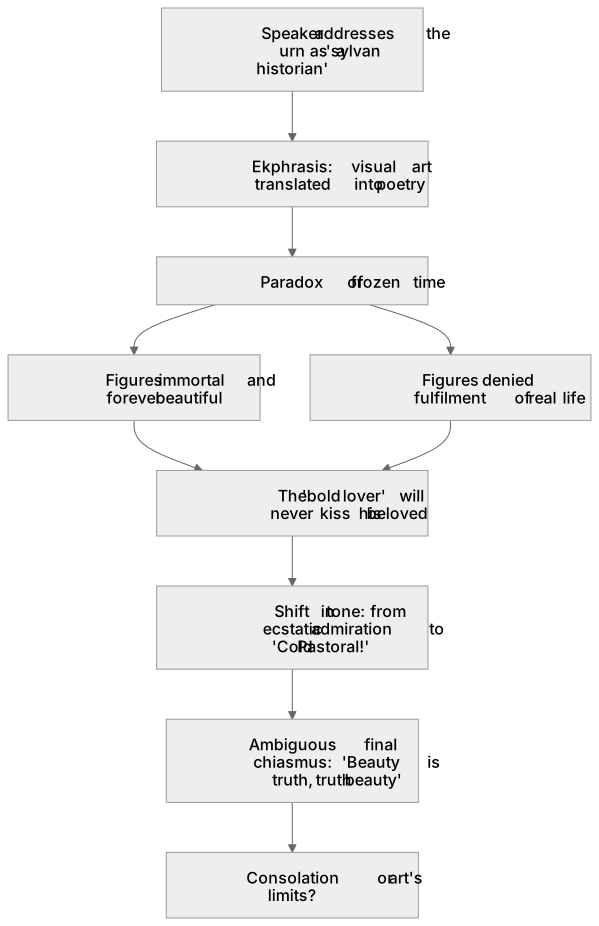
In ‘Ode on a Grecian Urn’, Keats employs ekphrasis to meditate on the complex relationship between art, time, and human experience. By addressing the urn as a ‘sylvan historian’, the speaker explores the paradox of frozen time: the figures depicted are immortal and forever beautiful, yet they are denied the fulfilment of real life. For example, the ‘bold lover’ will never kiss his beloved, though her beauty will never fade. The poem contrasts the permanence of classical art with the fleeting nature of human existence.
What earns the marks
- Analyse the use of ekphrasis and direct address (apostrophe) to explore the nature of the urn.
- Evaluate the thematic paradox of frozen time, contrasting eternal anticipation with the lack of consummation.
- Examine the structural development across the five stanzas, noting the shift from celebration to critical distance.
- Interpret the final aphorism ('Beauty is truth, truth beauty') in the context of Romantic aesthetics and the poem's overall meaning.
Common mistakes and how to put them right
Misinterpreting the urn's figures as living beings.
Put it right: Emphasise that the speaker is projecting life onto inanimate, frozen art.
Assuming the final lines are a simple, happy resolution.
Put it right: Explore the ambiguity and potential irony of the urn's 'cold' consolation.
Overlooking the poem's form.
Put it right: Analyse how the intricate ode stanza structure reflects the crafted nature of the urn itself.
Exam tips
- Use the term 'ekphrasis' explicitly when discussing how Keats translates visual art into poetry.
- Contrast the 'unheard' melodies of the urn with the sensory overload found in Keats's other odes.
- Discuss the significance of the rhetorical questions in the opening stanza to demonstrate the speaker's active, questioning engagement with the artwork.
Try the lesson
The start of the Component 3: Poetry – Section B: Specified Poetry Pre- or Post-1900 – Pre-1900 – The Romantic Period – English Romantic Verse, editor David Wright (Penguin Classics, 1973): Ode on a Grecian Urn lesson, made from checked teaching notes for this specification point.
Have a go first
In John Keats's 'Ode on a Grecian Urn', what is the primary paradox that the speaker explores regarding the figures depicted on the urn?
Listen
In ‘Ode on a Grecian Urn’, Keats employs ekphrasis to meditate on the complex relationship between art, time, and human experience. By addressing the urn as a ‘sylvan historian’, the speaker explores the paradox of frozen time: the figures depicted are immortal and forever beautiful, yet they are denied the fulfilment of real life. For example, the ‘bold lover’ will never kiss his beloved, though her beauty will never fade. The poem contrasts the permanence of classical art with the fleeting nature of human existence. A strong answer earns marks for these points. Analyse the use of ekphrasis and direct address (apostrophe) to explore the nature of the urn. Evaluate the thematic paradox of frozen time, contrasting eternal anticipation with the lack of consummation. Examine the structural development across the five stanzas, noting the shift from celebration to critical distance. Interpret the final aphorism ('Beauty is truth, truth beauty') in the context of Romantic aesthetics and the poem's overall meaning. A common slip: Misinterpreting the urn's figures as living beings. Instead, emphasise that the speaker is projecting life onto inanimate, frozen art. Exam tip: Use the term 'ekphrasis' explicitly when discussing how Keats translates visual art into poetry.
See it
Key words
Say what each word means before you turn the card.
Art and Permanence
Try answering aloud or in your head before turning the card.
Time and Mortality
Try answering aloud or in your head before turning the card.
Truth and Beauty
Try answering aloud or in your head before turning the card.
The Limits of Imagination
Try answering aloud or in your head before turning the card.
See every definition
- Art and Permanence
- The contrast between the permanence of classical art and the fleeting nature of human existence, explored through the urn's immortal and forever beautiful figures.
- Time and Mortality
- The paradox of frozen time, in which the figures depicted are immortal yet denied the fulfilment of real life, such as the bold lover who will never kiss his beloved.
- Truth and Beauty
- The ambiguous final chiasmus, 'Beauty is truth, truth beauty', which must be critically evaluated as offering consolation or highlighting art's limits.
- The Limits of Imagination
- The shift from ecstatic admiration to a sense of cold alienation, as in 'Cold Pastoral!', raising the question of whether the urn's consolation is ambiguous or ironic.
Label the diagram
Some boxes have lost their names. Pick the right name for each number.
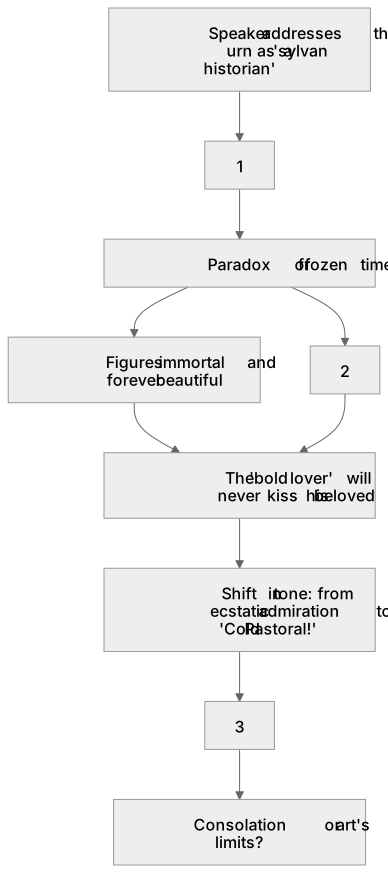
1Box 1
2Box 2
3Box 3
There is more to this lesson
The full lesson goes on to check your understanding and help you earn the marks. Create a free account to carry on, with your progress saved.
A week of Premium from your first lesson · Then the free plan continues · No card, no charge
Test your understanding of Component 3: Poetry – Section B: Specified Poetry Pre- or Post-1900 – Pre-1900 – The Romantic Period – English Romantic Verse, editor David Wright (Penguin Classics, 1973): Ode on a Grecian Urn
Active recall beats re-reading. Take an instant quiz now to test what you’ve learned and lock it into long-term memory.
A week of Premium from your first lesson · Then the free plan continues · No card, no charge