Pearson Edexcel · A-Level · English Literature
Course version: 9ET0 · Version from Sept 2015
Poetry – Section B: Specified Poetry Pre- or Post-1900 – Pre-1900 – The…
Full specification wording
Component 3: Poetry – Section B: Specified Poetry Pre- or Post-1900 – Pre-1900 – The Romantic Period – English Romantic Verse, editor David Wright (Penguin Classics, 1973): The Question
Shelley's "The Question" is a dream vision that explores the pursuit of ideal beauty and the melancholy of unfulfilled desire.
Checked against the Pearson Edexcel 9ET0 specification (opens in a new tab) on .
- Point 12 of 16
- 4 key terms
Study notes
From the checked teaching notes for this specification point.
The idea
Shelley's "The Question" is a dream vision that explores the pursuit of ideal beauty and the melancholy of unfulfilled desire. The speaker recounts wandering through a vibrant, surreal winter landscape that miraculously blooms with spring flowers. Shelley uses rich, sensory imagery and mythological allusions to construct this idyllic scene. However, the poem concludes with a poignant shift: after gathering a perfect bouquet, the speaker asks, "Oh! to whom?", revealing the isolation of possessing beauty without a companion to share it with.
What earns the marks
- Analyse the use of the dream vision framework to create a surreal, liminal space where winter and spring paradoxically coexist.
- Evaluate the extensive use of botanical imagery and colour symbolism to represent the overwhelming abundance of the natural world.
- Discuss the structural impact of the final rhetorical question, which abruptly shifts the tone from joyful accumulation to profound isolation.
- Explore the theme of the Romantic quest for the ideal, and how the poem suggests that beauty is incomplete without human connection.
Common mistakes and how to put them right
Focusing only on the flower imagery without addressing the ending.
Put it right: Connect the descriptive catalogues of nature to the final stanza's revelation of loneliness.
Misinterpreting the setting as a literal landscape.
Put it right: Identify the setting as a psychological or dream landscape, reflecting internal desires.
Overlooking the mythological references.
Put it right: Note how allusions elevate the natural world to a realm of mythic perfection.
Exam tips
- Contrast the sensory overload of the first four stanzas with the stark, monosyllabic simplicity of the final question to highlight the speaker's isolation.
- Use this poem to discuss the Romantic trope of the solitary wanderer, comparing the speaker's isolation with other figures in the anthology.
- Examine the rhyme scheme of ottava rima and how its final couplet in each stanza usually provides closure, making the unresolved final question even more striking.
Try the lesson
The start of the Component 3: Poetry – Section B: Specified Poetry Pre- or Post-1900 – Pre-1900 – The Romantic Period – English Romantic Verse, editor David Wright (Penguin Classics, 1973): The Question lesson, made from checked teaching notes for this specification point.
Have a go first
In Percy Bysshe Shelley's poem 'The Question', what action does the speaker perform after experiencing a vision of a sudden spring?
Listen
Shelley's "The Question" is a dream vision that explores the pursuit of ideal beauty and the melancholy of unfulfilled desire. The speaker recounts wandering through a vibrant, surreal winter landscape that miraculously blooms with spring flowers. Shelley uses rich, sensory imagery and mythological allusions to construct this idyllic scene. However, the poem concludes with a poignant shift: after gathering a perfect bouquet, the speaker asks, "Oh! to whom?", revealing the isolation of possessing beauty without a companion to share it with. A strong answer earns marks for these points. Analyse the use of the dream vision framework to create a surreal, liminal space where winter and spring paradoxically coexist. Evaluate the extensive use of botanical imagery and colour symbolism to represent the overwhelming abundance of the natural world. Discuss the structural impact of the final rhetorical question, which abruptly shifts the tone from joyful accumulation to profound isolation. Explore the theme of the Romantic quest for the ideal, and how the poem suggests that beauty is incomplete without human connection. A common slip: Focusing only on the flower imagery without addressing the ending. Instead, connect the descriptive catalogues of nature to the final stanza's revelation of loneliness. Exam tip: Contrast the sensory overload of the first four stanzas with the stark, monosyllabic simplicity of the final question to highlight the speaker's isolation.
See it
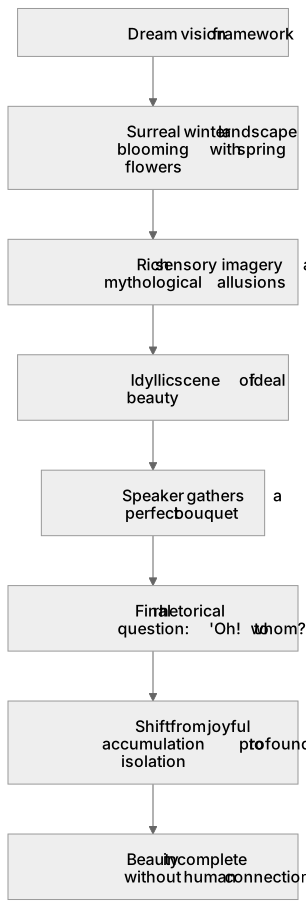
Put it in order
Put these steps in the order they happen.
- 1. Speaker gathers a perfect bouquet
- 2. Beauty incomplete without human connection
- 3. Final rhetorical question: 'Oh! to whom?'
- 4. Dream vision framework
- 5. Surreal winter landscape blooming with spring flowers
- 6. Shift from joyful accumulation to profound isolation
- 7. Rich sensory imagery and mythological allusions
- 8. Idyllic scene of ideal beauty
Key words
Say what each word means before you turn the card.
The Dream Vision
Try answering aloud or in your head before turning the card.
The Ideal versus Reality
Try answering aloud or in your head before turning the card.
Isolation and Loneliness
Try answering aloud or in your head before turning the card.
Nature and Beauty
Try answering aloud or in your head before turning the card.
See every definition
- The Dream Vision
- A framework in which the speaker recounts wandering through a vibrant, surreal landscape, creating a liminal space where winter and spring paradoxically coexist.
- The Ideal versus Reality
- The Romantic quest for the ideal, and how the poem suggests that beauty is incomplete without human connection.
- Isolation and Loneliness
- The final sense of existential loneliness, revealed when the speaker possesses beauty without a companion to share it with.
- Nature and Beauty
- The overwhelming abundance of the natural world, represented through extensive botanical imagery and colour symbolism.
Label the diagram
Some boxes have lost their names. Pick the right name for each number.
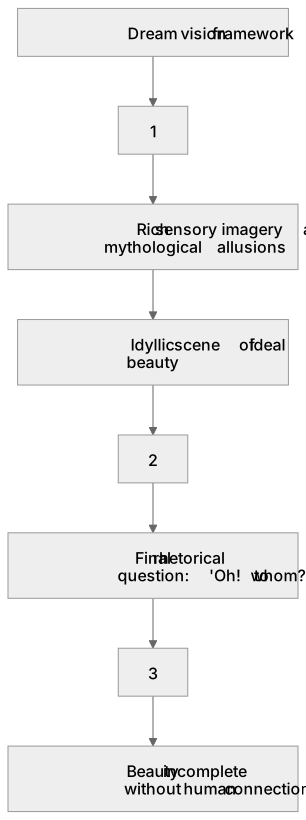
1Box 1
2Box 2
3Box 3
There is more to this lesson
The full lesson goes on to check your understanding and help you earn the marks. Create a free account to carry on, with your progress saved.
A week of Premium from your first lesson · Then the free plan continues · No card, no charge
Test your understanding of Component 3: Poetry – Section B: Specified Poetry Pre- or Post-1900 – Pre-1900 – The Romantic Period – English Romantic Verse, editor David Wright (Penguin Classics, 1973): The Question
Active recall beats re-reading. Take an instant quiz now to test what you’ve learned and lock it into long-term memory.
A week of Premium from your first lesson · Then the free plan continues · No card, no charge