Pearson Edexcel · A-Level · English Literature
Course version: 9ET0 · Version from Sept 2015
Poetry – Section B: Specified Poetry Pre- or Post-1900 – Pre-1900 – The…
Full specification wording
Component 3: Poetry – Section B: Specified Poetry Pre- or Post-1900 – Pre-1900 – The Romantic Period – English Romantic Verse, editor David Wright (Penguin Classics, 1973): Ode to a Nightingale John Keats
John Keats’s ‘Ode to a Nightingale’ explores the tension between the painful reality of human mortality and the eternal, transcendent beauty of the nightingale’s song.
Checked against the Pearson Edexcel 9ET0 specification (opens in a new tab) on .
- Point 13 of 16
- 4 key terms
Study notes
From the checked teaching notes for this specification point.
The idea
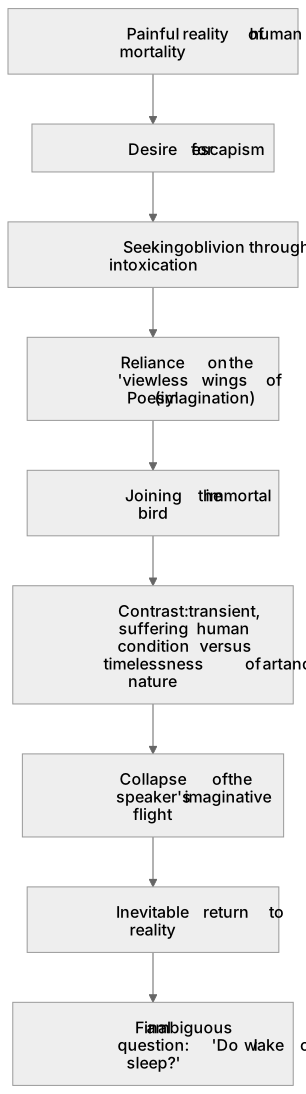
John Keats’s ‘Ode to a Nightingale’ explores the tension between the painful reality of human mortality and the eternal, transcendent beauty of the nightingale’s song. Keats uses rich synaesthesia and sensory imagery, such as ‘tasting of Flora and the country green’, to articulate a desire for escapism. Initially seeking oblivion through intoxication, the speaker ultimately relies on the ‘viewless wings of Poesy’ (imagination) to join the immortal bird. The poem contrasts the transient, suffering human condition—where ‘youth grows pale, and spectre-thin, and dies’—with the timelessness of art and nature.
What earns the marks
- Analyse Keats's use of sensory imagery and synaesthesia to convey the desire for escapism.
- Evaluate the structural shifts in the ode, particularly the movement from intoxication to poetic imagination.
- Explore the contrast between human mortality and the perceived immortality of the nightingale's song.
- Assess the significance of the poem's conclusion and the ambiguity of the speaker's final state of consciousness.
Common mistakes and how to put them right
Assuming the nightingale is literally immortal.
Put it right: Recognise that Keats refers to the immortality of the bird's song across generations, not the individual bird.
Treating the poem solely as a celebration of nature.
Put it right: Acknowledge the underlying despair regarding human suffering and tuberculosis.
Ignoring the formal structure.
Put it right: Analyse how the strict ten-line stanzas and iambic rhythm contrast with the wildness of the speaker's imagination.
Exam tips
- Link Keats's personal context, such as his medical training and brother's death, to the poem's visceral descriptions of physical decay.
- Compare the escapism in this poem with other Romantic works, focusing on the limitations of the imagination.
- Quote short, specific phrases like 'viewless wings' to demonstrate close reading of Keats's diction.
Try the lesson
The start of the Component 3: Poetry – Section B: Specified Poetry Pre- or Post-1900 – Pre-1900 – The Romantic Period – English Romantic Verse, editor David Wright (Penguin Classics, 1973): Ode to a Nightingale John Keats lesson, made from checked teaching notes for this specification point.
Have a go first
In the second stanza of John Keats's "Ode to a Nightingale", what means of escape does the speaker explicitly long for in order to "fade away into the forest dim"?
Listen
John Keats’s ‘Ode to a Nightingale’ explores the tension between the painful reality of human mortality and the eternal, transcendent beauty of the nightingale’s song. Keats uses rich synaesthesia and sensory imagery, such as ‘tasting of Flora and the country green’, to articulate a desire for escapism. Initially seeking oblivion through intoxication, the speaker ultimately relies on the ‘viewless wings of Poesy’ (imagination) to join the immortal bird. The poem contrasts the transient, suffering human condition—where ‘youth grows pale, and spectre-thin, and dies’—with the timelessness of art and nature. A strong answer earns marks for these points. Analyse Keats's use of sensory imagery and synaesthesia to convey the desire for escapism. Evaluate the structural shifts in the ode, particularly the movement from intoxication to poetic imagination. Explore the contrast between human mortality and the perceived immortality of the nightingale's song. Assess the significance of the poem's conclusion and the ambiguity of the speaker's final state of consciousness. A common slip: Assuming the nightingale is literally immortal. Instead, recognise that Keats refers to the immortality of the bird's song across generations, not the individual bird. Exam tip: Link Keats's personal context, such as his medical training and brother's death, to the poem's visceral descriptions of physical decay.
See it
Key words
Say what each word means before you turn the card.
Mortality and Death
Try answering aloud or in your head before turning the card.
The Power of Imagination
Try answering aloud or in your head before turning the card.
Escapism and Intoxication
Try answering aloud or in your head before turning the card.
Synaesthesia
Try answering aloud or in your head before turning the card.
See every definition
- Mortality and Death
- The painful reality of the human condition, in which youth grows pale, spectre-thin and dies, contrasted with the eternal nightingale's song.
- The Power of Imagination
- The 'viewless wings of Poesy' through which the speaker joins the immortal bird, later collapsing in the poem's ambiguous final question.
- Escapism and Intoxication
- The desire for escape articulated through rich synaesthesia and sensory imagery, initially sought through oblivion and then through poetic imagination.
- Synaesthesia
- A technique using rich sensory imagery, such as 'tasting of Flora and the country green', to articulate the desire for escapism.
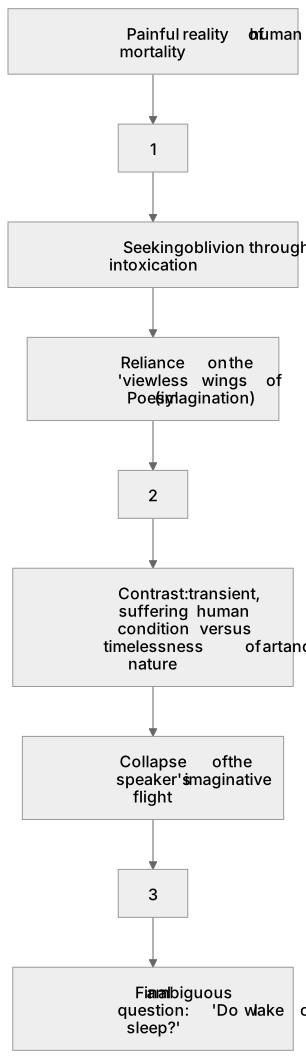
Label the diagram
Some boxes have lost their names. Pick the right name for each number.
1Box 1
2Box 2
3Box 3
There is more to this lesson
The full lesson goes on to check your understanding and help you earn the marks. Create a free account to carry on, with your progress saved.
A week of Premium from your first lesson · Then the free plan continues · No card, no charge
Test your understanding of Component 3: Poetry – Section B: Specified Poetry Pre- or Post-1900 – Pre-1900 – The Romantic Period – English Romantic Verse, editor David Wright (Penguin Classics, 1973): Ode to a Nightingale John Keats
Active recall beats re-reading. Take an instant quiz now to test what you’ve learned and lock it into long-term memory.
A week of Premium from your first lesson · Then the free plan continues · No card, no charge