Pearson Edexcel · A-Level · English Literature
Course version: 9ET0 · Version from Sept 2015
Poetry – Section B: Specified Poetry Pre- or Post-1900 – Pre-1900 – The…
Full specification wording
Component 3: Poetry – Section B: Specified Poetry Pre- or Post-1900 – Pre-1900 – The Romantic Period – English Romantic Verse, editor David Wright (Penguin Classics, 1973): ‘The cold earth slept below’ Percy Bysshe Shelley
Shelley’s poem moves through a winter landscape towards the body of a ‘beloved’ lying exposed beneath the night sky.
Checked against the Pearson Edexcel 9ET0 specification (opens in a new tab) on .
- Point 9 of 16
- 4 key terms
Study notes
From the checked teaching notes for this specification point.
The idea
Shelley’s poem moves through a winter landscape towards the body of a ‘beloved’ lying exposed beneath the night sky. Earth, sky, ice, snow, moon, frost and bare thorn create a world in which sleep repeatedly shades into death. Four seven-line stanzas narrow from the surrounding landscape to the beloved’s eyes, hair, lips, breast and head, while repeated cold and nocturnal images deny conventional pastoral comfort.
What earns the marks
- Analyse how cold, sleep and death imagery develops from the opening landscape to the exposed body in the final stanza.
- Evaluate how personified earth, night, moon and wind make nature active while leaving the beloved vulnerable.
- Explore how four seven-line stanzas combine short inset lines with longer lines to vary pace and emphasis.
- Discuss the fen-fire simile and the moon’s ‘dying light’ as unstable, eerie illumination rather than reliable comfort.
Common mistakes and how to put them right
Treating the winter scene as a conventional Romantic celebration.
Put it right: Connect each natural detail to the poem’s coldness, mortality and exposure.
Identifying the beloved as Harriet Westbrook or another historical person as fact.
Put it right: The poem does not name the figure, so keep biographical suggestions explicitly tentative or omit them.
Calling the form chaotic.
Put it right: Begin with the stable four-stanza, seven-line design, then analyse local changes in line length, syntax and sound.
Exam tips
- Trace the change in scale from earth and sky to eyes, hair, lips and head, explaining how the narrowing focus intensifies vulnerability.
- Compare this hostile or indifferent natural setting with a more restorative Romantic landscape using precise textual details from both.
- Prioritise the printed poem over speculative biography: context should clarify a reading, not supply an identity the text withholds.
Try the lesson
The start of the Component 3: Poetry – Section B: Specified Poetry Pre- or Post-1900 – Pre-1900 – The Romantic Period – English Romantic Verse, editor David Wright (Penguin Classics, 1973): ‘The cold earth slept below’ Percy Bysshe Shelley lesson, made from checked teaching notes for this specification point.
Have a go first
In Percy Bysshe Shelley's 'The cold earth slept below', which of the following best describes the central imagery used to reflect the theme of death?
Listen
Shelley’s poem moves through a winter landscape towards the body of a ‘beloved’ lying exposed beneath the night sky. Earth, sky, ice, snow, moon, frost and bare thorn create a world in which sleep repeatedly shades into death. Four seven-line stanzas narrow from the surrounding landscape to the beloved’s eyes, hair, lips, breast and head, while repeated cold and nocturnal images deny conventional pastoral comfort. A strong answer earns marks for these points. Analyse how cold, sleep and death imagery develops from the opening landscape to the exposed body in the final stanza. Evaluate how personified earth, night, moon and wind make nature active while leaving the beloved vulnerable. Explore how four seven-line stanzas combine short inset lines with longer lines to vary pace and emphasis. Discuss the fen-fire simile and the moon’s ‘dying light’ as unstable, eerie illumination rather than reliable comfort. A common slip: Treating the winter scene as a conventional Romantic celebration. Instead, connect each natural detail to the poem’s coldness, mortality and exposure. Exam tip: Trace the change in scale from earth and sky to eyes, hair, lips and head, explaining how the narrowing focus intensifies vulnerability.
See it
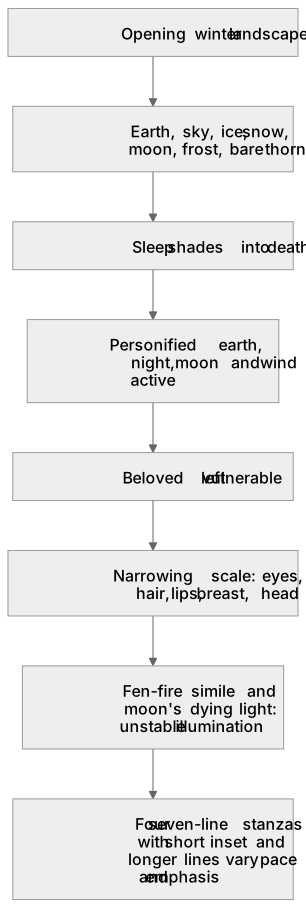
Put it in order
Put these steps in the order they happen.
- 1. Beloved left vulnerable
- 2. Four seven-line stanzas with short inset and longer lines vary pace and emphasis
- 3. Narrowing scale: eyes, hair, lips, breast, head
- 4. Opening winter landscape
- 5. Earth, sky, ice, snow, moon, frost, bare thorn
- 6. Fen-fire simile and moon's dying light: unstable illumination
- 7. Sleep shades into death
- 8. Personified earth, night, moon and wind active
Key words
Say what each word means before you turn the card.
Death and mortality
Try answering aloud or in your head before turning the card.
Nature's indifference
Try answering aloud or in your head before turning the card.
Isolation and grief
Try answering aloud or in your head before turning the card.
The subversion of Romantic ideals
Try answering aloud or in your head before turning the card.
See every definition
- Death and mortality
- Cold, sleep and death imagery develops from the opening landscape to the exposed body in the final stanza.
- Nature's indifference
- Personified earth, night, moon and wind make nature active while leaving the beloved vulnerable.
- Isolation and grief
- The narrowing focus from earth and sky to eyes, hair, lips and head intensifies vulnerability.
- The subversion of Romantic ideals
- Each natural detail connects to the poem's coldness, mortality and exposure rather than a conventional Romantic celebration.
Label the diagram
Some boxes have lost their names. Pick the right name for each number.
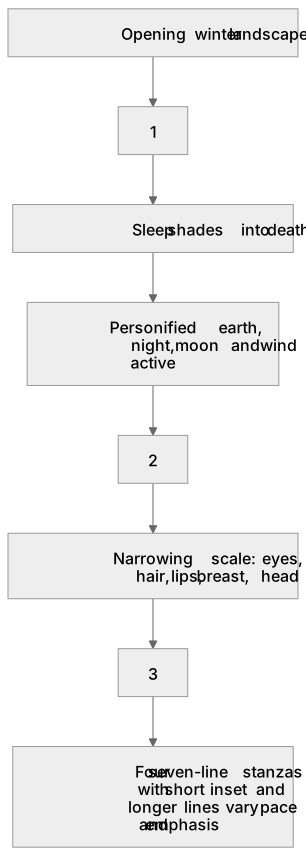
1Box 1
2Box 2
3Box 3
There is more to this lesson
The full lesson goes on to check your understanding and help you earn the marks. Create a free account to carry on, with your progress saved.
A week of Premium from your first lesson · Then the free plan continues · No card, no charge
Test your understanding of Component 3: Poetry – Section B: Specified Poetry Pre- or Post-1900 – Pre-1900 – The Romantic Period – English Romantic Verse, editor David Wright (Penguin Classics, 1973): ‘The cold earth slept below’ Percy Bysshe Shelley
Active recall beats re-reading. Take an instant quiz now to test what you’ve learned and lock it into long-term memory.
A week of Premium from your first lesson · Then the free plan continues · No card, no charge