Pearson Edexcel · A-Level · English Literature
Course version: 9ET0 · Version from Sept 2015
Poetry – Section B: Specified Poetry Pre- or Post-1900 – Pre-1900 – The…
Full specification wording
Component 3: Poetry – Section B: Specified Poetry Pre- or Post-1900 – Pre-1900 – The Romantic Period – English Romantic Verse, editor David Wright (Penguin Classics, 1973): On This Day I Complete My Thirty-Sixth Year
Written months before his death in Missolonghi, Byron’s final poem serves as a poignant reflection on mortality, unfulfilled love, and the pursuit of martial glory.
Checked against the Pearson Edexcel 9ET0 specification (opens in a new tab) on .
- Point 8 of 16
- 4 key terms
Study notes
From the checked teaching notes for this specification point.
The idea
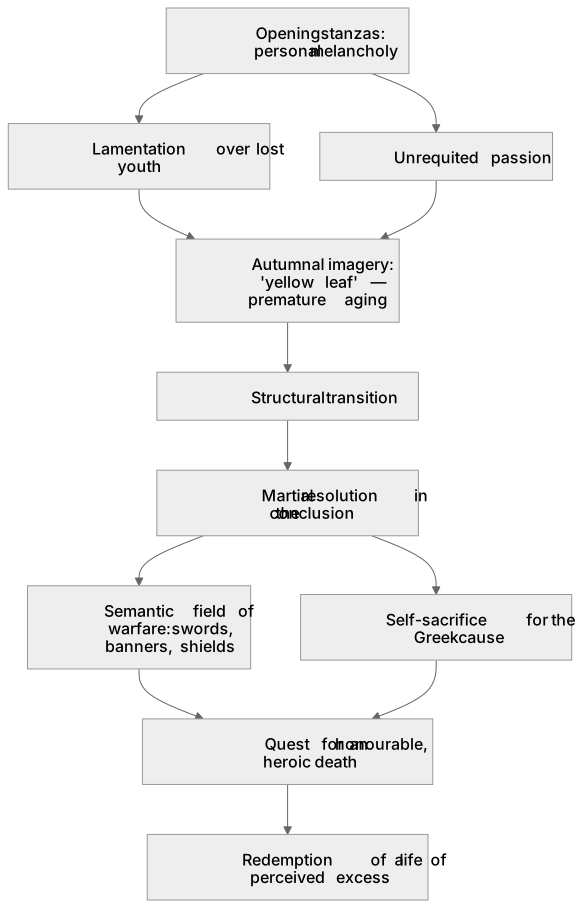
Written months before his death in Missolonghi, Byron’s final poem serves as a poignant reflection on mortality, unfulfilled love, and the pursuit of martial glory. The text shifts dramatically from personal lamentation over lost youth and unrequited passion to a resolute embrace of self-sacrifice for the Greek cause. Key analysis must focus on the imagery of autumn and yellow leaves to symbolise premature aging, contrasted with the semantic field of warfare—swords, banners, and shields—which represents his quest for an honourable, heroic death to redeem a life of perceived excess.
What earns the marks
- Analyse the shift in tone from personal melancholy in the opening stanzas to martial resolution in the conclusion.
- Evaluate the use of autumnal imagery ('yellow leaf') to convey the speaker's sense of premature aging and emotional barrenness.
- Discuss the significance of the Greek independence context in shaping the poem's themes of heroism and self-sacrifice.
- Examine the contrast between the imagery of romantic love and the semantic field of warfare and death.
Common mistakes and how to put them right
Reading the poem purely as a depressing lament about getting older.
Put it right: Acknowledge the crucial pivot towards finding purpose and redemption through military sacrifice.
Overlooking the specific historical context of the Greek War of Independence.
Put it right: Integrate Byron's presence in Missolonghi as essential context for his desire for a 'soldier's grave'.
Misinterpreting the 'fire' imagery as purely destructive.
Put it right: Analyse the 'fire' as a symbol of both consuming passion and the purifying nature of a heroic death.
Exam tips
- Track the pronoun shifts and changing focus from the internal 'I' to the external realities of war to demonstrate structural understanding.
- Contrast the passive imagery of the early stanzas with the active, imperative verbs used in the final sections.
- Connect the poem's exploration of the 'Byronic hero' to its ultimate conclusion in self-sacrifice rather than mere rebellion.
Try the lesson
The start of the Component 3: Poetry – Section B: Specified Poetry Pre- or Post-1900 – Pre-1900 – The Romantic Period – English Romantic Verse, editor David Wright (Penguin Classics, 1973): On This Day I Complete My Thirty-Sixth Year lesson, made from checked teaching notes for this specification point.
Have a go first
In Lord Byron's poem 'On This Day I Complete My Thirty-Sixth Year', what is the primary setting and context that shapes the speaker's desire for a martial death?
Listen
Written months before his death in Missolonghi, Byron’s final poem serves as a poignant reflection on mortality, unfulfilled love, and the pursuit of martial glory. The text shifts dramatically from personal lamentation over lost youth and unrequited passion to a resolute embrace of self-sacrifice for the Greek cause. Key analysis must focus on the imagery of autumn and yellow leaves to symbolise premature aging, contrasted with the semantic field of warfare—swords, banners, and shields—which represents his quest for an honourable, heroic death to redeem a life of perceived excess. A strong answer earns marks for these points. Analyse the shift in tone from personal melancholy in the opening stanzas to martial resolution in the conclusion. Evaluate the use of autumnal imagery ('yellow leaf') to convey the speaker's sense of premature aging and emotional barrenness. Discuss the significance of the Greek independence context in shaping the poem's themes of heroism and self-sacrifice. Examine the contrast between the imagery of romantic love and the semantic field of warfare and death. A common slip: Reading the poem purely as a depressing lament about getting older. Instead, Acknowledge the crucial pivot towards finding purpose and redemption through military sacrifice. Exam tip: Track the pronoun shifts and changing focus from the internal 'I' to the external realities of war to demonstrate structural understanding.
See it
Key words
Say what each word means before you turn the card.
Mortality and aging
Try answering aloud or in your head before turning the card.
Heroism and sacrifice
Try answering aloud or in your head before turning the card.
Unrequited love
Try answering aloud or in your head before turning the card.
The search for redemption
Try answering aloud or in your head before turning the card.
See every definition
- Mortality and aging
- A poignant reflection on death and on lost youth, with autumn and yellow leaves symbolising premature aging and emotional barrenness.
- Heroism and sacrifice
- A resolute embrace of self-sacrifice for the Greek cause, seeking an honourable, heroic death through the semantic field of warfare.
- Unrequited love
- Unfulfilled passion and unrequited love, part of the personal lamentation from which the text shifts dramatically.
- The search for redemption
- A quest to redeem a life of perceived excess through an honourable, heroic death, rather than mere rebellion.
Label the diagram
Some boxes have lost their names. Pick the right name for each number.
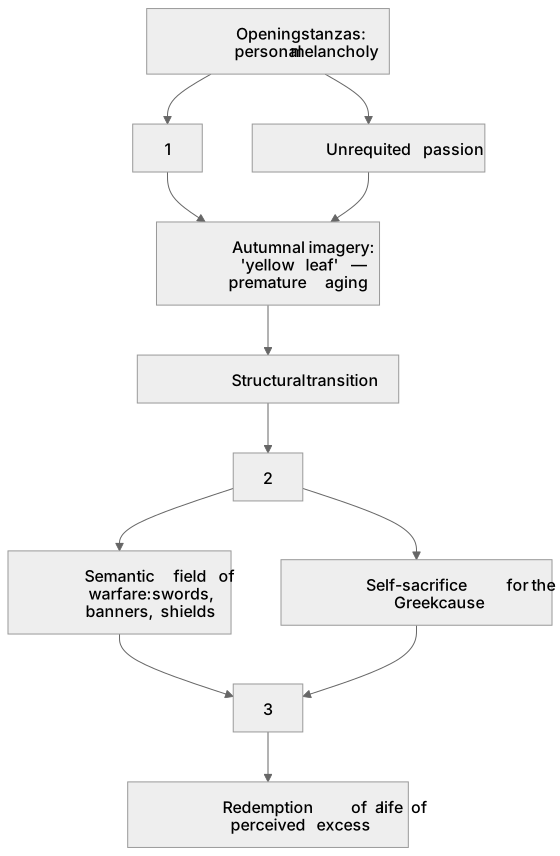
1Box 1
2Box 2
3Box 3
There is more to this lesson
The full lesson goes on to check your understanding and help you earn the marks. Create a free account to carry on, with your progress saved.
A week of Premium from your first lesson · Then the free plan continues · No card, no charge
Test your understanding of Component 3: Poetry – Section B: Specified Poetry Pre- or Post-1900 – Pre-1900 – The Romantic Period – English Romantic Verse, editor David Wright (Penguin Classics, 1973): On This Day I Complete My Thirty-Sixth Year
Active recall beats re-reading. Take an instant quiz now to test what you’ve learned and lock it into long-term memory.
A week of Premium from your first lesson · Then the free plan continues · No card, no charge