Pearson Edexcel · A-Level · English Literature
Course version: 9ET0 · Version from Sept 2015
Poetry – Section B: Specified Poetry Pre- or Post-1900 – Pre-1900 – The…
Full specification wording
Component 3: Poetry – Section B: Specified Poetry Pre- or Post-1900 – Pre-1900 – The Romantic Period – English Romantic Verse, editor David Wright (Penguin Classics, 1973): Lines Written in Early Spring William Wordsworth
In this lyrical ballad, the speaker sits in a woodland grove, observing the harmony and vitality of the natural world.
Checked against the Pearson Edexcel 9ET0 specification (opens in a new tab) on .
- Point 3 of 16
- 3 key terms
Study notes
From the checked teaching notes for this specification point.
The idea
In this lyrical ballad, the speaker sits in a woodland grove, observing the harmony and vitality of the natural world. The poem contrasts the joyful interconnectedness of nature—represented by the periwinkle, birds, and budding twigs—with the sorrowful state of humanity. The speaker laments "what man has made of man," highlighting the alienation of human society from the natural order during the Industrial Revolution. Structurally, the poem uses simple quatrains with an ABAB rhyme scheme, reflecting the accessible, democratic ideals of Romanticism.
What earns the marks
- Analyse the use of personification to give nature a conscious, joyful agency.
- Evaluate the contrast between the harmony of the natural world and human discord.
- Discuss the significance of the ABAB rhyme scheme and ballad meter in conveying Romantic ideals.
- Explore the contextual influence of the Industrial Revolution and the French Revolution on the speaker's lament.
Common mistakes and how to put them right
Assuming the poem is purely a celebration of nature.
Put it right: Acknowledge the underlying melancholy and critique of human society that drives the poem's central conflict.
Ignoring the specific historical context of the late 18th century.
Put it right: Connect the phrase "what man has made of man" to the societal shifts of the Industrial Revolution and political disillusionment.
Treating the simple structure as lacking depth.
Put it right: Explain how the accessible ballad form deliberately aligns with Wordsworth's aim to write in the language really used by men.
Exam tips
- Compare the personification of nature in this poem with other Romantic works to highlight Wordsworth's specific pantheistic views.
- Focus on the sensory language and active verbs used to describe the flora and fauna to demonstrate nature's vitality.
- Use the recurring phrase "what man has made of man" as a focal point for discussing the poem's philosophical message.
Try the lesson
The start of the Component 3: Poetry – Section B: Specified Poetry Pre- or Post-1900 – Pre-1900 – The Romantic Period – English Romantic Verse, editor David Wright (Penguin Classics, 1973): Lines Written in Early Spring William Wordsworth lesson, made from checked teaching notes for this specification point.
Have a go first
What is the central contrast explored by the speaker in William Wordsworth's 'Lines Written in Early Spring'?
Listen
In this lyrical ballad, the speaker sits in a woodland grove, observing the harmony and vitality of the natural world. The poem contrasts the joyful interconnectedness of nature—represented by the periwinkle, birds, and budding twigs—with the sorrowful state of humanity. The speaker laments "what man has made of man," highlighting the alienation of human society from the natural order during the Industrial Revolution. Structurally, the poem uses simple quatrains with an ABAB rhyme scheme, reflecting the accessible, democratic ideals of Romanticism. A strong answer earns marks for these points. Analyse the use of personification to give nature a conscious, joyful agency. Evaluate the contrast between the harmony of the natural world and human discord. Discuss the significance of the ABAB rhyme scheme and ballad meter in conveying Romantic ideals. Explore the contextual influence of the Industrial Revolution and the French Revolution on the speaker's lament. A common slip: Assuming the poem is purely a celebration of nature. Instead, Acknowledge the underlying melancholy and critique of human society that drives the poem's central conflict. Exam tip: Compare the personification of nature in this poem with other Romantic works to highlight Wordsworth's specific pantheistic views.
See it
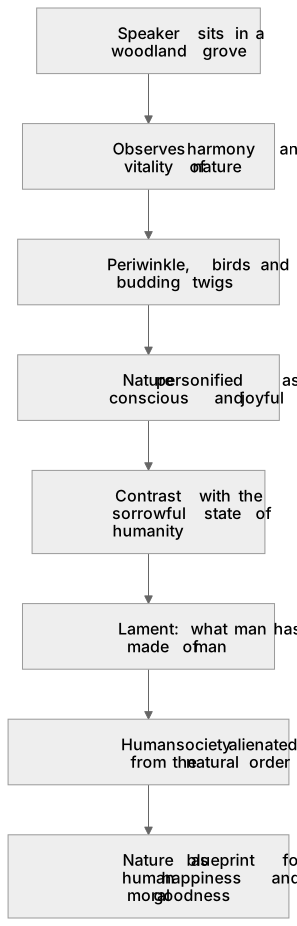
Put it in order
Put these steps in the order they happen.
- 1. Contrast with the sorrowful state of humanity
- 2. Nature as blueprint for human happiness and moral goodness
- 3. Lament: what man has made of man
- 4. Speaker sits in a woodland grove
- 5. Observes harmony and vitality of nature
- 6. Human society alienated from the natural order
- 7. Periwinkle, birds and budding twigs
- 8. Nature personified as conscious and joyful
Key words
Say what each word means before you turn the card.
Nature and harmony
Try answering aloud or in your head before turning the card.
Humanity's alienation
Try answering aloud or in your head before turning the card.
Joy and melancholy
Try answering aloud or in your head before turning the card.
See every definition
- Nature and harmony
- The joyful interconnectedness of the natural world, represented by the periwinkle, birds and budding twigs, which the speaker observes while sitting in a woodland grove.
- Humanity's alienation
- The sorrowful separation of human society from the natural order, lamented by the speaker as "what man has made of man" during the Industrial Revolution.
- Joy and melancholy
- The contrast between the vitality of the natural world and the speaker's underlying sorrow and critique of human society, which drives the poem's central conflict.
Label the diagram
Some boxes have lost their names. Pick the right name for each number.
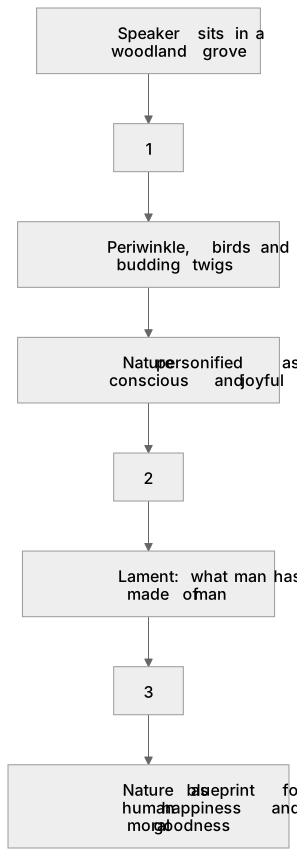
1Box 1
2Box 2
3Box 3
There is more to this lesson
The full lesson goes on to check your understanding and help you earn the marks. Create a free account to carry on, with your progress saved.
A week of Premium from your first lesson · Then the free plan continues · No card, no charge
Test your understanding of Component 3: Poetry – Section B: Specified Poetry Pre- or Post-1900 – Pre-1900 – The Romantic Period – English Romantic Verse, editor David Wright (Penguin Classics, 1973): Lines Written in Early Spring William Wordsworth
Active recall beats re-reading. Take an instant quiz now to test what you’ve learned and lock it into long-term memory.
A week of Premium from your first lesson · Then the free plan continues · No card, no charge