Pearson Edexcel · A-Level · English Literature
Course version: 9ET0 · Version from Sept 2015
Poetry – Section B: Specified Poetry Pre- or Post-1900 – Pre-1900 – The…
Full specification wording
Component 3: Poetry – Section B: Specified Poetry Pre- or Post-1900 – Pre-1900 – The Victorian Period – The New Oxford Book of Victorian Verse, editor Christopher Ricks (OUP, 2008): The Best Thing in the World
Elizabeth Barrett Browning's twelve-line lyric answers its opening question, "What's the best thing in the world?", by cataloguing imagined pleasures stripped of their usual costs.
Checked against the Pearson Edexcel 9ET0 specification (opens in a new tab) on .
- Point 3 of 17
- 4 key terms
Study notes
From the checked teaching notes for this specification point.
The idea
Elizabeth Barrett Browning's twelve-line lyric answers its opening question, "What's the best thing in the world?", by cataloguing imagined pleasures stripped of their usual costs. A "June-rose" keeps May's dew, truth does not hurt a friend, pleasure does not hurry to end, memory brings no pain and love is returned. The repeated question frames this accumulating list, while compressed phrases, semicolons and interlocking rhymes give it the pace of a playful riddle. The final answer, "Something out of it, I think", unsettles every candidate: the best may be beyond worldly experience, or the line may wryly expose the impossibility of demanding perfect pleasure without loss.
What earns the marks
- Analyse how the repeated opening question and catalogue structure turn an abstract inquiry into a sequence of vivid, qualified examples.
- Explore the pattern by which each pleasure is protected from a drawback: truth avoids cruelty, pleasure avoids ending and memory avoids pain.
- Evaluate the importance of reciprocated love as the catalogue's final worldly possibility before the repeated question returns.
- Discuss the ambiguity of "Something out of it, I think": it can suggest transcendence, scepticism about worldly perfection, or a deliberately light final paradox.
- Analyse how compact syntax, rhyme and the single-stanza form make the philosophical argument sound conversational and memorable.
Common mistakes and how to put them right
Assuming the title supplies a simple celebration of love.
Put it right: The poem tests several ideals and ends by locating the answer ambiguously outside the world.
Reading each item as an unrelated pretty image.
Put it right: Notice that almost every pleasure is defined by the absence of an associated harm or limitation.
Treating the final line as an unequivocal statement of religious faith.
Put it right: Its tentative "I think" also permits wit, uncertainty and scepticism.
Exam tips
- Use the opening and closing questions as structural anchors for an AO1–AO3 argument about how the speaker's answer changes.
- Pair brief quotations such as "Truth, not cruel" and "Memory, that gives no pain" to show the catalogue's repeated logic.
- If referring to another poem from the specified collection, use the connection to sharpen analysis of Browning's language and Victorian context rather than treating comparison as a separate AO.
Try the lesson
The start of the Component 3: Poetry – Section B: Specified Poetry Pre- or Post-1900 – Pre-1900 – The Victorian Period – The New Oxford Book of Victorian Verse, editor Christopher Ricks (OUP, 2008): The Best Thing in the World lesson, made from checked teaching notes for this specification point.
Have a go first
What is the central conclusion reached by the speaker in Elizabeth Barrett Browning's 'The Best Thing in the World'?
Listen
Elizabeth Barrett Browning's twelve-line lyric answers its opening question, "What's the best thing in the world?", by cataloguing imagined pleasures stripped of their usual costs. A "June-rose" keeps May's dew, truth does not hurt a friend, pleasure does not hurry to end, memory brings no pain and love is returned. The repeated question frames this accumulating list, while compressed phrases, semicolons and interlocking rhymes give it the pace of a playful riddle. The final answer, "Something out of it, I think", unsettles every candidate: the best may be beyond worldly experience, or the line may wryly expose the impossibility of demanding perfect pleasure without loss. A strong answer earns marks for these points. Analyse how the repeated opening question and catalogue structure turn an abstract inquiry into a sequence of vivid, qualified examples. Explore the pattern by which each pleasure is protected from a drawback: truth avoids cruelty, pleasure avoids ending and memory avoids pain. Evaluate the importance of reciprocated love as the catalogue's final worldly possibility before the repeated question returns. Discuss the ambiguity of "Something out of it, I think": it can suggest transcendence, scepticism about worldly perfection, or a deliberately light final paradox. A common slip: Assuming the title supplies a simple celebration of love. Instead, the poem tests several ideals and ends by locating the answer ambiguously outside the world. Exam tip: Use the opening and closing questions as structural anchors for an AO1–AO3 argument about how the speaker's answer changes.
See it
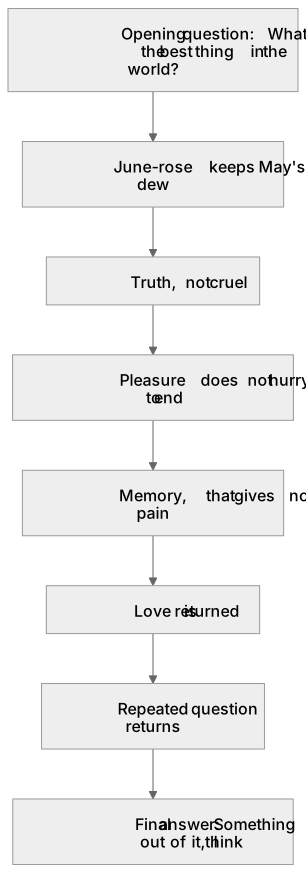
Put it in order
Put these steps in the order they happen.
- 1. Memory, that gives no pain
- 2. Final answer: Something out of it, I think
- 3. Love is returned
- 4. Opening question: What's the best thing in the world?
- 5. June-rose keeps May's dew
- 6. Repeated question returns
- 7. Truth, not cruel
- 8. Pleasure does not hurry to end
Key words
Say what each word means before you turn the card.
Value and worth
Try answering aloud or in your head before turning the card.
Love and human connection
Try answering aloud or in your head before turning the card.
Time and transience
Try answering aloud or in your head before turning the card.
Worldly and transcendent value
Try answering aloud or in your head before turning the card.
See every definition
- Value and worth
- The poem asks what is best in the world and tests several ideals before locating the answer ambiguously outside the world.
- Love and human connection
- Reciprocated love is the catalogue's final worldly possibility before the repeated question returns.
- Time and transience
- Pleasure is protected from a drawback by not hurrying to end, while memory is protected by giving no pain.
- Worldly and transcendent value
- The final line can suggest transcendence, scepticism about worldly perfection, or a deliberately light final paradox.
Label the diagram
Some boxes have lost their names. Pick the right name for each number.
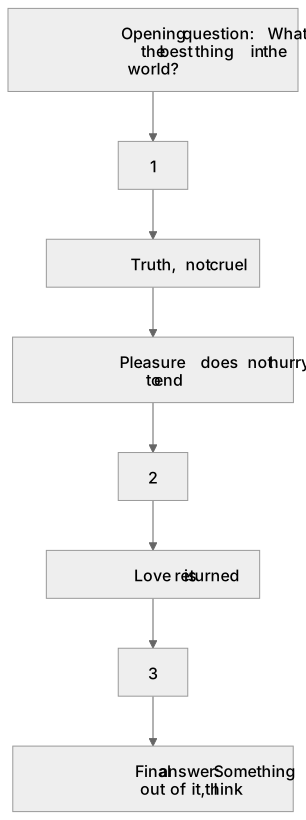
1Box 1
2Box 2
3Box 3
There is more to this lesson
The full lesson goes on to check your understanding and help you earn the marks. Create a free account to carry on, with your progress saved.
A week of Premium from your first lesson · Then the free plan continues · No card, no charge
Test your understanding of Component 3: Poetry – Section B: Specified Poetry Pre- or Post-1900 – Pre-1900 – The Victorian Period – The New Oxford Book of Victorian Verse, editor Christopher Ricks (OUP, 2008): The Best Thing in the World
Active recall beats re-reading. Take an instant quiz now to test what you’ve learned and lock it into long-term memory.
A week of Premium from your first lesson · Then the free plan continues · No card, no charge