Pearson Edexcel · A-Level · English Literature
Course version: 9ET0 · Version from Sept 2015
Poetry – Section B: Specified Poetry Pre- or Post-1900 – Pre-1900 – The…
Full specification wording
Component 3: Poetry – Section B: Specified Poetry Pre- or Post-1900 – Pre-1900 – The Victorian Period – The New Oxford Book of Victorian Verse, editor Christopher Ricks (OUP, 2008): My Last Duchess Robert Browning
Robert Browning’s ‘My Last Duchess’ is a masterful dramatic monologue that exposes the chilling psychology of the Duke of Ferrara.
Checked against the Pearson Edexcel 9ET0 specification (opens in a new tab) on .
- Point 4 of 17
- 4 key terms
Study notes
From the checked teaching notes for this specification point.
The idea
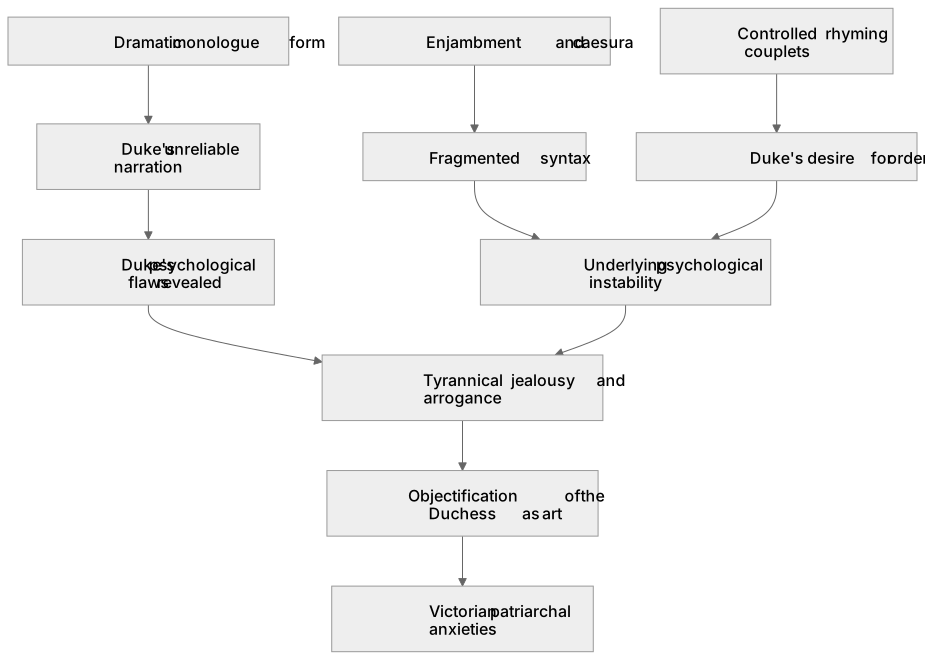
Robert Browning’s ‘My Last Duchess’ is a masterful dramatic monologue that exposes the chilling psychology of the Duke of Ferrara. Set during the Italian Renaissance but reflecting Victorian patriarchal anxieties, the poem reveals the Duke’s obsessive need for control over his late wife, whom he ultimately had killed for her perceived lack of exclusive devotion. Browning employs rhyming couplets to reflect the Duke’s desire for order, yet heavily subverts this with enjambment and caesura, mirroring his conversational tone and underlying psychological instability.
What earns the marks
- Analyse the use of the dramatic monologue form to reveal the Duke's unreliable narration and psychological flaws.
- Evaluate the structural tension between the controlled rhyming couplets and the fragmented syntax created by enjambment and caesura.
- Explore the theme of objectification, specifically how the Duke equates his late wife with the artwork of Fra Pandolf and Claus of Innsbruck.
- Contextualise the poem within Victorian patriarchal attitudes towards female sexuality and marital obedience, despite its Renaissance setting.
Common mistakes and how to put them right
Assuming the Duchess was definitely unfaithful.
Put it right: Recognise that the poem only presents the Duke's paranoid and jealous perspective, leaving her actual guilt ambiguous.
Describing the poem as free verse due to its conversational rhythm.
Put it right: Identify the strict AABB rhyming couplets that are masked by heavy enjambment.
Ignoring the silent listener.
Put it right: Explicitly discuss the role of the envoy, whose silent presence shapes the Duke's rhetorical strategies and the poem's dramatic tension.
Exam tips
- Focus on the Duke's use of possessive pronouns such as 'My' to demonstrate his obsessive need for ownership and control.
- Link the specific setting of Renaissance Italy to Browning's critique of Victorian gender politics and the commodification of women.
- Analyse the final image of Neptune taming a sea-horse as a metaphor for the Duke's tyrannical approach to marriage and dominance.
Try the lesson
The start of the Component 3: Poetry – Section B: Specified Poetry Pre- or Post-1900 – Pre-1900 – The Victorian Period – The New Oxford Book of Victorian Verse, editor Christopher Ricks (OUP, 2008): My Last Duchess Robert Browning lesson, made from checked teaching notes for this specification point.
Have a go first
Which poetic form does Robert Browning employ in 'My Last Duchess' to expose the speaker's psychology to the reader?
Listen
Robert Browning’s ‘My Last Duchess’ is a masterful dramatic monologue that exposes the chilling psychology of the Duke of Ferrara. Set during the Italian Renaissance but reflecting Victorian patriarchal anxieties, the poem reveals the Duke’s obsessive need for control over his late wife, whom he ultimately had killed for her perceived lack of exclusive devotion. Browning employs rhyming couplets to reflect the Duke’s desire for order, yet heavily subverts this with enjambment and caesura, mirroring his conversational tone and underlying psychological instability. A strong answer earns marks for these points. Analyse the use of the dramatic monologue form to reveal the Duke's unreliable narration and psychological flaws. Evaluate the structural tension between the controlled rhyming couplets and the fragmented syntax created by enjambment and caesura. Explore the theme of objectification, specifically how the Duke equates his late wife with the artwork of Fra Pandolf and Claus of Innsbruck. Contextualise the poem within Victorian patriarchal attitudes towards female sexuality and marital obedience, despite its Renaissance setting. A common slip: Assuming the Duchess was definitely unfaithful. Instead, recognise that the poem only presents the Duke's paranoid and jealous perspective, leaving her actual guilt ambiguous. Exam tip: Focus on the Duke's use of possessive pronouns such as 'My' to demonstrate his obsessive need for ownership and control.
See it
Key words
Say what each word means before you turn the card.
Power and control
Try answering aloud or in your head before turning the card.
Gender and patriarchy
Try answering aloud or in your head before turning the card.
Art and objectification
Try answering aloud or in your head before turning the card.
Jealousy and madness
Try answering aloud or in your head before turning the card.
See every definition
- Power and control
- The Duke's obsessive need for control over his late wife, whom he ultimately had killed for her perceived lack of exclusive devotion.
- Gender and patriarchy
- Victorian patriarchal attitudes towards female sexuality and marital obedience, which the poem reflects despite its Renaissance setting.
- Art and objectification
- The Duke equates his late wife with the artwork of Fra Pandolf and Claus of Innsbruck, treating women as mere art objects.
- Jealousy and madness
- The Duke unwittingly reveals his own tyrannical jealousy and arrogance while attempting to negotiate a new marriage.
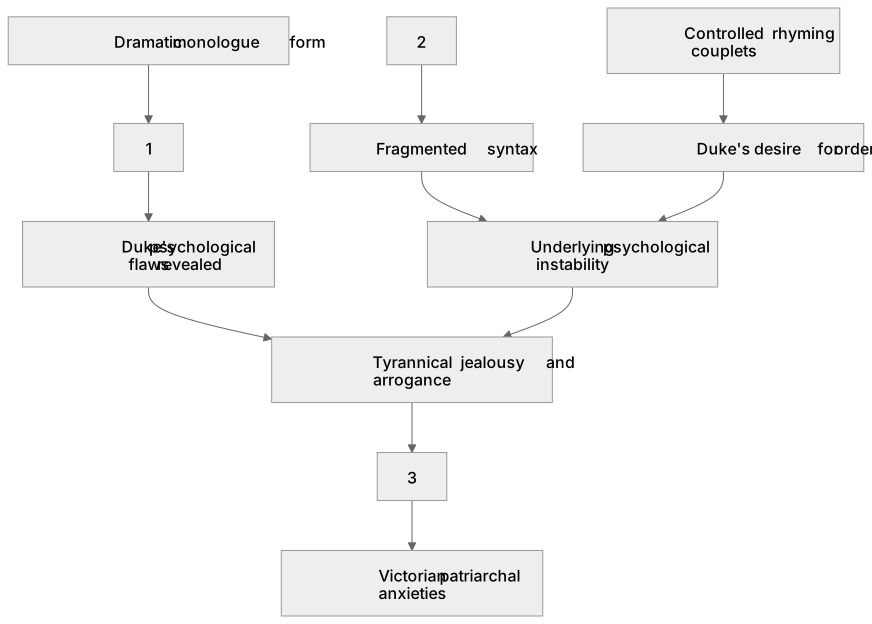
Label the diagram
Some boxes have lost their names. Pick the right name for each number.
1Box 1
2Box 2
3Box 3
There is more to this lesson
The full lesson goes on to check your understanding and help you earn the marks. Create a free account to carry on, with your progress saved.
A week of Premium from your first lesson · Then the free plan continues · No card, no charge
Test your understanding of Component 3: Poetry – Section B: Specified Poetry Pre- or Post-1900 – Pre-1900 – The Victorian Period – The New Oxford Book of Victorian Verse, editor Christopher Ricks (OUP, 2008): My Last Duchess Robert Browning
Active recall beats re-reading. Take an instant quiz now to test what you’ve learned and lock it into long-term memory.
A week of Premium from your first lesson · Then the free plan continues · No card, no charge