AQA · GCSE · French
Course version: 8658 · Version from Sept 2016
Adverbs: comparative and superlative, including mieux, le mieux
Adverbs modify verbs, adjectives, or other adverbs.
- Point 2 of 2
- 4 key terms
Study notes
From the teaching notes for this specification point.
The idea
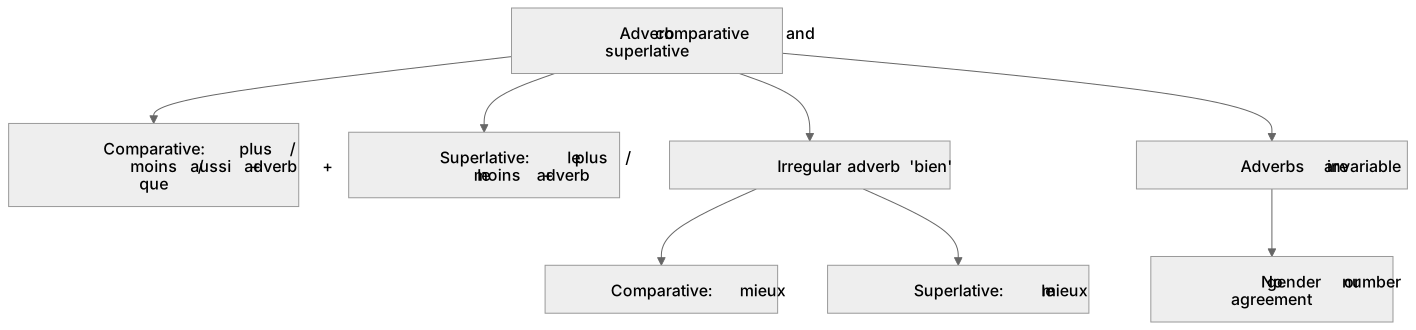
Adverbs modify verbs, adjectives, or other adverbs. The comparative of adverbs is formed using 'plus' (more), 'moins' (less), or 'aussi' (as) followed by the adverb and 'que' (than/as). For example, 'Il court plus vite que moi' (He runs faster than me). The superlative is formed by adding 'le' before 'plus' or 'moins', e.g., 'C'est lui qui court le plus vite' (He is the one who runs the fastest). The adverb 'bien' (well) has irregular comparative and superlative forms: 'mieux' (better) and 'le mieux' (the best). For instance, 'Elle chante mieux que lui' (She sings better than him) and 'C'est elle qui chante le mieux' (She is the one who sings the best). Remember that adverbs, unlike adjectives, are invariable and do not agree in gender or number.
What earns the marks
- Identify the correct comparative structure (plus/moins/aussi + adverb + que).
- Identify the correct superlative structure (le plus/le moins + adverb).
- Recognise and use 'mieux' as the comparative of 'bien'.
- Recognise and use 'le mieux' as the superlative of 'bien'.
- Distinguish between the adverb 'bien' (mieux) and the adjective 'bon' (meilleur).
Common mistakes and how to put them right
Confusing 'mieux' (better - adverb) with 'meilleur' (better - adjective).
Put it right: Use 'mieux' to modify a verb (e.g., 'il travaille mieux') and 'meilleur' to modify a noun (e.g., 'un meilleur ami').
Making adverbs agree in gender or number.
Put it right: Adverbs are invariable; 'le mieux' never changes to 'la mieux' or 'les mieux'.
Forgetting the article 'le' in the superlative of adverbs.
Put it right: Use 'le' for adverbial superlatives, e.g., 'le plus souvent', regardless of the subject's gender.
Exam tips
- When translating 'better' or 'best', check if it describes an action (use mieux/le mieux) or a noun (use meilleur/le meilleur).
- Look out for 'que' in reading and listening texts as a key indicator of a comparative structure.
- In writing, using 'le mieux' correctly demonstrates a strong grasp of irregular adverbs and can elevate your language mark.
Try the lesson
The start of the Adverbs: comparative and superlative, including mieux, le mieux lesson, made from teaching notes for this specification point.
Have a go first
Which sentence correctly translates "He sings better than his brother"?
Listen
Adverbs modify verbs, adjectives, or other adverbs. The comparative of adverbs is formed using 'plus' (more), 'moins' (less), or 'aussi' (as) followed by the adverb and 'que' (than/as). For example, 'Il court plus vite que moi' (He runs faster than me). The superlative is formed by adding 'le' before 'plus' or 'moins', e.g., 'C'est lui qui court le plus vite' (He is the one who runs the fastest). The adverb 'bien' (well) has irregular comparative and superlative forms: 'mieux' (better) and 'le mieux' (the best). For instance, 'Elle chante mieux que lui' (She sings better than him) and 'C'est elle qui chante le mieux' (She is the one who sings the best). Remember that adverbs, unlike adjectives, are invariable and do not agree in gender or number. A strong answer earns marks for these points. Identify the correct comparative structure (plus/moins/aussi + adverb + que). Identify the correct superlative structure (le plus/le moins + adverb). Recognise and use 'mieux' as the comparative of 'bien'. Recognise and use 'le mieux' as the superlative of 'bien'. A common slip: Confusing 'mieux' (better - adverb) with 'meilleur' (better - adjective). Instead, Use 'mieux' to modify a verb (e.g., 'il travaille mieux') and 'meilleur' to modify a noun (e.g., 'un meilleur ami'). Exam tip: When translating 'better' or 'best', check if it describes an action (use mieux/le mieux) or a noun (use meilleur/le meilleur).
See it
Key words
Say what each word means before you turn the card.
Comparisons
Try answering aloud or in your head before turning the card.
Irregular adverbs
Try answering aloud or in your head before turning the card.
Invariability of adverbs
Try answering aloud or in your head before turning the card.
Adverbial modification
Try answering aloud or in your head before turning the card.
See every definition
- Comparisons
- The comparative of adverbs is formed using 'plus' (more), 'moins' (less), or 'aussi' (as) followed by the adverb and 'que' (than/as).
- Irregular adverbs
- The adverb 'bien' (well) has irregular comparative and superlative forms: 'mieux' (better) and 'le mieux' (the best).
- Invariability of adverbs
- Adverbs, unlike adjectives, are invariable and do not agree in gender or number.
- Adverbial modification
- Adverbs modify verbs, adjectives, or other adverbs.
Label the diagram
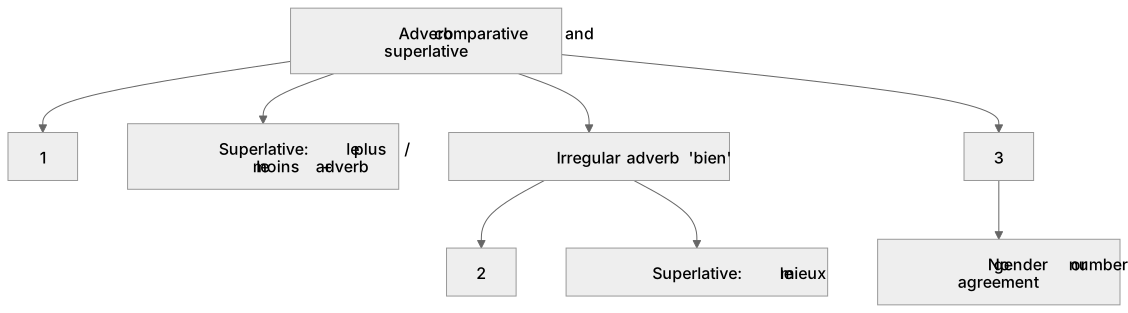
Some boxes have lost their names. Pick the right name for each number.
1Box 1
2Box 2
3Box 3
There is more to this lesson
The full lesson goes on to check your understanding and help you earn the marks. Create a free account to carry on, with your progress saved.
A week of Premium from your first lesson · Then the free plan continues · No card, no charge
Test your understanding of Adverbs: comparative and superlative, including mieux, le mieux
Active recall beats re-reading. Take an instant quiz now to test what you’ve learned and lock it into long-term memory.
A week of Premium from your first lesson · Then the free plan continues · No card, no charge