AQA · GCSE · French
Course version: 8658 · Version from Sept 2016
Common coordinating conjunctions eg car; donc; ensuite; et; mais; ou, ou…
Full specification wording
Conjunctions: common coordinating conjunctions eg car; donc; ensuite; et; mais; ou, ou bien, puis common subordinating conjunctions eg comme; lorsque; parce que; puisque; quand; que; si
Conjunctions link words and clauses to create fluent sentences in French.
- 3 key terms
Study notes
From the teaching notes for this specification point.
The idea
Conjunctions link words and clauses to create fluent sentences in French. Coordinating conjunctions connect items of equal rank. Key examples include 'car' (because), 'donc' (therefore), 'ensuite' (next), 'et' (and), 'mais' (but), 'ou' (or), 'ou bien' (or else), and 'puis' (then). Subordinating conjunctions introduce dependent clauses. Common examples are 'comme' (as/since), 'lorsque' (when), 'parce que' (because), 'puisque' (since), 'quand' (when), 'que' (that), and 'si' (if). For instance, "Je mange parce que j'ai faim" uses a subordinating conjunction, whereas "J'ai faim donc je mange" uses a coordinating one. Mastering these conjunctions allows for more sophisticated expression and better flow in both written and spoken French.
What earns the marks
- Identify coordinating conjunctions in a given sentence.
- Identify subordinating conjunctions in a given sentence.
- Select the correct conjunction to logically link two clauses.
- Recognise the specific meaning of conjunctions such as 'puisque' or 'lorsque' in context.
Common mistakes and how to put them right
Confusing 'parce que' and 'à cause de'.
Put it right: 'parce que' is a conjunction followed by a clause, whereas 'à cause de' is a preposition followed by a noun.
Misusing 'si' before 'il' or 'ils'.
Put it right: 'si' must elide to 's'il' or 's'ils', but it does not elide before 'elle' or 'elles'.
Using 'que' without elision.
Put it right: 'que' must become 'qu'' before a vowel or silent h, which is often forgotten when writing quickly.
Exam tips
- Memorise the difference between coordinating and subordinating conjunctions to structure complex sentences logically.
- Always check for elision when using 'que', 'puisque', 'lorsque', and 'si' before words starting with a vowel.
- Use a variety of conjunctions in your writing to avoid repetition and demonstrate a wider range of vocabulary.
Try the lesson
The start of the Conjunctions: common coordinating conjunctions eg car; donc; ensuite; et; mais; ou, ou bien, puis common subordinating conjunctions eg comme; lorsque; parce que; puisque; quand; que; si lesson, made from teaching notes for this specification point.
Have a go first
What is the correct English translation of the coordinating conjunction "car" in the sentence "Je mange car j'ai faim"?
Listen
Conjunctions link words and clauses to create fluent sentences in French. Coordinating conjunctions connect items of equal rank. Key examples include 'car' (because), 'donc' (therefore), 'ensuite' (next), 'et' (and), 'mais' (but), 'ou' (or), 'ou bien' (or else), and 'puis' (then). Subordinating conjunctions introduce dependent clauses. Common examples are 'comme' (as/since), 'lorsque' (when), 'parce que' (because), 'puisque' (since), 'quand' (when), 'que' (that), and 'si' (if). For instance, "Je mange parce que j'ai faim" uses a subordinating conjunction, whereas "J'ai faim donc je mange" uses a coordinating one. Mastering these conjunctions allows for more sophisticated expression and better flow in both written and spoken French. A strong answer earns marks for these points. Identify coordinating conjunctions in a given sentence. Identify subordinating conjunctions in a given sentence. Select the correct conjunction to logically link two clauses. Recognise the specific meaning of conjunctions such as 'puisque' or 'lorsque' in context. Exam tip: Memorise the difference between coordinating and subordinating conjunctions to structure complex sentences logically.
See it
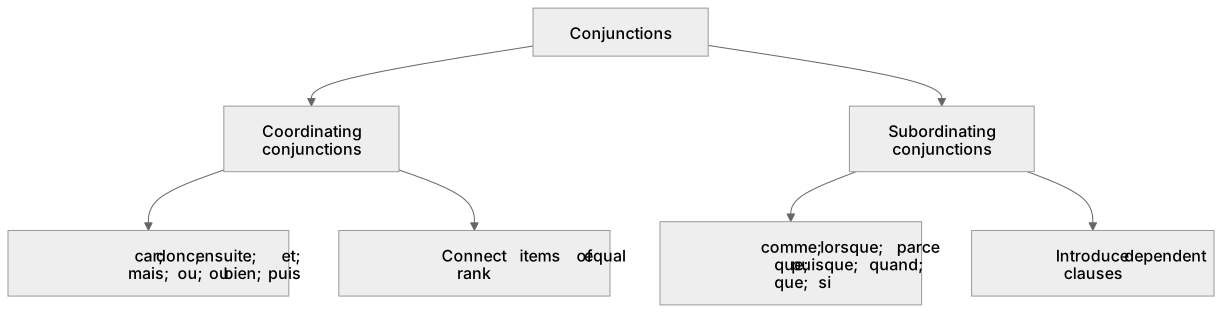
Key words
Say what each word means before you turn the card.
Conjunctions
Try answering aloud or in your head before turning the card.
Coordinating conjunctions
Try answering aloud or in your head before turning the card.
Subordinating conjunctions
Try answering aloud or in your head before turning the card.
See every definition
- Conjunctions
- Words that link words and clauses to create fluent sentences in French.
- Coordinating conjunctions
- Conjunctions that connect items of equal rank, such as 'car', 'donc', 'ensuite', 'et', 'mais', 'ou', 'ou bien' and 'puis'.
- Subordinating conjunctions
- Conjunctions that introduce dependent clauses, such as 'comme', 'lorsque', 'parce que', 'puisque', 'quand', 'que' and 'si'.
Label the diagram
Some boxes have lost their names. Pick the right name for each number.
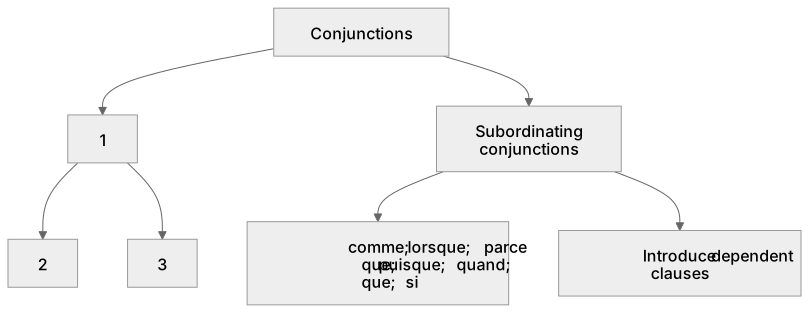
1Box 1
2Box 2
3Box 3
There is more to this lesson
The full lesson goes on to check your understanding and help you earn the marks. Create a free account to carry on, with your progress saved.
A week of Premium from your first lesson · Then the free plan continues · No card, no charge
Test your understanding of Conjunctions: common coordinating conjunctions eg car; donc; ensuite; et; mais; ou, ou bien, puis common subordinating conjunctions eg comme; lorsque; parce que; puisque; quand; que; si
Active recall beats re-reading. Take an instant quiz now to test what you’ve learned and lock it into long-term memory.
A week of Premium from your first lesson · Then the free plan continues · No card, no charge