AQA · GCSE · French
Course version: 8658 · Version from Sept 2016
The sound [i] will always involve a French i, which in English may be a…
Full specification wording
Near-cognates: the sound [i] will always involve a French i, which in English may be a diphthong eg pipe, mine
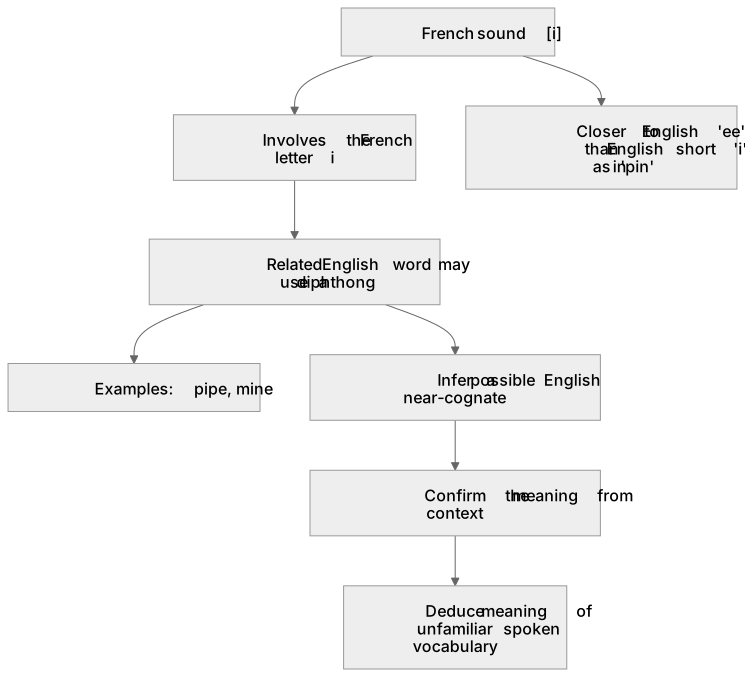
In the stated near-cognate pattern, the French sound [i] involves the French letter i, while the related English word may use a diphthong, as in pipe or mine.
- Point 1 of 9
- 2 key terms
Study notes
From the teaching notes for this specification point.
The idea
In the stated near-cognate pattern, the French sound [i] involves the French letter i, while the related English word may use a diphthong, as in pipe or mine. Apply this correspondence only where the source pattern fits; do not assume every written i or every French word has the same sound. Use the surrounding word and context to test the inferred English meaning. Revise this point by linking the stated rule to a concrete French example and then checking how the same idea appears in listening, reading, speaking or writing tasks, so the knowledge is usable in the exam rather than memorised as an isolated phrase.
What earns the marks
- Identify [i] as the French sound associated with the letter i in the stated pattern.
- Recognise that the English equivalent often uses a diphthong for the same letter.
- Use the pattern to infer a possible English near-cognate, then confirm it from context.
- Apply this sound pattern to deduce the meaning of unfamiliar spoken vocabulary in context.
Common mistakes and how to put them right
Pronouncing the French letter 'i' as the English diphthong 'eye'. (Correction.
Put it right: In the stated pattern, [i] is the relevant French sound; do not generalise it to every occurrence of i.).
Failing to recognise a spoken French word like 'mine' because the [i] sound masks its similarity to the English word. (Correction.
Put it right: Use the [i] to English diphthong correspondence only when the full near-cognate pattern and context support it.).
Confusing the French [i] sound with the English short 'i' as in 'pin'. (Correction.
Put it right: The French [i] is closer to the English 'ee' sound.).
Exam tips
- When you hear the [i] sound in a French listening exam, consider if it might be a near-cognate spelled with an 'i' in English.
- Practise saying near-cognates aloud in both languages to highlight the difference between the French [i] and the English diphthong.
- Do not let the 'ee' sound in French mislead you into looking for an English word spelled with 'ee' or 'ea'.
Try the lesson
The start of the Near-cognates: the sound [i] will always involve a French i, which in English may be a diphthong eg pipe, mine lesson, made from teaching notes for this specification point.
Have a go first
Which English word contains the closest vowel sound to the letter 'i' in the French word *mine*?
Listen
In the stated near-cognate pattern, the French sound [i] involves the French letter i, while the related English word may use a diphthong, as in pipe or mine. Apply this correspondence only where the source pattern fits; do not assume every written i or every French word has the same sound. Use the surrounding word and context to test the inferred English meaning. Revise this point by linking the stated rule to a concrete French example and then checking how the same idea appears in listening, reading, speaking or writing tasks, so the knowledge is usable in the exam rather than memorised as an isolated phrase. A strong answer earns marks for these points. Identify [i] as the French sound associated with the letter i in the stated pattern. Recognise that the English equivalent often uses a diphthong for the same letter. Use the pattern to infer a possible English near-cognate, then confirm it from context. Apply this sound pattern to deduce the meaning of unfamiliar spoken vocabulary in context. Exam tip: When you hear the [i] sound in a French listening exam, consider if it might be a near-cognate spelled with an 'i' in English.
See it
Key words
Say what each word means before you turn the card.
Near-cognates
Try answering aloud or in your head before turning the card.
Diphthongs
Try answering aloud or in your head before turning the card.
See every definition
- Near-cognates
- Words in French and English that are similar, where the French sound [i] involves the French letter i while the English word may use a diphthong.
- Diphthongs
- English vowel sounds that may appear in words such as pipe or mine where French uses the sound [i].
Label the diagram
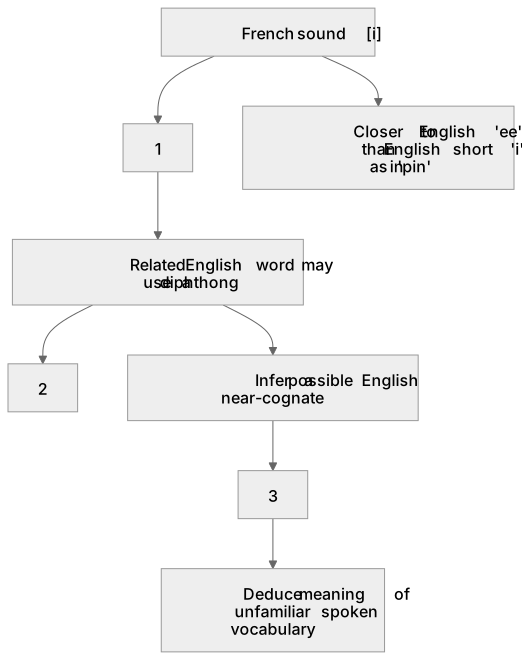
Some boxes have lost their names. Pick the right name for each number.
1Box 1
2Box 2
3Box 3
There is more to this lesson
The full lesson goes on to check your understanding and help you earn the marks. Create a free account to carry on, with your progress saved.
A week of Premium from your first lesson · Then the free plan continues · No card, no charge
Test your understanding of Near-cognates: the sound [i] will always involve a French i, which in English may be a diphthong eg pipe, mine
Active recall beats re-reading. Take an instant quiz now to test what you’ve learned and lock it into long-term memory.
A week of Premium from your first lesson · Then the free plan continues · No card, no charge