AQA · GCSE · French
Course version: 8658 · Version from Sept 2016
The termination [α˜] which can be added to the stem of listed verbs to…
Full specification wording
Near-cognates: the termination [α˜] which can be added to the stem of listed verbs to give the present participle eg mangeant, gémissant.
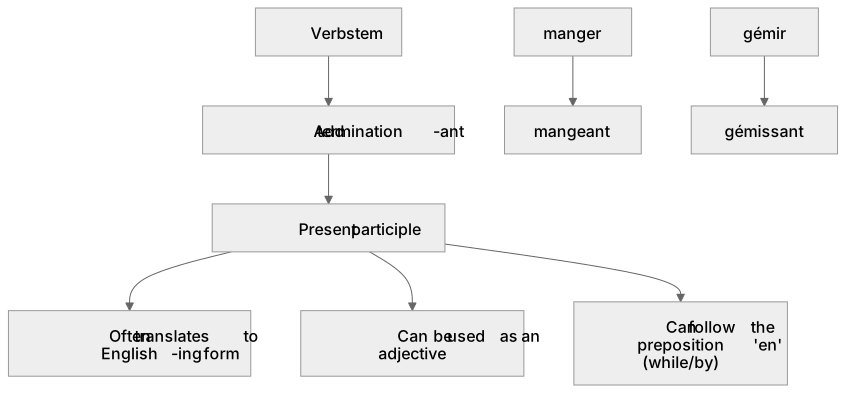
The French present participle is formed by adding the termination '-ant' (phonetically represented as [α˜]) to the stem of a verb.
- Point 9 of 9
- 3 key terms
Study notes
From the teaching notes for this specification point.
The idea
The French present participle is formed by adding the termination '-ant' (phonetically represented as [α˜]) to the stem of a verb. This form often translates to the English '-ing' form. For example, from the verb 'manger' (to eat), we get 'mangeant' (eating), and from 'gémir' (to moan), we get 'gémissant' (moaning). To find the correct stem, you typically take the 'nous' form of the present tense and remove the '-ons' ending. Recognising this termination helps you deduce the meaning of verb forms in complex sentences, such as when they are used as adjectives or after the preposition 'en' (meaning 'while' or 'by'). This knowledge is essential for decoding unfamiliar vocabulary in reading and listening tasks.
What earns the marks
- Identify that the French suffix '-ant' often corresponds to the English '-ing' participle.
- Recognise 'mangeant' as the present participle of 'manger' (eating).
- Recognise 'gémissant' as the present participle of 'gémir' (moaning).
- Deduce the meaning of unfamiliar present participles by identifying the verb stem and the '-ant' termination.
Common mistakes and how to put them right
Forgetting to keep the 'e' in 'mangeant' to preserve the soft 'g' sound before the 'a'.
Failing to use the correct stem for '-ir' verbs like 'gémir', which requires the '-iss-' infix (gémissant, not gémant).
Confusing the present participle ending '-ant' with the third-person plural present tense ending '-ent'.
Exam tips
- When you encounter a word ending in '-ant', check if it comes from a verb you know to deduce its meaning as an '-ing' word.
- Look out for the preposition 'en' before an '-ant' word, which usually translates to 'while [doing]' or 'by [doing]'.
- Remember that when used as adjectives, present participles ending in '-ant' must agree in gender and number with the noun they describe.
Try the lesson
The start of the Near-cognates: the termination [α˜] which can be added to the stem of listed verbs to give the present participle eg mangeant, gémissant. lesson, made from teaching notes for this specification point.
Have a go first
Which word correctly completes the sentence to mean 'While eating'?
"En ________, il regarde la télé."
Listen
The French present participle is formed by adding the termination '-ant' (phonetically represented as [α˜]) to the stem of a verb. This form often translates to the English '-ing' form. For example, from the verb 'manger' (to eat), we get 'mangeant' (eating), and from 'gémir' (to moan), we get 'gémissant' (moaning). To find the correct stem, you typically take the 'nous' form of the present tense and remove the '-ons' ending. Recognising this termination helps you deduce the meaning of verb forms in complex sentences, such as when they are used as adjectives or after the preposition 'en' (meaning 'while' or 'by'). This knowledge is essential for decoding unfamiliar vocabulary in reading and listening tasks. A strong answer earns marks for these points. Identify that the French suffix '-ant' often corresponds to the English '-ing' participle. Recognise 'mangeant' as the present participle of 'manger' (eating). Recognise 'gémissant' as the present participle of 'gémir' (moaning). Deduce the meaning of unfamiliar present participles by identifying the verb stem and the '-ant' termination. Exam tip: When you encounter a word ending in '-ant', check if it comes from a verb you know to deduce its meaning as an '-ing' word.
See it
Key words
Say what each word means before you turn the card.
Present participles
Try answering aloud or in your head before turning the card.
Vocabulary deduction
Try answering aloud or in your head before turning the card.
Word formation
Try answering aloud or in your head before turning the card.
See every definition
- Present participles
- Forms made by adding the termination [α˜] to the stem of listed verbs, such as mangeant and gémissant.
- Vocabulary deduction
- Working out the meaning of unfamiliar present participles by identifying the verb stem and the '-ant' termination.
- Word formation
- Building the present participle by adding the termination [α˜] to the stem of a listed verb.
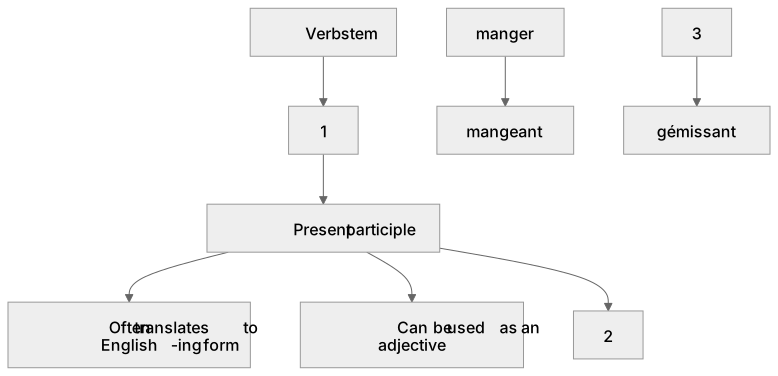
Label the diagram
Some boxes have lost their names. Pick the right name for each number.
1Box 1
2Box 2
3Box 3
There is more to this lesson
The full lesson goes on to check your understanding and help you earn the marks. Create a free account to carry on, with your progress saved.
A week of Premium from your first lesson · Then the free plan continues · No card, no charge
Test your understanding of Near-cognates: the termination [α˜] which can be added to the stem of listed verbs to give the present participle eg mangeant, gémissant.
Active recall beats re-reading. Take an instant quiz now to test what you’ve learned and lock it into long-term memory.
A week of Premium from your first lesson · Then the free plan continues · No card, no charge