AQA · GCSE · French
Course version: 8658 · Version from Sept 2016
This may be accompanied by some appropriate language (eg "Comme ça…"…
Full specification wording
Non-verbal strategies - Pointing and demonstration: This may be accompanied by some appropriate language (eg "Comme ça…" "Qu'est-ce que c'est ?" "Ça fait mal ici").
When using non-verbal strategies like pointing or demonstration during a speaking assessment, candidates should accompany their actions with appropriate spoken language to maintain communication.
- 4 key terms
Study notes
From the teaching notes for this specification point.
The idea
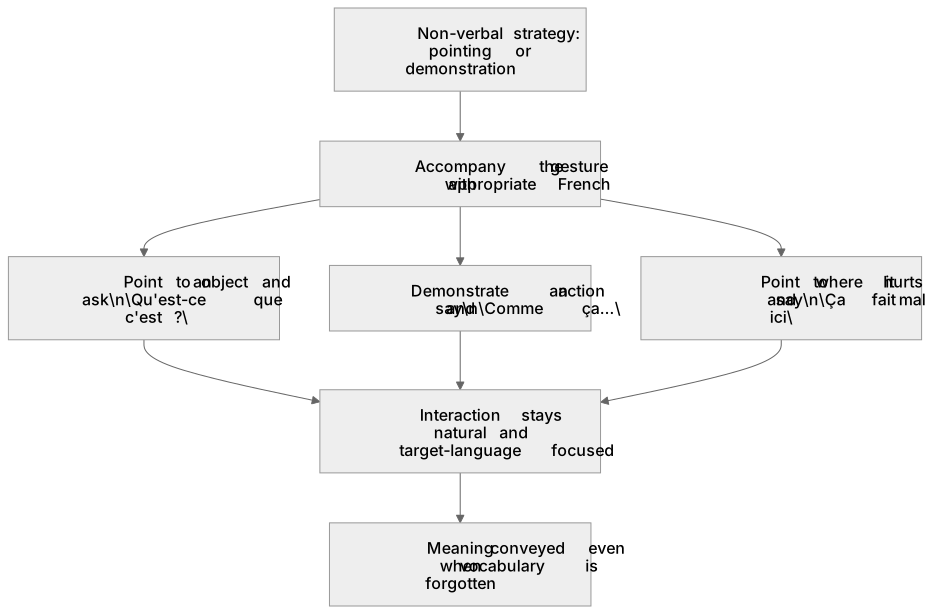
When using non-verbal strategies like pointing or demonstration during a speaking assessment, candidates should accompany their actions with appropriate spoken language to maintain communication. For example, a student might point to an object and ask "Qu'est-ce que c'est ?" (What is this?), demonstrate an action while saying "Comme ça…" (Like this...), or indicate a physical ailment by pointing and stating "Ça fait mal ici" (It hurts here). This combination of physical gesture and simple, relevant French phrases ensures that the interaction remains natural and target-language focused, allowing the candidate to successfully convey meaning even when specific vocabulary is temporarily forgotten.
What earns the marks
- Use of appropriate filler or demonstrative phrases in French to accompany gestures.
- Accurate pronunciation and intonation of phrases like "Comme ça…" or "Qu'est-ce que c'est ?".
- Successful communication of the intended meaning through a combination of words and actions.
- Maintenance of the target language even when specific vocabulary is lacking.
Common mistakes and how to put them right
Pointing in silence without using any French.
Put it right: Accompany pointing with a relevant phrase like "Comme ça…".
Asking the examiner for the word in English.
Put it right: Use a French phrase such as "Qu'est-ce que c'est ?" to ask for vocabulary.
Using incorrect grammar when indicating pain, such as saying "Je suis mal ici".
Put it right: Use the correct expression "Ça fait mal ici".
Exam tips
- Memorise key demonstrative phrases like "Comme ça…" to use alongside gestures in the speaking exam.
- If you need to ask the examiner a question, always use French phrases like "Qu'est-ce que c'est ?".
- Practice role-playing medical scenarios using "Ça fait mal ici" while pointing to different body parts.
Try the lesson
The start of the Non-verbal strategies - Pointing and demonstration: This may be accompanied by some appropriate language (eg "Comme ça…" "Qu'est-ce que c'est ?" "Ça fait mal ici"). lesson, made from teaching notes for this specification point.
Have a go first
Which French phrase is most appropriate to use when pointing at an unfamiliar object to ask what it is?
Listen
When using non-verbal strategies like pointing or demonstration during a speaking assessment, candidates should accompany their actions with appropriate spoken language to maintain communication. For example, a student might point to an object and ask "Qu'est-ce que c'est ? What is this?), demonstrate an action while saying "Comme ça… Like this...), or indicate a physical ailment by pointing and stating "Ça fait mal ici" (It hurts here). This combination of physical gesture and simple, relevant French phrases ensures that the interaction remains natural and target-language focused, allowing the candidate to successfully convey meaning even when specific vocabulary is temporarily forgotten. A strong answer earns marks for these points. Use of appropriate filler or demonstrative phrases in French to accompany gestures. Accurate pronunciation and intonation of phrases like "Comme ça… or "Qu'est-ce que c'est ? Successful communication of the intended meaning through a combination of words and actions. Maintenance of the target language even when specific vocabulary is lacking. A common slip: Pointing in silence without using any French. Instead, accompany pointing with a relevant phrase like "Comme ça… Exam tip: Memorise key demonstrative phrases like "Comme ça… to use alongside gestures in the speaking exam.
See it
Key words
Say what each word means before you turn the card.
Demonstrative language
Try answering aloud or in your head before turning the card.
Asking for clarification
Try answering aloud or in your head before turning the card.
Medical role-play
Try answering aloud or in your head before turning the card.
Combining gestures and speech
Try answering aloud or in your head before turning the card.
See every definition
- Demonstrative language
- Appropriate spoken language that may accompany pointing and demonstration, such as "Comme ça…".
- Asking for clarification
- Using a French phrase such as "Qu'est-ce que c'est ?" to ask for vocabulary instead of asking the examiner in English.
- Medical role-play
- Practising medical scenarios using "Ça fait mal ici" while pointing to different body parts.
- Combining gestures and speech
- Accompanying physical gesture with simple, relevant French phrases so that the interaction remains natural and target-language focused.
There is more to this lesson
The full lesson goes on to check your understanding and help you earn the marks. Create a free account to carry on, with your progress saved.
A week of Premium from your first lesson · Then the free plan continues · No card, no charge
Test your understanding of Non-verbal strategies - Pointing and demonstration: This may be accompanied by some appropriate language (eg "Comme ça…" "Qu'est-ce que c'est ?" "Ça fait mal ici").
Active recall beats re-reading. Take an instant quiz now to test what you’ve learned and lock it into long-term memory.
A week of Premium from your first lesson · Then the free plan continues · No card, no charge