AQA · GCSE · French
Course version: 8658 · Version from Sept 2016
Personal: all subjects, including on reflexive relative: qui relative: que…
Full specification wording
Pronouns: personal: all subjects, including on reflexive relative: qui relative: que (R)
Personal subject pronouns replace nouns as the subject of a verb, including 'je', 'tu', 'il', 'elle', 'on' (we/one), 'nous', 'vous', 'ils', and 'elles'.
- Point 1 of 3
- 4 key terms
Study notes
From the teaching notes for this specification point.
The idea
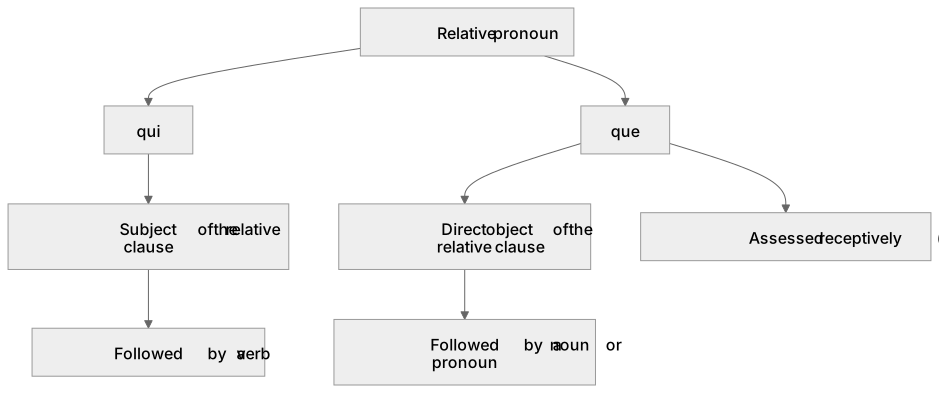
Personal subject pronouns replace nouns as the subject of a verb, including 'je', 'tu', 'il', 'elle', 'on' (we/one), 'nous', 'vous', 'ils', and 'elles'. Reflexive pronouns ('me', 'te', 'se', 'nous', 'vous', 'se') are used when the subject and object are the same, such as in 'je me lave' (I wash myself). Relative pronouns connect clauses. 'Qui' acts as the subject of the relative clause (e.g., 'le chien qui aboie' - the dog which barks).
What earns the marks
- Identify and translate all personal subject pronouns, including the indefinite pronoun 'on'.
- Recognise and apply reflexive pronouns matching the subject in reflexive verbs.
- Understand 'qui' as a relative pronoun functioning as the subject of a clause.
- Comprehend 'que' as a relative pronoun functioning as the direct object of a clause (receptive skill).
Common mistakes and how to put them right
Confusing 'qui' and 'que' based on English translations.
Put it right: Use 'qui' when it is followed by a verb (subject) and 'que' when followed by a noun or pronoun (object).
Forgetting to change the reflexive pronoun when conjugating a verb.
Put it right: Ensure the reflexive pronoun matches the subject (e.g., 'nous nous lavons', not 'nous se lavons').
Translating 'on' exclusively as 'one'.
Put it right: Recognise that 'on' is most frequently used in spoken French to mean 'we', taking a third-person singular verb.
Exam tips
- When reading, look at the word immediately following the relative pronoun to determine if 'qui' or 'que' is used.
- Remember that 'que' elides to 'qu'' before a vowel or silent h, whereas 'qui' never elides.
- Pay attention to the pronoun 'on' in listening tasks, as it often replaces 'nous' but sounds very different.
Try the lesson
The start of the Pronouns: personal: all subjects, including on reflexive relative: qui relative: que (R) lesson, made from teaching notes for this specification point.
Have a go first
Which subject pronoun correctly completes the sentence "___ va au cinéma" to mean "We are going to the cinema" in informal spoken French?
Listen
Personal subject pronouns replace nouns as the subject of a verb, including 'je', 'tu', 'il', 'elle', 'on' (we/one), 'nous', 'vous', 'ils', and 'elles'. Reflexive pronouns ('me', 'te', 'se', 'nous', 'vous', 'se') are used when the subject and object are the same, such as in 'je me lave' (I wash myself). Relative pronouns connect clauses. Qui' acts as the subject of the relative clause (e.g., 'le chien qui aboie' - the dog which barks). A strong answer earns marks for these points. Identify and translate all personal subject pronouns, including the indefinite pronoun 'on'. Recognise and apply reflexive pronouns matching the subject in reflexive verbs. Understand 'qui' as a relative pronoun functioning as the subject of a clause. Comprehend 'que' as a relative pronoun functioning as the direct object of a clause (receptive skill). A common slip: Confusing 'qui' and 'que' based on English translations. Instead, Use 'qui' when it is followed by a verb (subject) and 'que' when followed by a noun or pronoun (object). Exam tip: When reading, look at the word immediately following the relative pronoun to determine if 'qui' or 'que' is used.
See it
Key words
Say what each word means before you turn the card.
Personal identification
Try answering aloud or in your head before turning the card.
Reflexive actions
Try answering aloud or in your head before turning the card.
Sentence cohesion
Try answering aloud or in your head before turning the card.
Grammar and syntax
Try answering aloud or in your head before turning the card.
See every definition
- Personal identification
- All subjects, including 'on', are covered as personal subject pronouns that replace nouns as the subject of a verb.
- Reflexive actions
- Reflexive pronouns are used when the subject and object are the same, and the reflexive pronoun must match the subject.
- Sentence cohesion
- Relative pronouns connect clauses, with 'qui' acting as the subject of the relative clause and 'que' as the direct object.
- Grammar and syntax
- 'Que' is assessed receptively, so students must understand it in reading and listening but are not required to produce it.
Label the diagram
Some boxes have lost their names. Pick the right name for each number.
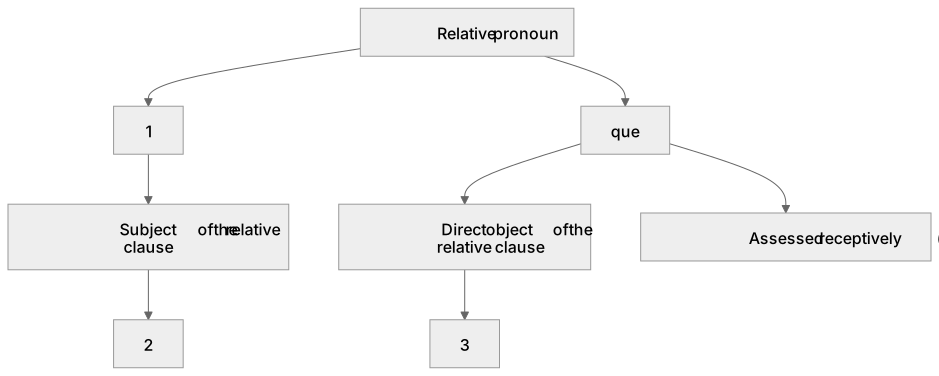
1Box 1
2Box 2
3Box 3
There is more to this lesson
The full lesson goes on to check your understanding and help you earn the marks. Create a free account to carry on, with your progress saved.
A week of Premium from your first lesson · Then the free plan continues · No card, no charge
Test your understanding of Pronouns: personal: all subjects, including on reflexive relative: qui relative: que (R)
Active recall beats re-reading. Take an instant quiz now to test what you’ve learned and lock it into long-term memory.
A week of Premium from your first lesson · Then the free plan continues · No card, no charge