AQA · GCSE · French
Course version: 8658 · Version from Sept 2016
Quantifiers/intensifiers: très, assez, beaucoup, peu, trop
Quantifiers and intensifiers modify adjectives, adverbs, or verbs to express degree or quantity.
- 4 key terms
Study notes
From the teaching notes for this specification point.
The idea
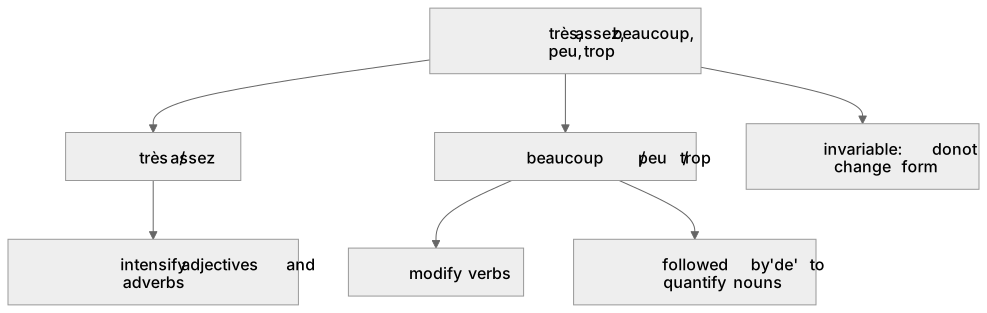
Quantifiers and intensifiers modify adjectives, adverbs, or verbs to express degree or quantity. 'Très' (very) and 'assez' (quite/enough) commonly intensify adjectives (e.g., c'est très grand, il est assez fatigué). 'Beaucoup' (a lot/much), 'peu' (little/few), and 'trop' (too much/too many) can modify verbs (e.g., je mange beaucoup) or, when followed by 'de', quantify nouns (e.g., trop de devoirs, peu de temps). These invariable words are essential for adding nuance to opinions, describing quantities accurately, and expressing excess or insufficiency in both spoken and written French.
What earns the marks
- Understand and apply 'très' and 'assez' to modify the intensity of adjectives and adverbs.
- Use 'beaucoup', 'peu', and 'trop' to modify verbs, indicating the extent of an action.
- Combine 'beaucoup', 'peu', and 'trop' with 'de' to quantify nouns accurately.
- Recognise that these quantifiers and intensifiers are invariable and do not change form.
Common mistakes and how to put them right
Adding an 's' to 'beaucoup' or 'trop' when referring to plural nouns, forgetting that they are invariable.
Using 'très beaucoup' to mean 'very much', whereas in French 'beaucoup' alone is sufficient or 'énormément' should be used.
Using 'des' instead of 'de' after quantifiers when followed by a plural noun, for example writing 'beaucoup des amis' instead of the correct 'beaucoup d'amis'.
Exam tips
- Always use 'de' or 'd'' immediately after 'beaucoup', 'peu', or 'trop' when a noun follows, regardless of whether the noun is plural.
- Use intensifiers like 'très' and 'assez' to upgrade your writing and speaking by adding detail to basic adjectives.
- Pay attention to 'trop' in listening tasks, as it often indicates a negative opinion or a problem.
Try the lesson
The start of the Quantifiers/intensifiers: très, assez, beaucoup, peu, trop lesson, made from teaching notes for this specification point.
Have a go first
What does the French quantifier "beaucoup" mean in English?
Listen
Quantifiers and intensifiers modify adjectives, adverbs, or verbs to express degree or quantity. Très' (very) and 'assez' (quite/enough) commonly intensify adjectives (e.g., c'est très grand, il est assez fatigué). Beaucoup' (a lot/much), 'peu' (little/few), and 'trop' (too much/too many) can modify verbs (e.g., je mange beaucoup) or, when followed by 'de', quantify nouns (e.g., trop de devoirs, peu de temps). These invariable words are essential for adding nuance to opinions, describing quantities accurately, and expressing excess or insufficiency in both spoken and written French. A strong answer earns marks for these points. Understand and apply 'très' and 'assez' to modify the intensity of adjectives and adverbs. Use 'beaucoup', 'peu', and 'trop' to modify verbs, indicating the extent of an action. Combine 'beaucoup', 'peu', and 'trop' with 'de' to quantify nouns accurately. Recognise that these quantifiers and intensifiers are invariable and do not change form. Exam tip: Always use 'de' or 'd'' immediately after 'beaucoup', 'peu', or 'trop' when a noun follows, regardless of whether the noun is plural.
See it
Key words
Say what each word means before you turn the card.
Expressing degree and intensity
Try answering aloud or in your head before turning the card.
Quantifying nouns
Try answering aloud or in your head before turning the card.
Modifying verbs
Try answering aloud or in your head before turning the card.
Adding nuance to opinions
Try answering aloud or in your head before turning the card.
See every definition
- Expressing degree and intensity
- Using words such as 'très' and 'assez' to modify the intensity of adjectives and adverbs.
- Quantifying nouns
- Combining 'beaucoup', 'peu' and 'trop' with 'de' to describe amounts of nouns accurately.
- Modifying verbs
- Using 'beaucoup', 'peu' and 'trop' to indicate the extent of an action.
- Adding nuance to opinions
- Using these invariable words to add nuance to opinions, describe quantities accurately and express excess or insufficiency.
Label the diagram
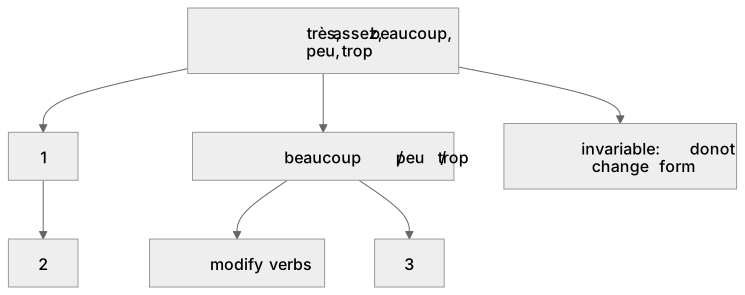
Some boxes have lost their names. Pick the right name for each number.
1Box 1
2Box 2
3Box 3
There is more to this lesson
The full lesson goes on to check your understanding and help you earn the marks. Create a free account to carry on, with your progress saved.
A week of Premium from your first lesson · Then the free plan continues · No card, no charge
Test your understanding of Quantifiers/intensifiers: très, assez, beaucoup, peu, trop
Active recall beats re-reading. Take an instant quiz now to test what you’ve learned and lock it into long-term memory.
A week of Premium from your first lesson · Then the free plan continues · No card, no charge