AQA · GCSE · French
Course version: 8658 · Version from Sept 2016
Identity and culture - Topic 3: Free-time activities: Food and eating out
Full specification wording
Theme 1: Identity and culture - Topic 3: Free-time activities: Food and eating out
This topic focuses on vocabulary and grammar for discussing food, meals, and eating out.
- Point 3 of 4
- 4 key terms
Study notes
From the teaching notes for this specification point.
The idea
This topic focuses on vocabulary and grammar for discussing food, meals, and eating out. You need to express preferences and dietary habits, such as being vegetarian (*être végétarien*). The topic also covers eating out, requiring knowledge of restaurant vocabulary like *la carte* (the menu), *l'addition* (the bill), and ordering phrases (e.g., *Je voudrais...*). Using the partitive article (*du*, *de la*, *des*) correctly when talking about quantities of food is essential.
For example: "Au restaurant, j'ai mangé du poulet, c'était délicieux." You must also understand descriptions of past and future dining.
What earns the marks
- Recognise vocabulary for different foods, drinks, and daily meals.
- Understand phrases related to ordering food and interacting in a restaurant setting.
- Identify positive and negative opinions about food and dining experiences.
- Distinguish between different quantities and partitive articles used with food items.
Common mistakes and how to put them right
Confusing *le menu* (set menu) with *la carte* (the full menu).
Put it right: *à la carte* means choosing individual items from the full selection.
Using the definite article instead of the partitive article when saying "some" (e.g., saying *Je mange le pain* instead of *Je mange du pain*).
Put it right: Use *du*, *de la*, or *des* for unspecified quantities.
Misunderstanding *le petit-déjeuner* as a small lunch.
Put it right: It specifically means breakfast, while *le déjeuner* is lunch.
Exam tips
- Revise transactional vocabulary for restaurants, as this frequently appears in listening and reading role-play scenarios.
- Pay close attention to adjectives describing food, such as *épicé* (spicy) or *froid* (cold), as they often hold the key to answering comprehension questions.
- Watch out for the negative form *ne... pas de* (e.g., *Je ne mange pas de viande*), which replaces the partitive article in negative sentences.
Try the lesson
The start of the Theme 1: Identity and culture - Topic 3: Free-time activities: Food and eating out lesson, made from teaching notes for this specification point.
Have a go first
Read the following sentence: "Je voudrais un steak-frites et une carafe d'eau, s'il vous plaît." What is the customer ordering in the restaurant?
Listen
This topic focuses on vocabulary and grammar for discussing food, meals, and eating out. You need to express preferences and dietary habits, such as being vegetarian (*être végétarien*). The topic also covers eating out, requiring knowledge of restaurant vocabulary like la carte (the menu), l'addition (the bill), and ordering phrases (e.g., *Je voudrais...*). Using the partitive article (*du*, de la, *des*) correctly when talking about quantities of food is essential. For example, "Au restaurant, j'ai mangé du poulet, c'était délicieux. You must also understand descriptions of past and future dining. A strong answer earns marks for these points. Recognise vocabulary for different foods, drinks, and daily meals. Understand phrases related to ordering food and interacting in a restaurant setting. Identify positive and negative opinions about food and dining experiences. Distinguish between different quantities and partitive articles used with food items. Exam tip: Revise transactional vocabulary for restaurants, as this frequently appears in listening and reading role-play scenarios.
See it

Key words
Say what each word means before you turn the card.
Food and drink vocabulary
Try answering aloud or in your head before turning the card.
Meals and dietary habits
Try answering aloud or in your head before turning the card.
Restaurant transactions
Try answering aloud or in your head before turning the card.
Expressing opinions on food
Try answering aloud or in your head before turning the card.
See every definition
- Food and drink vocabulary
- Words for naming various food items such as la viande and les légumes, meals such as le petit-déjeuner and le dîner, and drinks.
- Meals and dietary habits
- Language for expressing preferences and dietary habits, such as being vegetarian (être végétarien).
- Restaurant transactions
- Restaurant vocabulary such as la carte (the menu) and l'addition (the bill), plus ordering phrases such as Je voudrais...
- Expressing opinions on food
- Identifying positive and negative opinions about food and dining experiences, including adjectives describing food such as épicé or froid.
Label the diagram
Some boxes have lost their names. Pick the right name for each number.
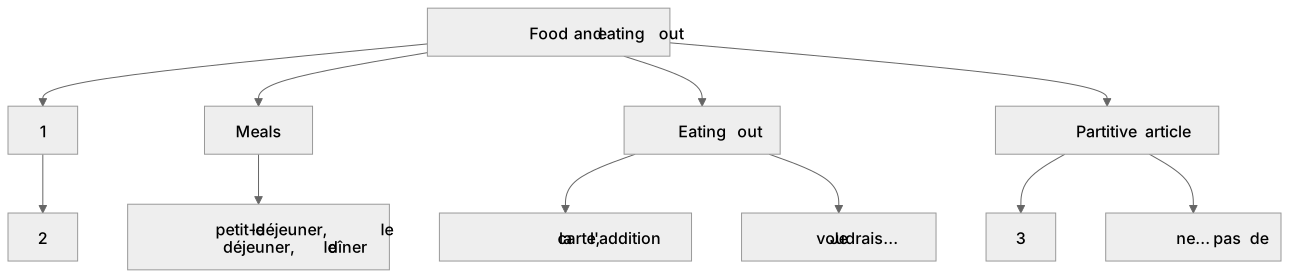
1Box 1
2Box 2
3Box 3
There is more to this lesson
The full lesson goes on to check your understanding and help you earn the marks. Create a free account to carry on, with your progress saved.
A week of Premium from your first lesson · Then the free plan continues · No card, no charge
Test your understanding of Theme 1: Identity and culture - Topic 3: Free-time activities: Food and eating out
Active recall beats re-reading. Take an instant quiz now to test what you’ve learned and lock it into long-term memory.
A week of Premium from your first lesson · Then the free plan continues · No card, no charge