AQA · GCSE · French
Course version: 8658 · Version from Sept 2016
A few 'false friends' (eg expérimenté, sensible, large) make it necessary…
Full specification wording
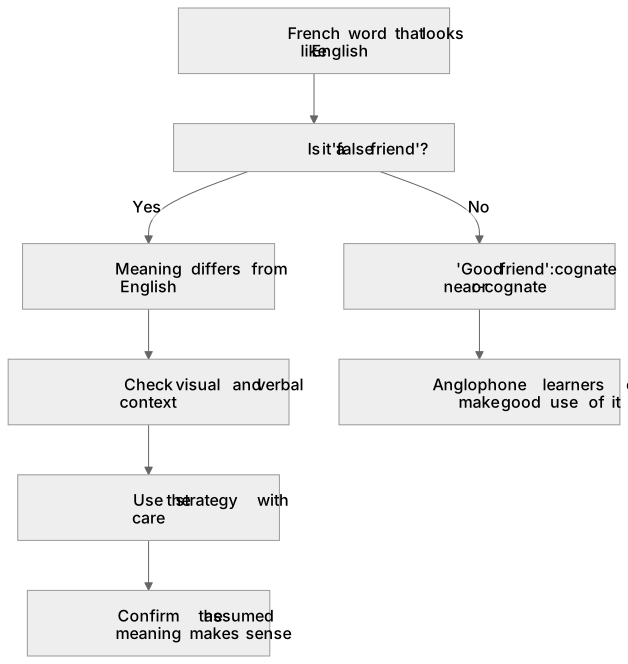
Using cognates and near-cognates: A few 'false friends' (eg expérimenté, sensible, large) make it necessary to use this strategy with care and in collaboration with the strategy of using the visual and verbal context above. However, for each 'false friend' there are very many 'good friends' of which anglophone learners of French can make good use. These fall into two main categories: cognates and near-cognates.
Teach the concept of 'false friends' (faux amis) alongside cognates and near-cognates.
- 3 key terms
Study notes
From the teaching notes for this specification point.
The idea
Teach the concept of 'false friends' (faux amis) alongside cognates and near-cognates. While many French words look like English words and share the same meaning ('good friends'), a few look similar but mean something different. For example, 'expérimenté' means 'experienced', 'sensible' means 'sensitive', and 'large' means 'wide'. Despite these exceptions, learners should actively use cognates and near-cognates, as these 'good friends' vastly outnumber the false ones and are highly useful for anglophone learners.
What earns the marks
- Identify 'false friends' as words that look similar in French and English but have different meanings.
- Translate 'expérimenté' correctly as 'experienced' rather than 'experimented'.
- Translate 'sensible' correctly as 'sensitive' rather than 'sensible'.
- Translate 'large' correctly as 'wide' rather than 'large'.
- Use surrounding verbal and visual context to verify the meaning of a potential cognate.
Common mistakes and how to put them right
Translating 'sensible' as 'sensible' in English.
Put it right: Translate it as 'sensitive' and use 'raisonnable' for 'sensible'.
Translating 'large' as 'large' (big).
Put it right: Translate it as 'wide' and use 'grand' or 'gros' for 'large'.
Ignoring the context of a sentence when guessing a word's meaning.
Put it right: Check if the cognate's meaning logically fits the sentence.
Exam tips
- Memorise common false friends like 'sensible', 'large', and 'expérimenté' to avoid easy traps in reading and listening exams.
- Always read the whole sentence before deciding on the meaning of a word that looks like English.
- Do not be afraid to guess the meaning of unfamiliar words that look like English, as most will be true cognates or near-cognates.
Try the lesson
The start of the Using cognates and near-cognates: A few 'false friends' (eg expérimenté, sensible, large) make it necessary to use this strategy with care and in collaboration with the strategy of using the visual and verbal context above. However, for each 'false friend' there are very many 'good friends' of which anglophone learners of French can make good use. These fall into two main categories: cognates and near-cognates. lesson, made from teaching notes for this specification point.
Have a go first
In French, the word 'sensible' is a 'false friend'. What is the correct English translation of 'sensible'?
Listen
Teach the concept of 'false friends' (faux amis) alongside cognates and near-cognates. While many French words look like English words and share the same meaning ('good friends'), a few look similar but mean something different. For example, 'expérimenté' means 'experienced', 'sensible' means 'sensitive', and 'large' means 'wide'. Despite these exceptions, learners should actively use cognates and near-cognates, as these 'good friends' vastly outnumber the false ones and are highly useful for anglophone learners. A strong answer earns marks for these points. Identify 'false friends' as words that look similar in French and English but have different meanings. Translate 'expérimenté' correctly as 'experienced' rather than 'experimented'. Translate 'sensible' correctly as 'sensitive' rather than 'sensible'. Translate 'large' correctly as 'wide' rather than 'large'. A common slip: Translating 'sensible' as 'sensible' in English. Instead, translate it as 'sensitive' and use 'raisonnable' for 'sensible'. Exam tip: Memorise common false friends like 'sensible', 'large', and 'expérimenté' to avoid easy traps in reading and listening exams.
See it
Key words
Say what each word means before you turn the card.
False friends (faux amis)
Try answering aloud or in your head before turning the card.
Cognates and near-cognates
Try answering aloud or in your head before turning the card.
Contextual deduction
Try answering aloud or in your head before turning the card.
See every definition
- False friends (faux amis)
- Words that look similar in French and English but have different meanings, so this strategy must be used with care.
- Cognates and near-cognates
- The two main categories of 'good friends' of which anglophone learners of French can make good use.
- Contextual deduction
- Using the visual and verbal context to check whether the assumed meaning of a word makes sense.
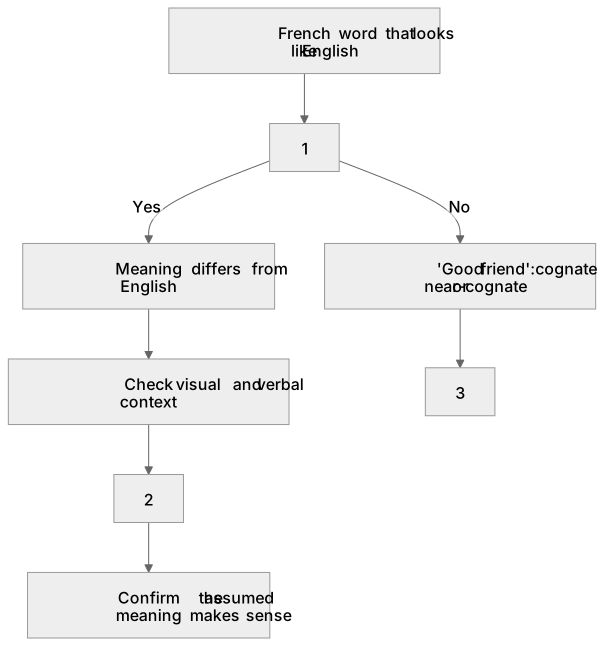
Label the diagram
Some boxes have lost their names. Pick the right name for each number.
1Box 1
2Box 2
3Box 3
There is more to this lesson
The full lesson goes on to check your understanding and help you earn the marks. Create a free account to carry on, with your progress saved.
A week of Premium from your first lesson · Then the free plan continues · No card, no charge
Test your understanding of Using cognates and near-cognates: A few 'false friends' (eg expérimenté, sensible, large) make it necessary to use this strategy with care and in collaboration with the strategy of using the visual and verbal context above. However, for each 'false friend' there are very many 'good friends' of which anglophone learners of French can make good use. These fall into two main categories: cognates and near-cognates.
Active recall beats re-reading. Take an instant quiz now to test what you’ve learned and lock it into long-term memory.
A week of Premium from your first lesson · Then the free plan continues · No card, no charge