AQA · GCSE · French
Course version: 8658 · Version from Sept 2016
There are many words which have the same form and essentially the same…
Full specification wording
Using cognates and near-cognates - Cognates: There are many words which have the same form and essentially the same meaning in French and in English (eg innocent, justice, muscle, rectangle). When such words occur in context, students can be expected to understand them in English and French.
Teach the concept of exact cognates, which are words that have the same form and essentially the same meaning in both French and English.
- 2 key terms
Study notes
From the teaching notes for this specification point.
The idea
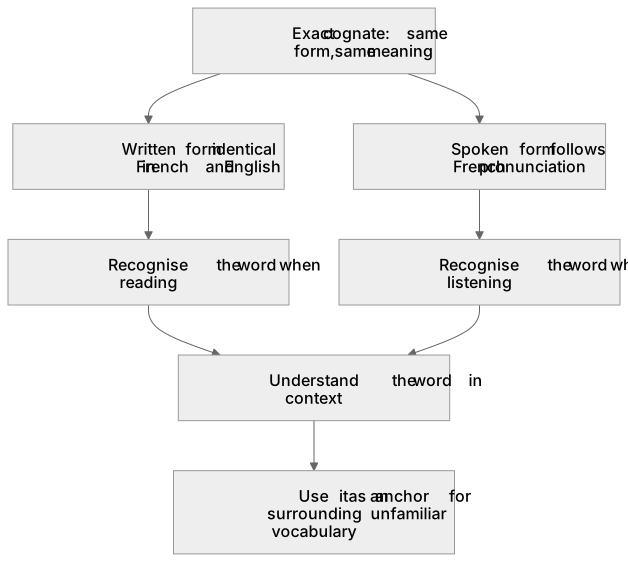
Teach the concept of exact cognates, which are words that have the same form and essentially the same meaning in both French and English. The specification highlights examples such as 'innocent', 'justice', 'muscle', and 'rectangle'. When such words occur in context, students can be expected to understand them in both English and French without needing prior vocabulary memorisation. Recognising these cognates is a powerful strategy for boosting reading comprehension.
What earns the marks
- Define exact cognates as words with identical spelling and meaning in both languages.
- Recognise and translate exact cognates like 'innocent', 'justice', 'muscle', and 'rectangle' without hesitation.
- Apply knowledge of exact cognates to deduce the overall meaning of a sentence or text.
- Differentiate between the written form (identical) and the spoken form (different pronunciation) of exact cognates.
Common mistakes and how to put them right
Mispronouncing exact cognates in speaking exams by using the English pronunciation.
Put it right: Apply French phonics (e.g., nasal vowels in 'innocent').
Failing to recognise a cognate in a listening exam due to its French pronunciation.
Put it right: Familiarise yourself with how French vowels and consonants sound in familiar words.
Overlooking exact cognates when scanning a text for information because they blend in with English thought processes.
Put it right: Actively spot them to anchor your understanding of the text.
Exam tips
- Use exact cognates as anchor words to help you understand the surrounding, more difficult vocabulary in a reading passage.
- When listening, pay attention to the context, as a word like 'justice' will sound different but means the same thing.
- Incorporate exact cognates into your writing to easily expand your vocabulary without needing to learn new spellings.
Try the lesson
The start of the Using cognates and near-cognates - Cognates: There are many words which have the same form and essentially the same meaning in French and in English (eg innocent, justice, muscle, rectangle). When such words occur in context, students can be expected to understand them in English and French. lesson, made from teaching notes for this specification point.
Have a go first
Read the following description: *La table dans la salle à manger est un grand rectangle.*
What shape is the table?
Listen
Teach the concept of exact cognates, which are words that have the same form and essentially the same meaning in both French and English. The specification highlights examples such as 'innocent', 'justice', 'muscle', and 'rectangle'. When such words occur in context, students can be expected to understand them in both English and French without needing prior vocabulary memorisation. Recognising these cognates is a powerful strategy for boosting reading comprehension. A strong answer earns marks for these points. Define exact cognates as words with identical spelling and meaning in both languages. Recognise and translate exact cognates like 'innocent', 'justice', 'muscle', and 'rectangle' without hesitation. Apply knowledge of exact cognates to deduce the overall meaning of a sentence or text. Differentiate between the written form (identical) and the spoken form (different pronunciation) of exact cognates. A common slip: Mispronouncing exact cognates in speaking exams by using the English pronunciation. Instead, apply French phonics (e.g., nasal vowels in 'innocent'). Exam tip: Use exact cognates as anchor words to help you understand the surrounding, more difficult vocabulary in a reading passage.
See it
Key words
Say what each word means before you turn the card.
Exact cognates
Try answering aloud or in your head before turning the card.
Pronunciation differences
Try answering aloud or in your head before turning the card.
See every definition
- Exact cognates
- Words which have the same form and essentially the same meaning in French and in English, such as innocent, justice, muscle and rectangle.
- Pronunciation differences
- The written form of an exact cognate is identical, but the pronunciation in French will follow French phonetic rules.
Label the diagram
Some boxes have lost their names. Pick the right name for each number.
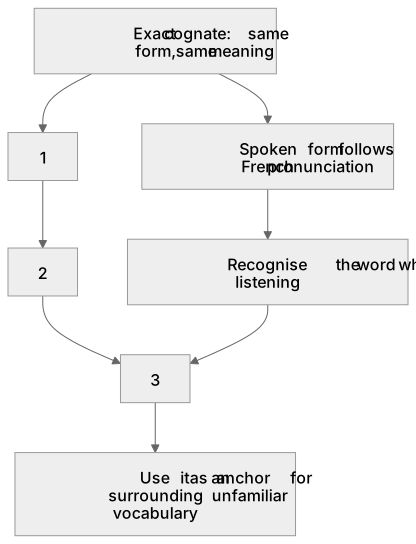
1Box 1
2Box 2
3Box 3
There is more to this lesson
The full lesson goes on to check your understanding and help you earn the marks. Create a free account to carry on, with your progress saved.
A week of Premium from your first lesson · Then the free plan continues · No card, no charge
Test your understanding of Using cognates and near-cognates - Cognates: There are many words which have the same form and essentially the same meaning in French and in English (eg innocent, justice, muscle, rectangle). When such words occur in context, students can be expected to understand them in English and French.
Active recall beats re-reading. Take an instant quiz now to test what you’ve learned and lock it into long-term memory.
A week of Premium from your first lesson · Then the free plan continues · No card, no charge