AQA · GCSE · French
Course version: 8658 · Version from Sept 2016
Il donne/ils donnent: il chantait/ils chantaient
Full specification wording
Using common patterns between French and English: il donne/ils donnent: il chantait/ils chantaient
Distinguishing between third-person singular and plural verb forms in spoken French is challenging because they often sound identical.
- Point 7 of 9
- 4 key terms
Study notes
From the teaching notes for this specification point.
The idea
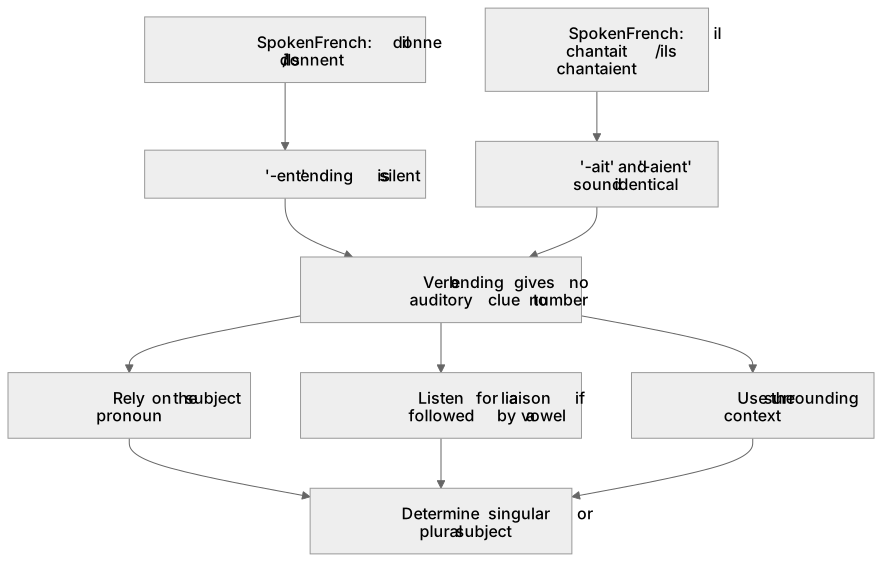
Distinguishing between third-person singular and plural verb forms in spoken French is challenging because they often sound identical. For regular '-er' verbs in the present tense, like 'il donne' and 'ils donnent', the '-ent' ending is completely silent. Similarly, in the imperfect tense, 'il chantait' and 'ils chantaient' share the exact same pronunciation, as both '-ait' and '-aient' produce an identical sound.
What earns the marks
- Identify that the '-ent' ending on third-person plural verbs is silent.
- Recognise that 'il donne' and 'ils donnent' have the exact same pronunciation.
- Understand that imperfect endings '-ait' and '-aient' sound identical.
- Use context or liaisons to distinguish between singular and plural subjects in spoken French.
Common mistakes and how to put them right
Pronouncing the '-ent' ending in 'ils donnent' like the adverb ending '-ment'. (Correction.
Put it right: The '-ent' ending on verbs is always silent).
Assuming 'il' and 'ils' always sound different. (Correction.
Put it right: Before a consonant, 'il' and 'ils' sound identical; they only differ if 'ils' makes a liaison with a following vowel).
Misinterpreting 'ils chantaient' as singular in a listening task. (Correction.
Put it right: Rely on context clues to determine if the subject is plural when the verb sounds identical).
Exam tips
- When listening, pay close attention to liaisons after 'ils' or 'elles' to identify plural subjects before verbs starting with a vowel.
- Use surrounding context, such as plural nouns or adjectives, to determine if a verb like 'donne' or 'donnent' is singular or plural.
- Remember that in reading tasks, the silent '-ent' is your visual cue for a plural subject, even if it does not change the sound.
Try the lesson
The start of the Using common patterns between French and English: il donne/ils donnent: il chantait/ils chantaient lesson, made from teaching notes for this specification point.
Have a go first
Which form correctly completes the sentence « Ils ___ une chanson » (they are singing a song)?
Listen
Distinguishing between third-person singular and plural verb forms in spoken French is challenging because they often sound identical. For regular '-er' verbs in the present tense, like 'il donne' and 'ils donnent', the '-ent' ending is completely silent. Similarly, in the imperfect tense, 'il chantait' and 'ils chantaient' share the exact same pronunciation, as both '-ait' and '-aient' produce an identical sound. A strong answer earns marks for these points. Identify that the '-ent' ending on third-person plural verbs is silent. Recognise that 'il donne' and 'ils donnent' have the exact same pronunciation. Understand that imperfect endings '-ait' and '-aient' sound identical. Use context or liaisons to distinguish between singular and plural subjects in spoken French. Exam tip: When listening, pay close attention to liaisons after 'ils' or 'elles' to identify plural subjects before verbs starting with a vowel.
See it
Key words
Say what each word means before you turn the card.
Singular versus plural distinction
Try answering aloud or in your head before turning the card.
Verb conjugations
Try answering aloud or in your head before turning the card.
Listening comprehension strategies
Try answering aloud or in your head before turning the card.
Phonetics and pronunciation
Try answering aloud or in your head before turning the card.
See every definition
- Singular versus plural distinction
- Telling whether the subject is singular or plural, which is hard in spoken French because third-person singular and plural verb forms often sound identical.
- Verb conjugations
- Forms such as 'il donne' and 'ils donnent', where the '-ent' ending is completely silent, and 'il chantait' and 'ils chantaient', which share the exact same pronunciation.
- Listening comprehension strategies
- Relying entirely on the subject pronoun, listening for a liaison if followed by a vowel, or the surrounding context to determine whether the subject is singular or plural.
- Phonetics and pronunciation
- The '-ent' ending is completely silent, and the imperfect endings '-ait' and '-aient' produce an identical sound.
Label the diagram
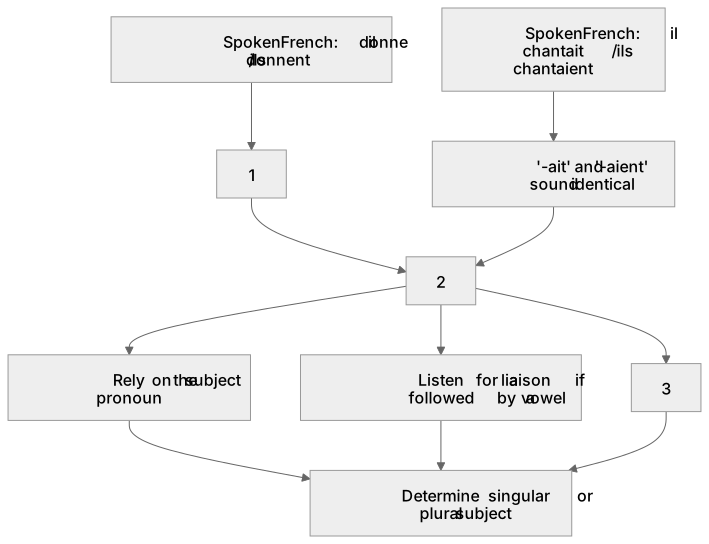
Some boxes have lost their names. Pick the right name for each number.
1Box 1
2Box 2
3Box 3
There is more to this lesson
The full lesson goes on to check your understanding and help you earn the marks. Create a free account to carry on, with your progress saved.
A week of Premium from your first lesson · Then the free plan continues · No card, no charge
Test your understanding of Using common patterns between French and English: il donne/ils donnent: il chantait/ils chantaient
Active recall beats re-reading. Take an instant quiz now to test what you’ve learned and lock it into long-term memory.
A week of Premium from your first lesson · Then the free plan continues · No card, no charge