AQA · GCSE · French
Course version: 8658 · Version from Sept 2016
Il vend/ils vendent: il finit/ils finissent.
Full specification wording
Using common patterns between French and English: il vend/ils vendent: il finit/ils finissent.
This statement highlights specific examples where a pronounced consonant distinguishes the third-person plural from the singular in spoken French.
- Point 9 of 9
- 4 key terms
Study notes
From the teaching notes for this specification point.
The idea
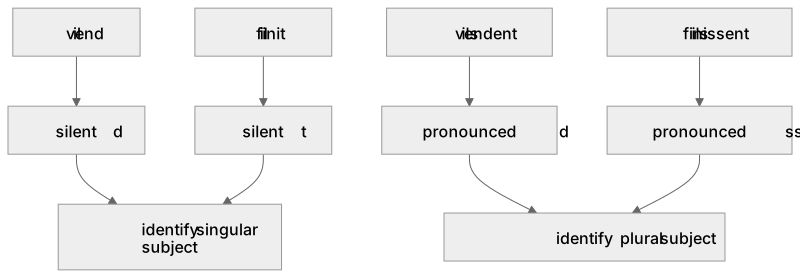
This statement highlights specific examples where a pronounced consonant distinguishes the third-person plural from the singular in spoken French. For regular '-re' verbs like 'vendre', the singular 'il vend' ends in a silent 'd'. However, in the plural 'ils vendent', the 'd' is clearly pronounced before the silent '-ent'. Similarly, for regular '-ir' verbs like 'finir', the singular 'il finit' ends with a silent 't', whereas the plural 'ils finissent' introduces a distinct 'ss' sound. Recognising these auditory differences—hearing the 'd' in 'vendent' or the 'ss' in 'finissent'—is essential for students to correctly identify plural subjects in listening tasks, as the pronouns 'il' and 'ils' often sound identical before consonants.
What earns the marks
- Identify that the 'd' in 'il vend' is silent, while the 'd' in 'ils vendent' is pronounced.
- Recognise that 'il finit' ends with a silent 't', whereas 'ils finissent' contains a pronounced 'ss' sound.
- Use these specific consonant sounds to distinguish between singular and plural subjects in listening tasks.
- Understand that the '-ent' ending itself remains silent, but causes the preceding consonant to be pronounced.
Common mistakes and how to put them right
Pronouncing the 't' in 'il finit' or the 'd' in 'il vend'. (Correction.
Put it right: These final consonants are silent in the singular forms).
Failing to hear the 'ss' in 'ils finissent' and translating it as 'he finishes'. (Correction.
Put it right: Train your ear to catch the 'ss' sound which marks the plural form of regular '-ir' verbs).
Pronouncing the '-ent' in 'ils vendent' or 'ils finissent'. (Correction.
Put it right: The '-ent' is silent; it merely forces the pronunciation of the preceding consonant).
Exam tips
- When you hear a 'd' sound at the end of a verb like 'vendre', immediately recognise it as the plural 'ils vendent' or 'elles vendent'.
- Listen for the distinct 'ss' sound in verbs like 'choisir' or 'finir' to correctly identify the 'ils' or 'elles' form.
- Cross-reference the verb sound with the rest of the sentence to confirm whether the subject is singular or plural.
Try the lesson
The start of the Using common patterns between French and English: il vend/ils vendent: il finit/ils finissent. lesson, made from teaching notes for this specification point.
Have a go first
When listening to spoken French, how can you distinguish between the singular verb *il finit* and the plural verb *ils finissent*?
Listen
This statement highlights specific examples where a pronounced consonant distinguishes the third-person plural from the singular in spoken French. For regular '-re' verbs like 'vendre', the singular 'il vend' ends in a silent 'd'. However, in the plural 'ils vendent', the 'd' is clearly pronounced before the silent '-ent'. Similarly, for regular '-ir' verbs like 'finir', the singular 'il finit' ends with a silent 't', whereas the plural 'ils finissent' introduces a distinct 'ss' sound. Recognising these auditory differences—hearing the 'd' in 'vendent' or the 'ss' in 'finissent'—is essential for students to correctly identify plural subjects in listening tasks, as the pronouns 'il' and 'ils' often sound identical before consonants. A strong answer earns marks for these points. Identify that the 'd' in 'il vend' is silent, while the 'd' in 'ils vendent' is pronounced. Recognise that 'il finit' ends with a silent 't', whereas 'ils finissent' contains a pronounced 'ss' sound. Use these specific consonant sounds to distinguish between singular and plural subjects in listening tasks. Understand that the '-ent' ending itself remains silent, but causes the preceding consonant to be pronounced. Exam tip: When you hear a 'd' sound at the end of a verb like 'vendre', immediately recognise it as the plural 'ils vendent' or 'elles vendent'.
See it
Key words
Say what each word means before you turn the card.
Phonetics and pronunciation
Try answering aloud or in your head before turning the card.
Regular '-ir' and '-re' verbs
Try answering aloud or in your head before turning the card.
Listening comprehension strategies
Try answering aloud or in your head before turning the card.
Singular versus plural distinction
Try answering aloud or in your head before turning the card.
See every definition
- Phonetics and pronunciation
- The auditory differences in spoken French, such as hearing the 'd' in 'vendent' or the 'ss' in 'finissent', which are essential for correctly identifying plural subjects in listening tasks.
- Regular '-ir' and '-re' verbs
- Verb groups where the singular form ends in a silent consonant, as in 'il vend' with a silent 'd' and 'il finit' with a silent 't', while the plural introduces a pronounced consonant.
- Listening comprehension strategies
- Recognising specific consonant sounds, such as the 'd' in 'vendent' or the 'ss' in 'finissent', to distinguish between singular and plural subjects when the pronouns 'il' and 'ils' often sound identical before consonants.
- Singular versus plural distinction
- The contrast in which the '-ent' ending itself remains silent but causes the preceding consonant to be pronounced, so the 'd' in 'ils vendent' and the 'ss' in 'ils finissent' mark the plural.
Label the diagram
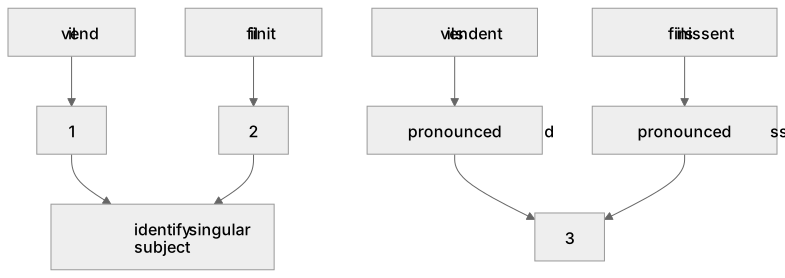
Some boxes have lost their names. Pick the right name for each number.
1Box 1
2Box 2
3Box 3
There is more to this lesson
The full lesson goes on to check your understanding and help you earn the marks. Create a free account to carry on, with your progress saved.
A week of Premium from your first lesson · Then the free plan continues · No card, no charge
Test your understanding of Using common patterns between French and English: il vend/ils vendent: il finit/ils finissent.
Active recall beats re-reading. Take an instant quiz now to test what you’ve learned and lock it into long-term memory.
A week of Premium from your first lesson · Then the free plan continues · No card, no charge