AQA · GCSE · French
Course version: 8658 · Version from Sept 2016
Verbs: conditional: vouloir and aimer
The conditional tense is used to express what would happen or what you would like to do.
- Point 8 of 20
- 4 key terms
Study notes
From the teaching notes for this specification point.
The idea
The conditional tense is used to express what would happen or what you would like to do. For this specification, you must be able to use and understand the conditional forms of 'vouloir' (to want) and 'aimer' (to like/love). These are highly useful for expressing polite requests, desires, and preferences. The stem for 'vouloir' is 'voudr-' and for 'aimer' it is 'aimer-'. The conditional endings are -ais, -ais, -ait, -ions, -iez, -aient. Therefore, 'je voudrais' translates to 'I would like' (often used when ordering food or buying tickets), and 'j'aimerais' translates to 'I would like' or 'I would love' (often used to express a wish, such as 'j'aimerais visiter Paris').
What earns the marks
- Forms the conditional of 'vouloir' using the stem 'voudr-' and the correct imperfect endings.
- Forms the conditional of 'aimer' using the infinitive 'aimer-' and the correct imperfect endings.
- Translates 'je voudrais' accurately as 'I would like' in the context of requests.
- Translates 'j'aimerais' accurately as 'I would like' or 'I would love' in the context of desires.
Common mistakes and how to put them right
Confusing 'je voudrais' (I would like) with 'je veux' (I want).
Put it right by using the conditional for polite requests.
Misspelling the stem of 'vouloir' in the conditional as 'voulr-'.
Put it right by memorising the irregular stem 'voudr-'.
Pronouncing the conditional ending '-ais' as '-a'.
Put it right by pronouncing it with an open 'e' sound, similar to the English word 'pet'.
Exam tips
- Use 'je voudrais' followed by a noun or an infinitive when ordering food or buying items in role-play tasks.
- Use 'j'aimerais' followed by an infinitive to express future wishes or ambitions in writing and speaking tasks.
- Pay attention to the pronunciation of the '-ais' ending in speaking exams to distinguish it from the future tense '-ai' ending.
Try the lesson
The start of the Verbs: conditional: vouloir and aimer lesson, made from teaching notes for this specification point.
Have a go first
What is the correct English translation of the phrase "Je voudrais un café"?
Listen
The conditional tense is used to express what would happen or what you would like to do. For this specification, you must be able to use and understand the conditional forms of 'vouloir' (to want) and 'aimer' (to like/love). These are highly useful for expressing polite requests, desires, and preferences. The stem for 'vouloir' is 'voudr-' and for 'aimer' it is 'aimer-'. The conditional endings are -ais, -ais, -ait, -ions, -iez, -aient. Therefore, 'je voudrais' translates to 'I would like' (often used when ordering food or buying tickets), and 'j'aimerais' translates to 'I would like' or 'I would love' (often used to express a wish, such as 'j'aimerais visiter Paris'). A strong answer earns marks for these points. Forms the conditional of 'vouloir' using the stem 'voudr-' and the correct imperfect endings. Forms the conditional of 'aimer' using the infinitive 'aimer-' and the correct imperfect endings. Translates 'je voudrais' accurately as 'I would like' in the context of requests. Translates 'j'aimerais' accurately as 'I would like' or 'I would love' in the context of desires. A common slip: Confusing 'je voudrais' (I would like) with 'je veux' (I want). Instead, using the conditional for polite requests. Exam tip: Use 'je voudrais' followed by a noun or an infinitive when ordering food or buying items in role-play tasks.
See it
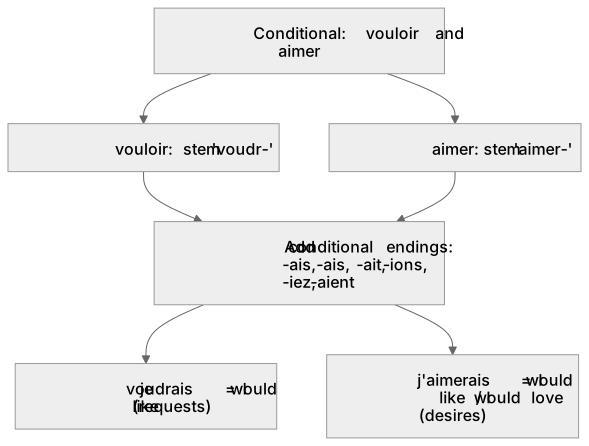
Key words
Say what each word means before you turn the card.
Polite requests
Try answering aloud or in your head before turning the card.
Expressing desires and preferences
Try answering aloud or in your head before turning the card.
Verb morphology
Try answering aloud or in your head before turning the card.
Role-play and transactional language
Try answering aloud or in your head before turning the card.
See every definition
- Polite requests
- The conditional forms of 'vouloir' and 'aimer' are highly useful for expressing polite requests, such as 'je voudrais' when ordering food or buying tickets.
- Expressing desires and preferences
- The conditional forms of 'vouloir' and 'aimer' are highly useful for expressing desires and preferences, with 'j'aimerais' often used to express a wish.
- Verb morphology
- The stem for 'vouloir' is 'voudr-' and for 'aimer' it is 'aimer-', with the conditional endings -ais, -ais, -ait, -ions, -iez, -aient.
- Role-play and transactional language
- 'Je voudrais' is often used when ordering food or buying tickets, and can be followed by a noun or an infinitive in role-play tasks.
Label the diagram
Some boxes have lost their names. Pick the right name for each number.
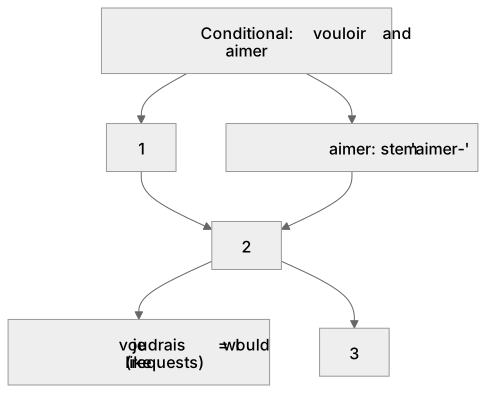
1Box 1
2Box 2
3Box 3
There is more to this lesson
The full lesson goes on to check your understanding and help you earn the marks. Create a free account to carry on, with your progress saved.
A week of Premium from your first lesson · Then the free plan continues · No card, no charge
Test your understanding of Verbs: conditional: vouloir and aimer
Active recall beats re-reading. Take an instant quiz now to test what you’ve learned and lock it into long-term memory.
A week of Premium from your first lesson · Then the free plan continues · No card, no charge