AQA · GCSE · French
Course version: 8658 · Version from Sept 2016
Verbs: imperfect
The imperfect tense (l'imparfait) is used to describe past states, habits, and ongoing actions without a defined end.
- Point 14 of 20
- 4 key terms
Study notes
From the teaching notes for this specification point.
The idea
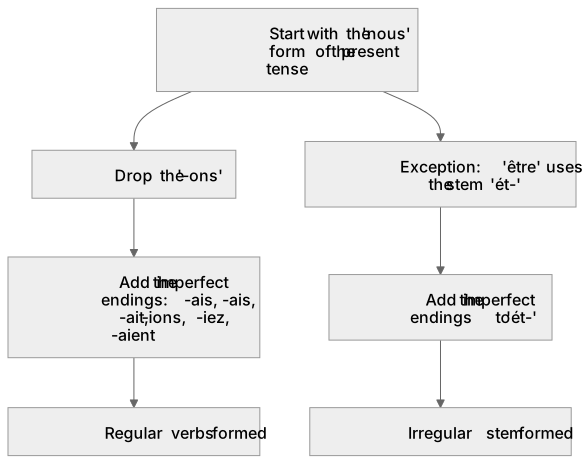
The imperfect tense (l'imparfait) is used to describe past states, habits, and ongoing actions without a defined end. It translates to 'was/were doing' or 'used to do'. To form it, take the 'nous' form of the present tense, drop the '-ons', and add the imperfect endings: -ais, -ais, -ait, -ions, -iez, -aient. For example, 'nous parlons' becomes 'je parlais' (I was speaking / I used to speak). The only irregular stem is 'être', which uses the stem 'ét-' (e.g., 'j'étais' - I was). It is essential for setting the scene in past narratives, often used alongside the perfect tense which describes specific, completed actions, providing background details like weather or emotions.
What earns the marks
- Identify the imperfect tense in reading and listening texts to understand past habits or descriptions.
- Form the imperfect tense correctly using the 'nous' stem of the present tense.
- Apply the correct imperfect endings (-ais, -ais, -ait, -ions, -iez, -aient) to regular and irregular verbs.
- Recognise and use the irregular imperfect stem for 'être' (ét-).
- Distinguish between the use of the imperfect for descriptions or habits and the perfect tense for completed actions.
Common mistakes and how to put them right
Using the infinitive stem instead of the 'nous' present tense stem (e.g., writing 'je finissais' as 'je finais').
Put it right: Derive the stem from the 'nous' form of the present tense (nous finissons -> finiss-).
Confusing the imperfect endings with conditional endings.
Put it right: The imperfect is added to the present 'nous' stem, while the conditional is added to the future stem.
Overusing the imperfect for completed past actions.
Put it right: Use the perfect tense for specific, completed events and the imperfect for background descriptions or habits.
Exam tips
- Look for time markers like 'souvent', 'tous les jours', or 'quand j'étais jeune' as clues that the imperfect tense is required.
- When writing a past narrative, use the imperfect to set the scene and the perfect tense for the main events.
- Memorise the 'être' imperfect paradigm ('j'étais', 'tu étais', etc.) as it is highly frequent in exams.
Try the lesson
The start of the Verbs: imperfect lesson, made from teaching notes for this specification point.
Have a go first
Which of the following sentences correctly uses the imperfect tense to describe a past habit?
Listen
The imperfect tense (l'imparfait) is used to describe past states, habits, and ongoing actions without a defined end. It translates to 'was/were doing' or 'used to do'. To form it, take the 'nous' form of the present tense, drop the '-ons', and add the imperfect endings: -ais, -ais, -ait, -ions, -iez, -aient. For example, 'nous parlons' becomes 'je parlais' (I was speaking / I used to speak). The only irregular stem is 'être', which uses the stem 'ét-' (e.g., 'j'étais' - I was). It is essential for setting the scene in past narratives, often used alongside the perfect tense which describes specific, completed actions, providing background details like weather or emotions. A strong answer earns marks for these points. Identify the imperfect tense in reading and listening texts to understand past habits or descriptions. Form the imperfect tense correctly using the 'nous' stem of the present tense. Apply the correct imperfect endings (-ais, -ais, -ait, -ions, -iez, -aient) to regular and irregular verbs. Recognise and use the irregular imperfect stem for 'être' (ét-). A common slip: Using the infinitive stem instead of the 'nous' present tense stem (e.g., writing 'je finissais' as 'je finais'). Instead, derive the stem from the 'nous' form of the present tense (nous finissons -> finiss-). Exam tip: Look for time markers like 'souvent', 'tous les jours', or 'quand j'étais jeune' as clues that the imperfect tense is required.
See it
Key words
Say what each word means before you turn the card.
Past habits and routines
Try answering aloud or in your head before turning the card.
Descriptions in the past
Try answering aloud or in your head before turning the card.
Verb formation and stems
Try answering aloud or in your head before turning the card.
Tense contrast
Try answering aloud or in your head before turning the card.
See every definition
- Past habits and routines
- The imperfect tense is used to describe past states, habits, and ongoing actions without a defined end, translating to 'used to do'.
- Descriptions in the past
- It is essential for setting the scene in past narratives, providing background details like weather or emotions.
- Verb formation and stems
- Take the 'nous' form of the present tense, drop the '-ons', and add the imperfect endings, with 'ét-' as the only irregular stem for 'être'.
- Tense contrast
- The imperfect is often used alongside the perfect tense, which describes specific, completed actions.
Label the diagram
Some boxes have lost their names. Pick the right name for each number.
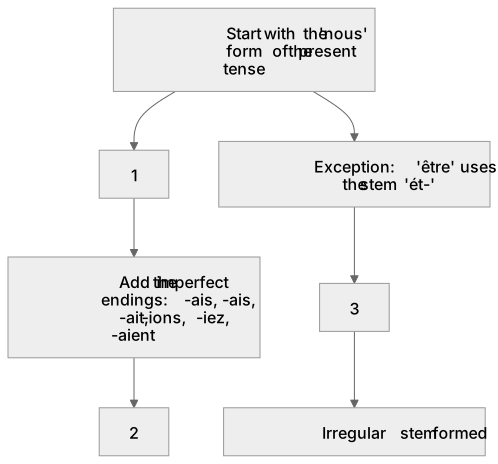
1Box 1
2Box 2
3Box 3
There is more to this lesson
The full lesson goes on to check your understanding and help you earn the marks. Create a free account to carry on, with your progress saved.
A week of Premium from your first lesson · Then the free plan continues · No card, no charge
Test your understanding of Verbs: imperfect
Active recall beats re-reading. Take an instant quiz now to test what you’ve learned and lock it into long-term memory.
A week of Premium from your first lesson · Then the free plan continues · No card, no charge