AQA · GCSE · French
Course version: 8658 · Version from Sept 2016
Verbs: passive voice: present tense (R)
The passive voice changes the focus of a sentence from the person doing the action to the person or thing receiving the action.
- Point 10 of 20
Study notes
From the teaching notes for this specification point.
The idea
The passive voice changes the focus of a sentence from the person doing the action to the person or thing receiving the action. For this specification, you only need to recognise the passive voice in the present tense during reading and listening tasks (receptive use). It is formed using the present tense of the verb 'être' (suis, es, est, sommes, êtes, sont) followed by a past participle. The past participle must agree in gender and number with the subject. The agent (who is doing the action) is often introduced by the preposition 'par' (by).
For example: In the sentence 'La porte est ouverte par le professeur' (The door is opened by the teacher), 'est ouverte' is the present passive.
What earns the marks
- Identifies the present tense of the verb 'être' used as an auxiliary.
- Recognises the past participle following 'être' and its agreement with the subject.
- Identifies the preposition 'par' introducing the agent of the passive action.
- Translates the present passive voice accurately into English (e.g., 'is done', 'are made').
Common mistakes and how to put them right
Confusing the present passive with the perfect tense (passé composé) of verbs taking 'être'.
Put it right by checking if the verb is a verb of motion/change of state or if there is an agent introduced by 'par'.
Ignoring the past participle agreement.
Put it right by recognising that in the passive voice, the past participle always agrees with the subject in gender and number.
Translating the present passive as a past tense.
Put it right by noting that the auxiliary 'être' is in the present tense, so the translation must be present (e.g., 'is eaten', not 'was eaten').
Exam tips
- Look for the combination of 'être' in the present tense, a past participle, and the word 'par' to quickly identify the passive voice.
- Remember that the passive voice is often used in formal texts, such as news reports or historical accounts, in reading exams.
- Do not confuse the present passive (e.g., 'il est fermé' - it is closed) with the perfect tense of 'être' verbs (e.g., 'il est allé' - he went).
Try the lesson
The start of the Verbs: passive voice: present tense (R) lesson, made from teaching notes for this specification point.
Have a go first
What is the correct English translation of the following sentence? "Les portes sont fermées à 20h00."
Listen
The passive voice changes the focus of a sentence from the person doing the action to the person or thing receiving the action. For this specification, you only need to recognise the passive voice in the present tense during reading and listening tasks (receptive use). It is formed using the present tense of the verb 'être' (suis, es, est, sommes, êtes, sont) followed by a past participle. The past participle must agree in gender and number with the subject. The agent (who is doing the action) is often introduced by the preposition 'par' (by). For example, in the sentence 'La porte est ouverte par le professeur' (The door is opened by the teacher), 'est ouverte' is the present passive. A strong answer earns marks for these points. Identifies the present tense of the verb 'être' used as an auxiliary. Recognises the past participle following 'être' and its agreement with the subject. Identifies the preposition 'par' introducing the agent of the passive action. Translates the present passive voice accurately into English (e.g., 'is done', 'are made'). A common slip: Confusing the present passive with the perfect tense (passé composé) of verbs taking 'être'. Instead, checking if the verb is a verb of motion/change of state or if there is an agent introduced by 'par'. Exam tip: Look for the combination of 'être' in the present tense, a past participle, and the word 'par' to quickly identify the passive voice.
See it
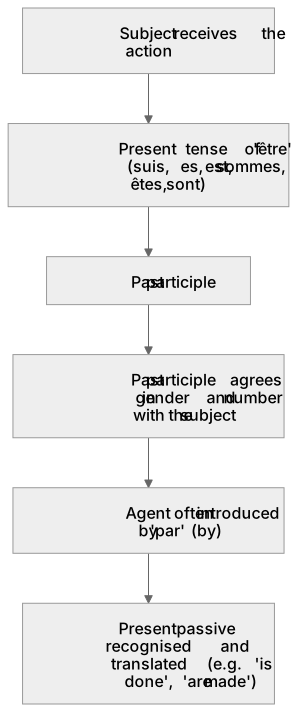
Put it in order
Put these steps in the order they happen.
- 1. Past participle
- 2. Present tense of 'être' (suis, es, est, sommes, êtes, sont)
- 3. Subject receives the action
- 4. Present passive recognised and translated (e.g. 'is done', 'are made')
- 5. Agent often introduced by 'par' (by)
- 6. Past participle agrees in gender and number with the subject
Label the diagram
Some boxes have lost their names. Pick the right name for each number.
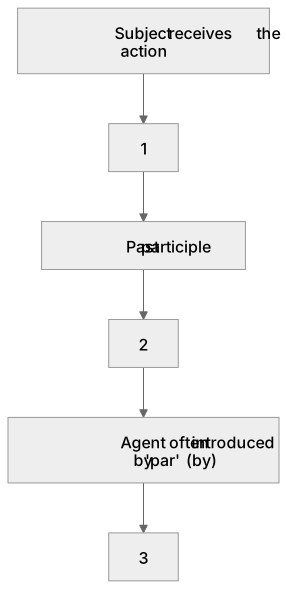
1Box 1
2Box 2
3Box 3
There is more to this lesson
The full lesson goes on to check your understanding and help you earn the marks. Create a free account to carry on, with your progress saved.
A week of Premium from your first lesson · Then the free plan continues · No card, no charge
Test your understanding of Verbs: passive voice: present tense (R)
Active recall beats re-reading. Take an instant quiz now to test what you’ve learned and lock it into long-term memory.
A week of Premium from your first lesson · Then the free plan continues · No card, no charge