OCR · GCSE · French
Adjectives and adverbs
Mastering French adjectives and adverbs is a game-changer for your OCR GCSE. This guide breaks down the essential rules of agreement and placement, giving you the tools to boost your AO4 (Quality of Language) marks and write with confidence and accuracy.
- 4 min read
- 3 worked examples
- 5 practice questions
- 6 key terms
Study Notes
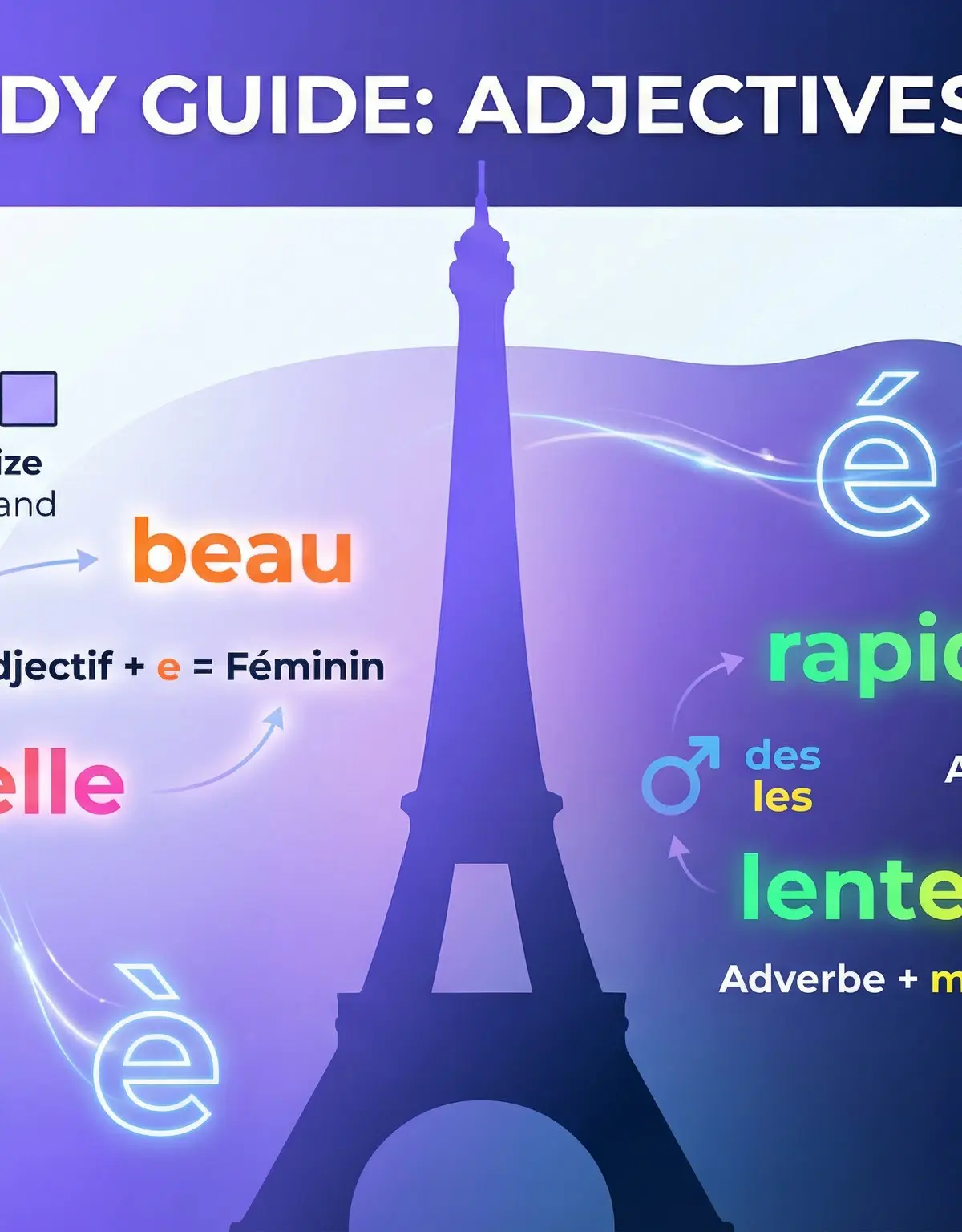
Overview
Welcome to your essential guide to French adjectives and adverbs for the OCR GCSE. This topic is fundamental to achieving high marks in both the writing and speaking papers, as it directly assesses your control over the grammatical structure of the language (AO4). Examiners are looking for candidates who can consistently and accurately apply agreement rules, even with irregular forms, and who understand the nuances of adjective placement. This guide will equip you with the core knowledge of regular and irregular patterns, the critical BAGS rule for pre-nominal adjectives, and the formation of adverbs. By mastering these concepts, you demonstrate a higher level of linguistic maturity, moving beyond basic vocabulary to construct more sophisticated and precise sentences. We will cover the exact patterns examiners reward, the common mistakes that lose candidates marks, and the techniques you need to secure the top bands.
Key Concepts: Adjective Agreement
Gender & Number Agreement
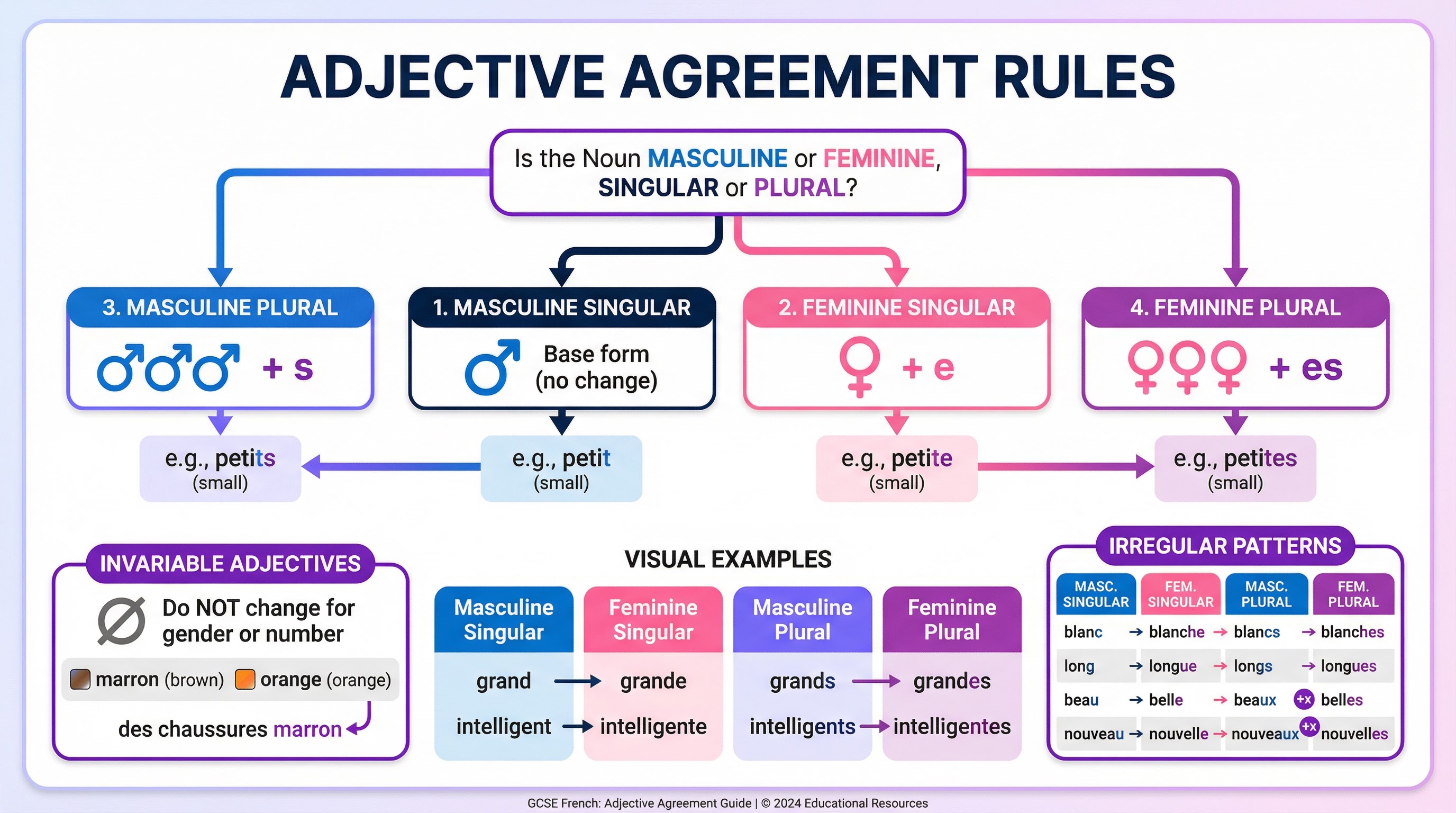
What it is: In French, every noun has a gender (masculine or feminine) and a number (singular or plural). The adjectives describing that noun must change their form to match. This is a non-negotiable rule and a primary focus for examiners.
Why it matters: Correct agreement is a key indicator of linguistic competence. Failure to agree adjectives is one of the most common errors at GCSE and will prevent candidates from accessing the highest mark bands for AO4.
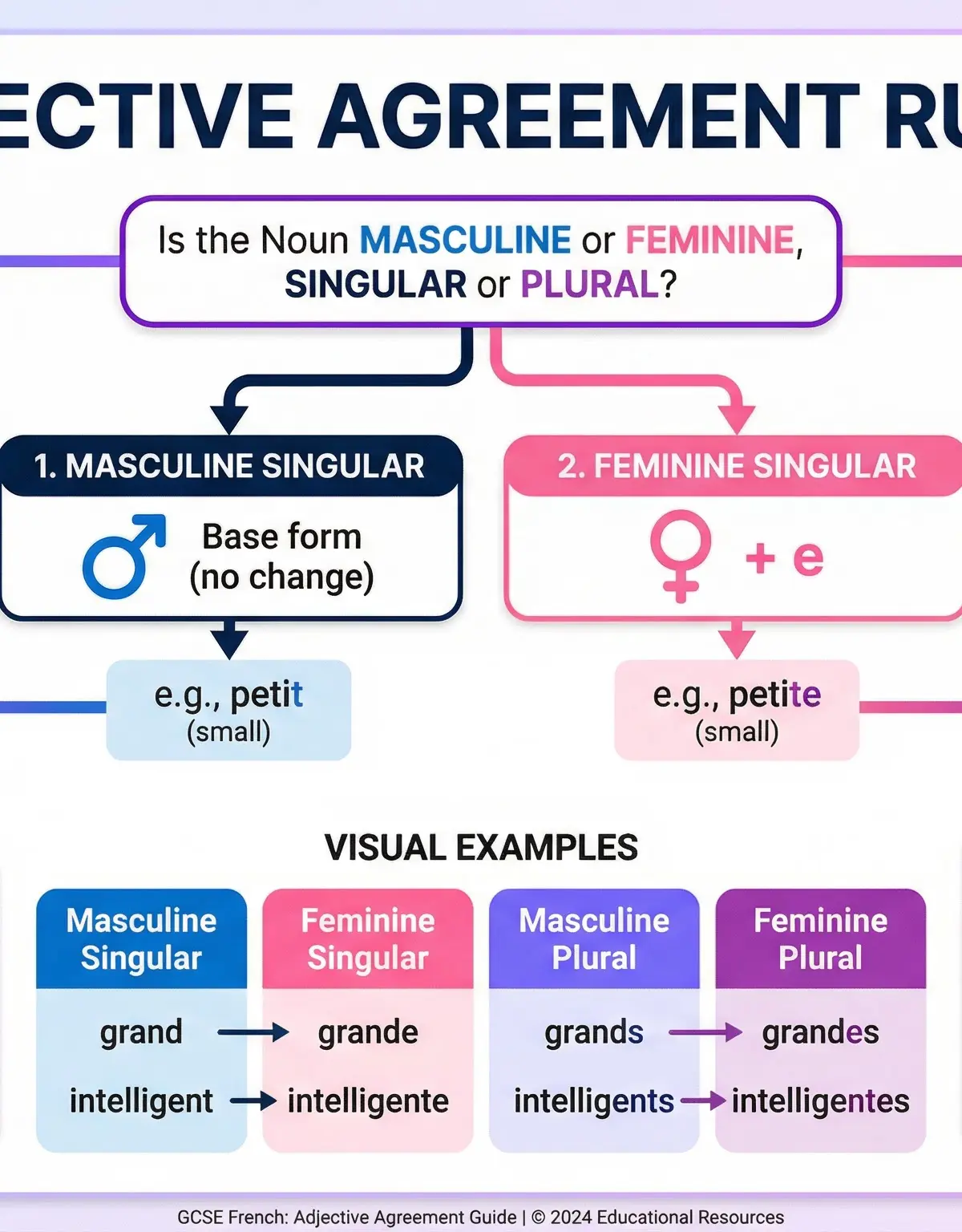
Specific Knowledge: Candidates must know the four basic forms:
- Masculine Singular: The default dictionary form (e.g., petit).
- Feminine Singular: Usually formed by adding an '-e' (e.g., petite).
- Masculine Plural: Usually formed by adding an '-s' (e.g., petits).
- Feminine Plural: Usually formed by adding an '-es' (e.g., petites).
Irregular Adjectives
What they are: Many common adjectives do not follow the standard pattern. These are frequently tested.
Why they matter: Correctly using irregular forms demonstrates a deeper knowledge of the language. Examiners will often use these to differentiate between mid- and high-level candidates.
Specific Knowledge: Key irregulars include:
- blanc → blanche (white)
- long → longue (long)
- gentil → gentille (kind)
- beau → bel / belle (beautiful)
- nouveau → nouvel / nouvelle (new)
- vieux → vieil / vieille (old)
Examiner Tip: Note that beau, nouveau, and vieux have special masculine forms (bel, nouvel, vieil) used before a noun starting with a vowel or silent 'h' (e.g., un bel homme).
Key Concepts: Adjective Placement
The BAGS Rule
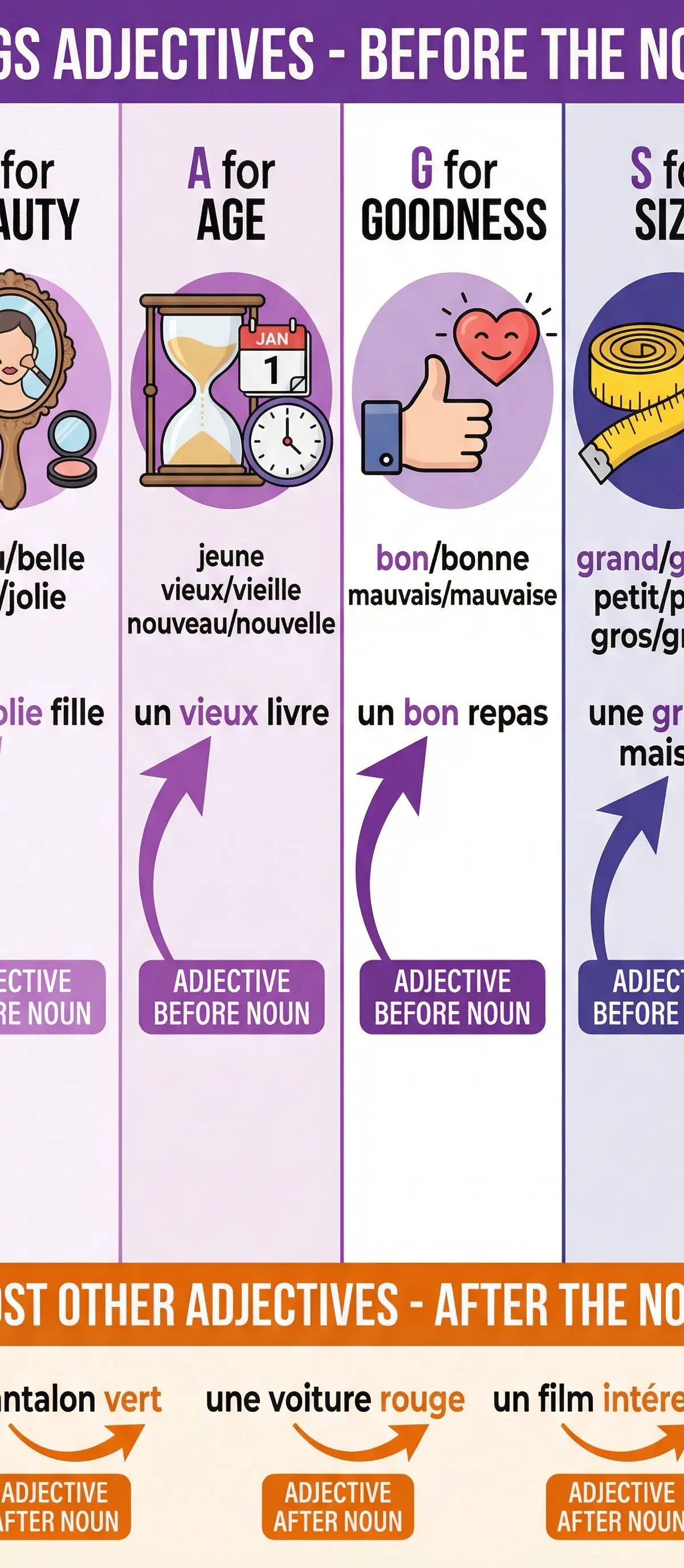
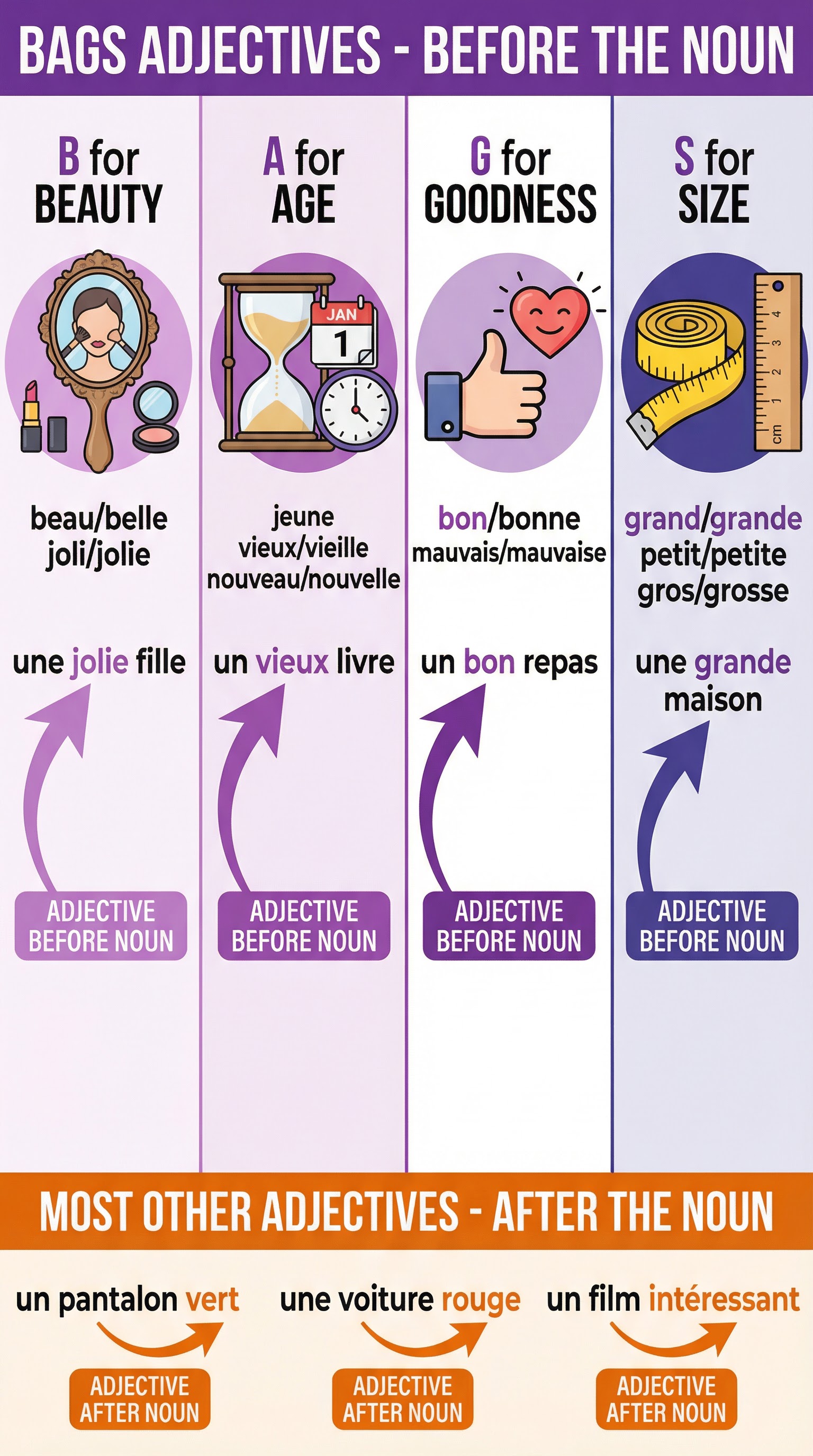
What it is: While most adjectives follow the noun, a small but important group comes before it. These can be remembered with the acronym BAGS.
Why it matters: Correct placement is as important as agreement. Placing a BAGS adjective after the noun is a significant grammatical error.
Specific Knowledge:
- Beauty: beau, joli
- Age: jeune, vieux, nouveau
- Goodness: bon, mauvais
- Size: grand, petit, gros
Key Concepts: Adverbs
Adverb Formation
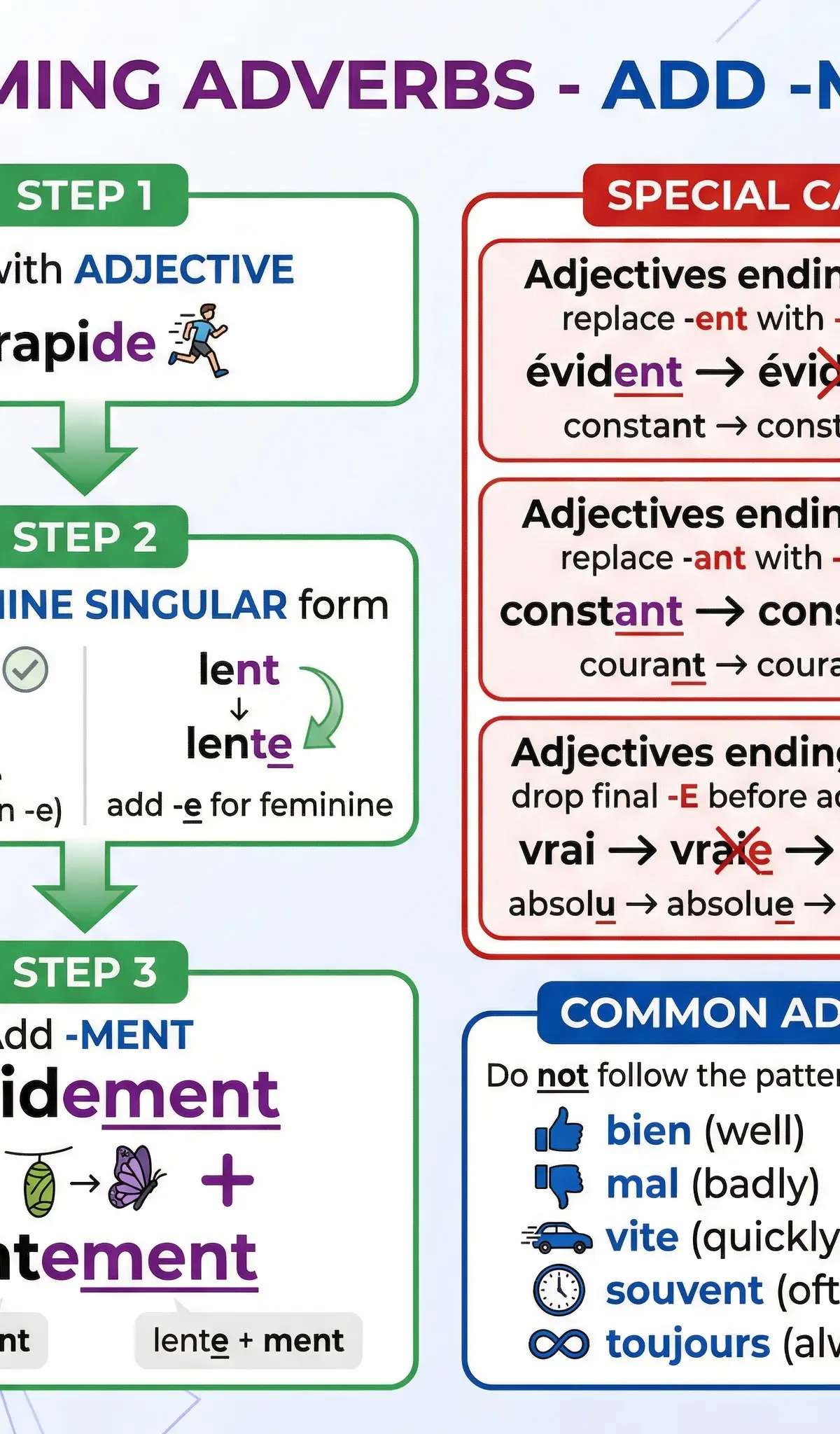
What it is: Adverbs describe how an action is done. Most are formed from adjectives.
Why it matters: Using adverbs allows for more descriptive and varied language, which is rewarded in both speaking and writing.
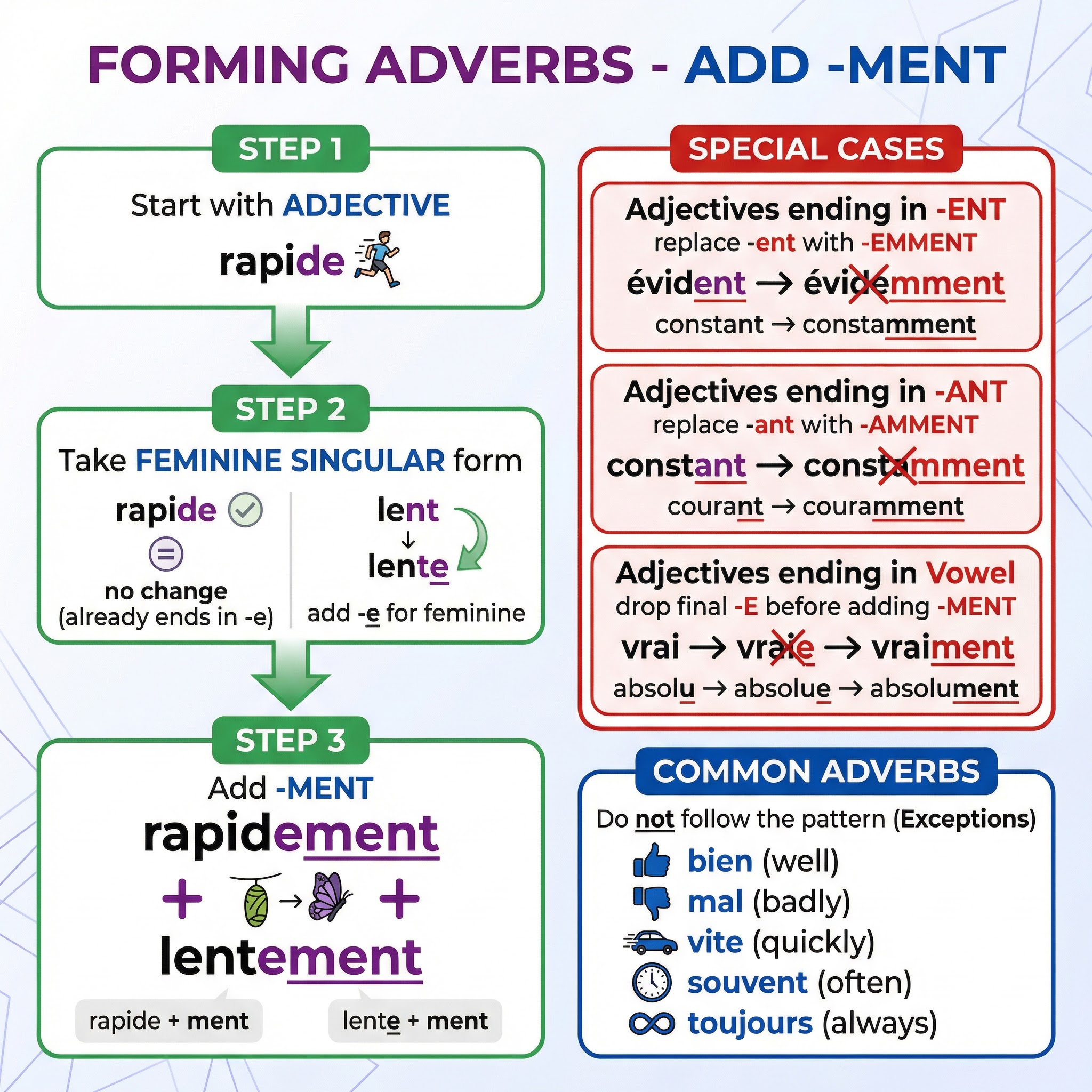
Specific Knowledge: The standard rule is to take the feminine singular form of the adjective and add -ment.
- lent (slow) → lente → lentement (slowly)
- sérieux (serious) → sérieuse → sérieusement (seriously)
Special Cases:
- Adjectives ending in a vowel: vrai → vraiment (truly/really)
- Adjectives ending in -ent: prudent → prudemment (carefully)
- Adjectives ending in -ant: constant → constamment (constantly)
Visual Resources
3 diagrams and illustrations
Interactive Diagrams
1 interactive diagram to visualise key concepts
Conceptual Flow Outline
A decision-making flowchart for correct adjective usage.
Worked Examples
3 worked examples — open one to explore the question and available guidance.
Practice Questions
Test your understanding — click to reveal model answers
Translate into French: 'The little boy has some old, interesting books.' (4 marks)
Hint: Remember BAGS and be careful with the plural partitive article 'des'.
Rewrite the following sentence in the feminine plural: 'Le chanteur canadien est talentueux.' (3 marks)
Hint: Change the subject, the nationality adjective, the verb, and the final adjective.
Form an adverb from the adjective 'élégant' and use it in a sentence. (2 marks)
Hint: This adjective ends in '-ant'. What is the special rule?
Translate into French: 'It is a beautiful, white church.' (3 marks)
Hint: One BAGS adjective, one irregular adjective.
Why is the following sentence incorrect? 'J'ai acheté des marrons chaussures.' Correct it. (3 marks)
Hint: Think about invariable adjectives and standard word order.
Test your understanding of Adjectives and adverbs
Active recall beats re-reading. Take an instant quiz now to test what you’ve learned and lock it into long-term memory.
7 days Premium · Then free forever · No card, no charge