OCR · GCSE · French
Identity and culture: Me, my family and friends
This study guide for OCR GCSE French (Theme 1: Identity and Culture) provides a comprehensive, exam-focused resource for mastering the topic of 'Me, my family and friends'. It is designed to help students secure top marks by focusing on key vocabulary, grammatical structures, and exam techniques.
- 5 min read
- 3 worked examples
- 5 practice questions
- 6 key terms
Study Notes
Overview
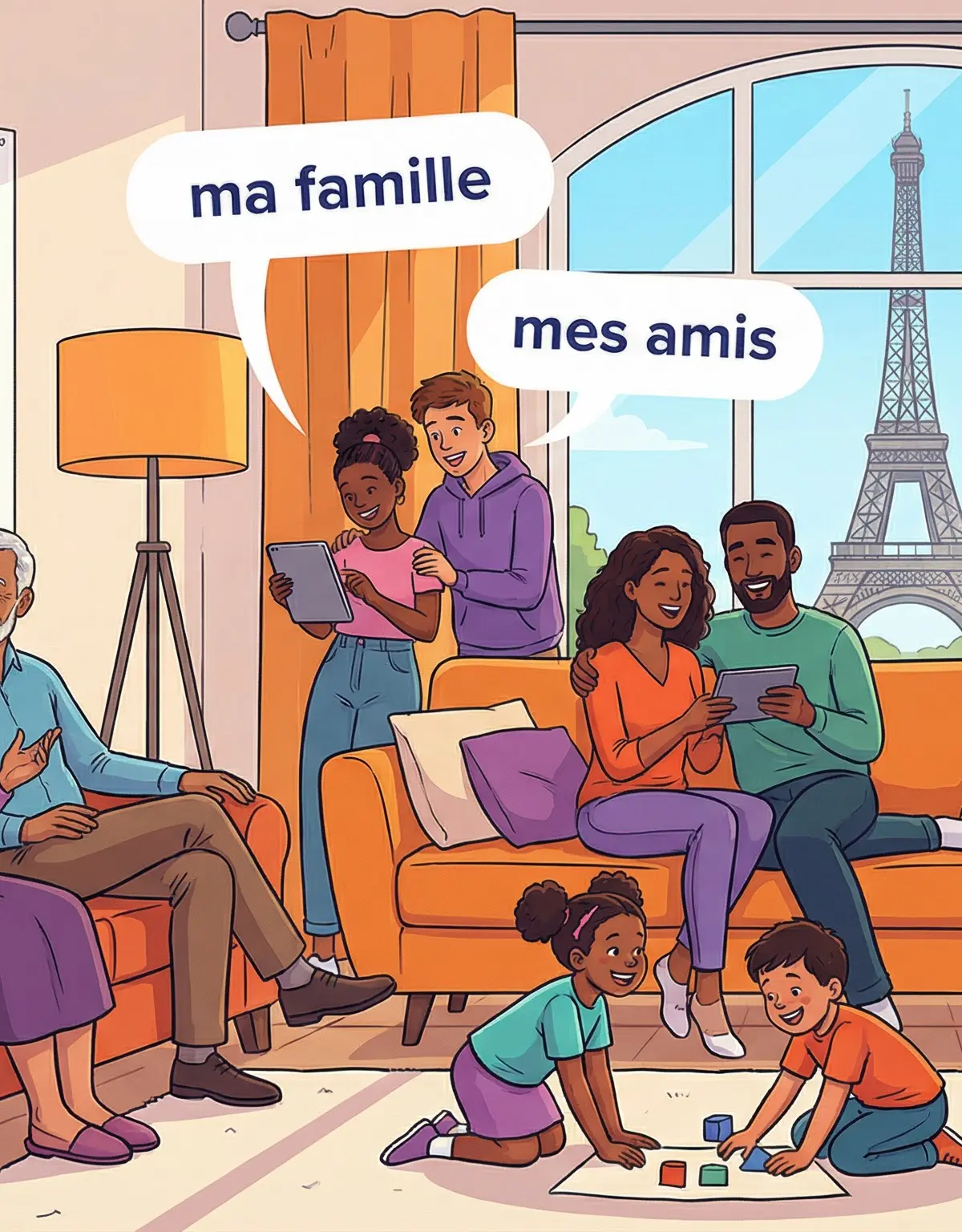
This topic, 'Me, my family and friends', is a cornerstone of the OCR GCSE French specification. It requires candidates to discuss personal identity, family structures, friendships, and relationships with confidence and accuracy. Examiners expect to see a solid command of descriptive language, the ability to narrate in different time frames (past, present, and future), and the skill to justify opinions using a range of connectives. This guide will break down the core knowledge and skills you need to excel in all four assessment areas: Listening, Speaking, Reading, and Writing. We will cover essential vocabulary for describing people, the grammar of possessive adjectives and adjective agreement, the use of reflexive verbs to talk about relationships, and how to structure your answers for maximum impact. By mastering this foundational topic, you build the linguistic confidence needed for the entire GCSE course.
Key Concepts & Grammar
Describing People: Vocabulary & Adjective Agreement
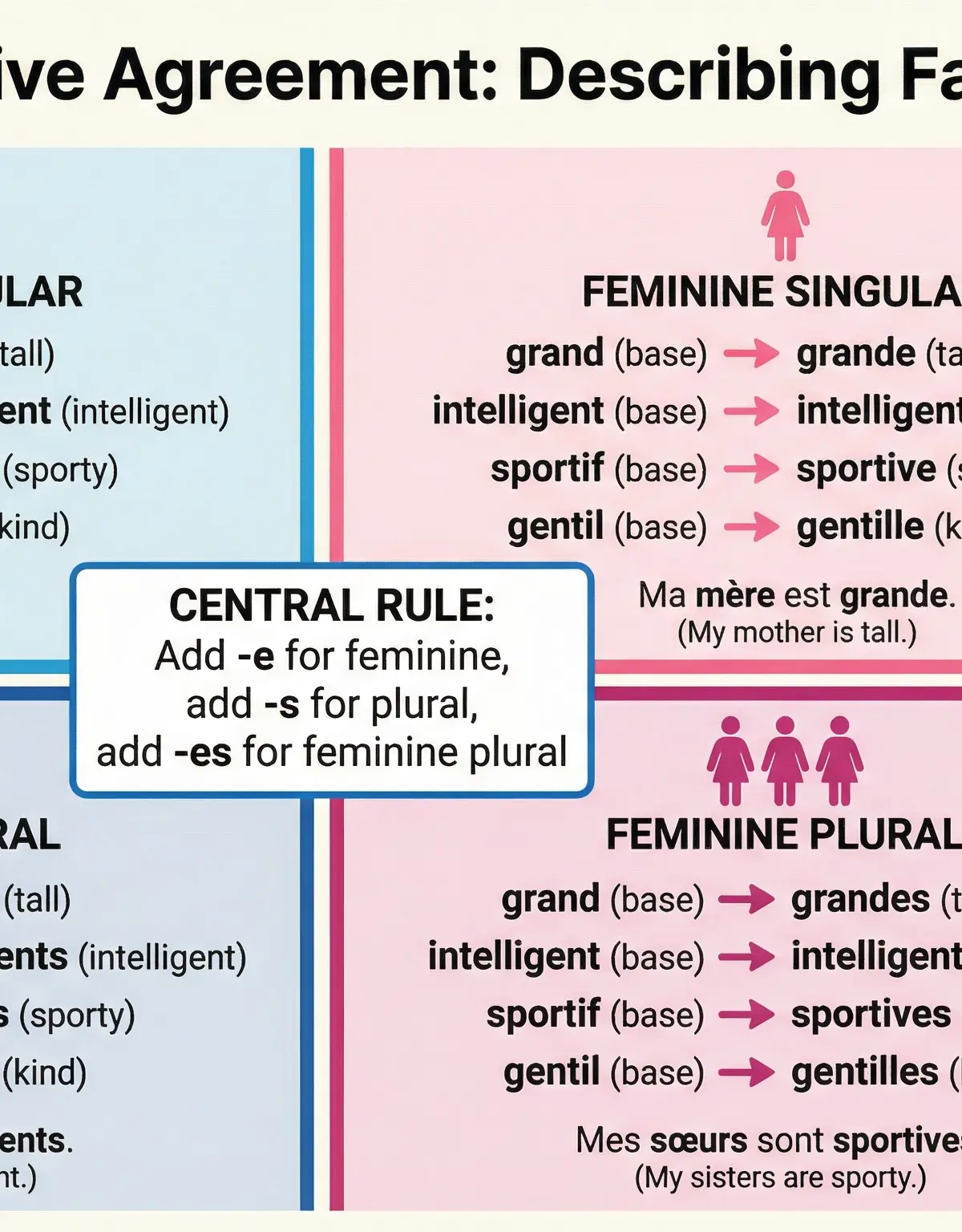
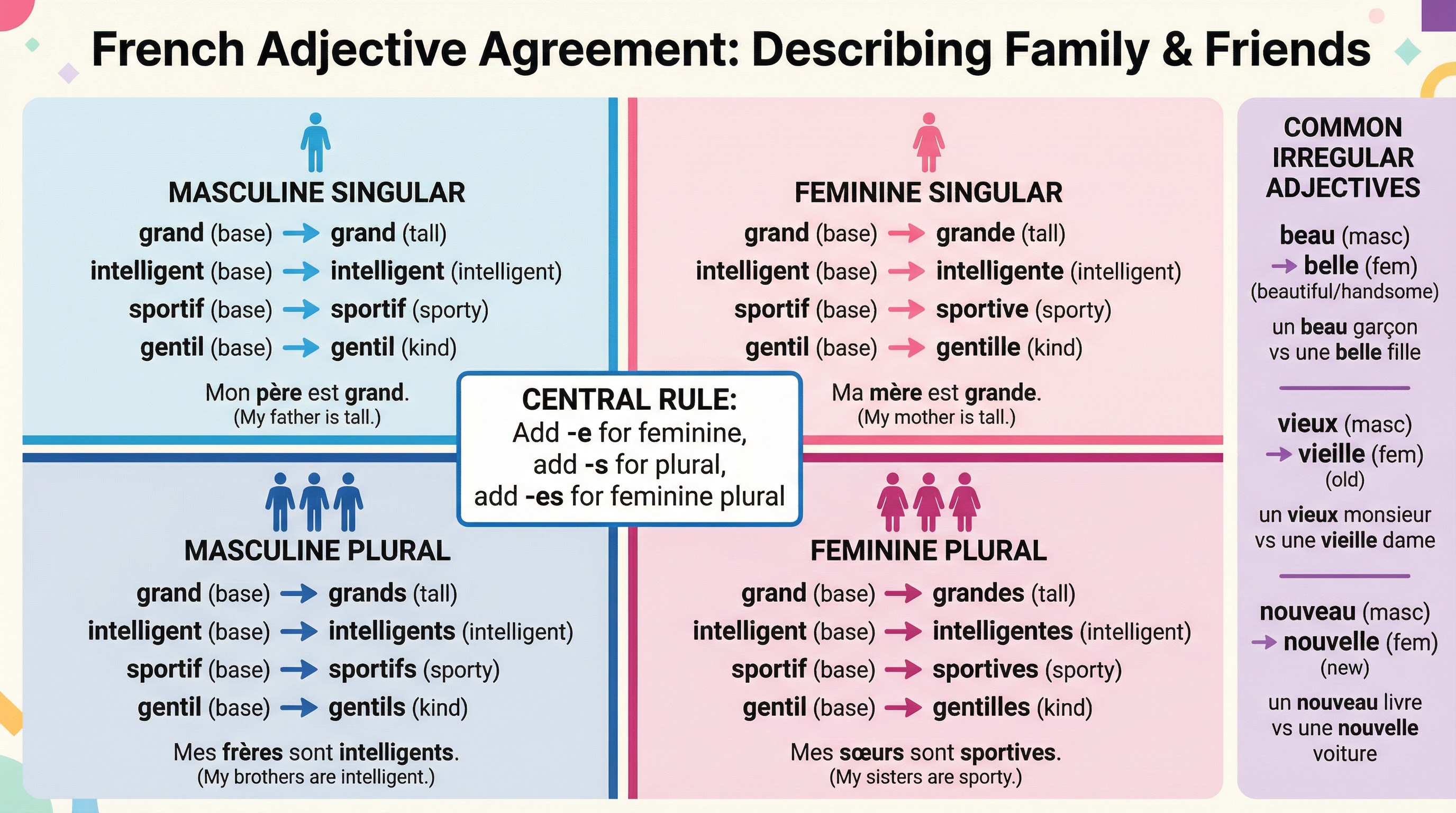
What you need to know: To describe family and friends, you need a range of adjectives for both physical appearance and personality. Crucially, you must make these adjectives agree with the gender and number of the person you are describing. This is a fundamental rule that examiners look for constantly.
Why it matters: Correct adjective agreement is a hallmark of accurate French. Failing to make adjectives agree is a common error that can prevent candidates from reaching the higher mark bands. For example, saying 'ma mère est grand' instead of 'ma mère est grande' is a clear mistake.
Specific Knowledge:
- Physical Appearance: grand(e), petit(e), de taille moyenne, mince, gros(se), beau/belle, joli(e), laid(e), jeune, vieux/vieille.
- Personality: gentil(le), méchant(e), sympa, drôle, amusant(e), intelligent(e), sportif/sportive, paresseux/paresseuse, travailleur/travailleuse.
- The Rule: Add an '-e' to make most adjectives feminine. Add an '-s' for plural. Add '-es' for feminine plural. Watch out for irregulars like 'beau/belle' and 'vieux/vieille'.
Family & Relationships: Vocabulary & Possessive Adjectives
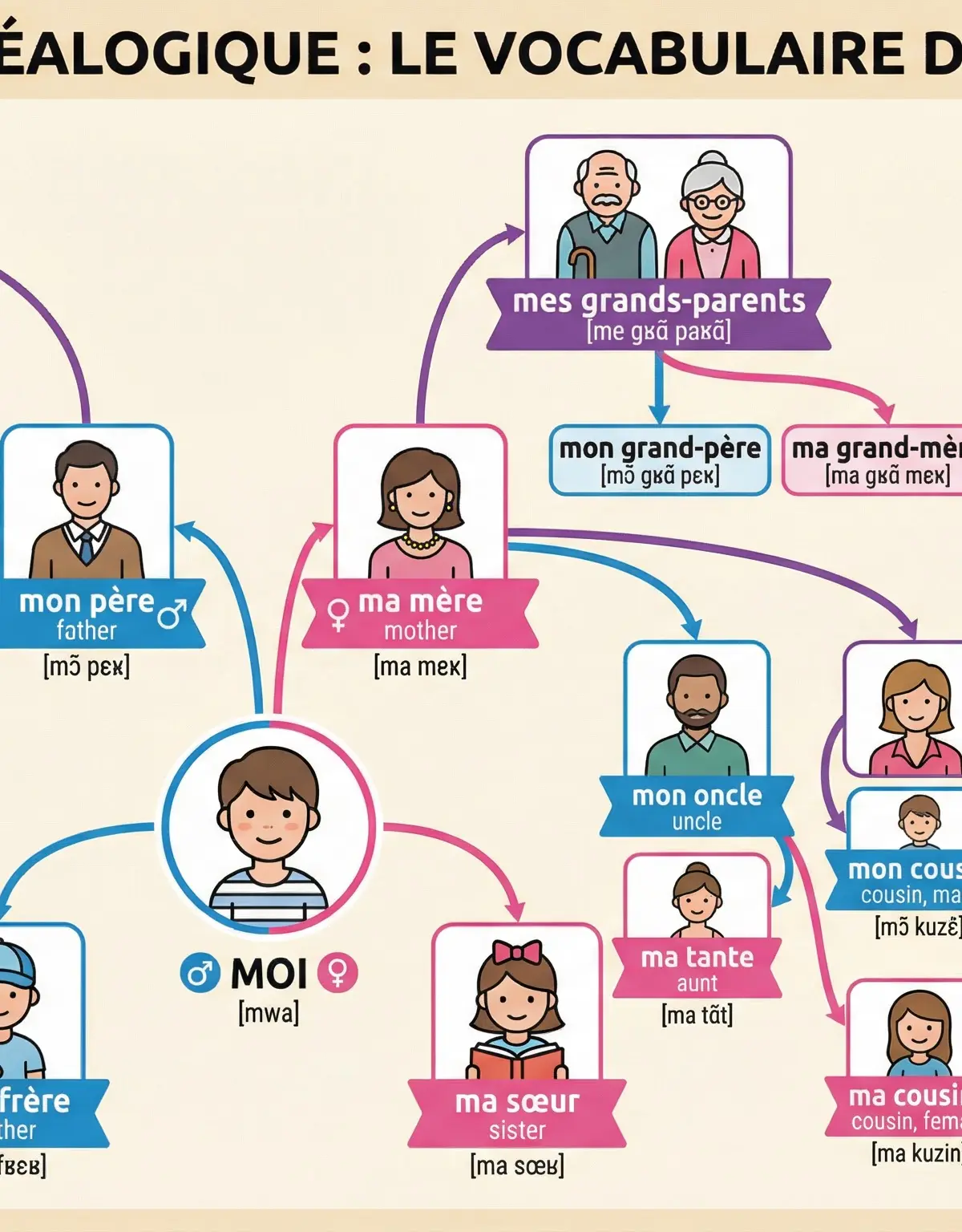
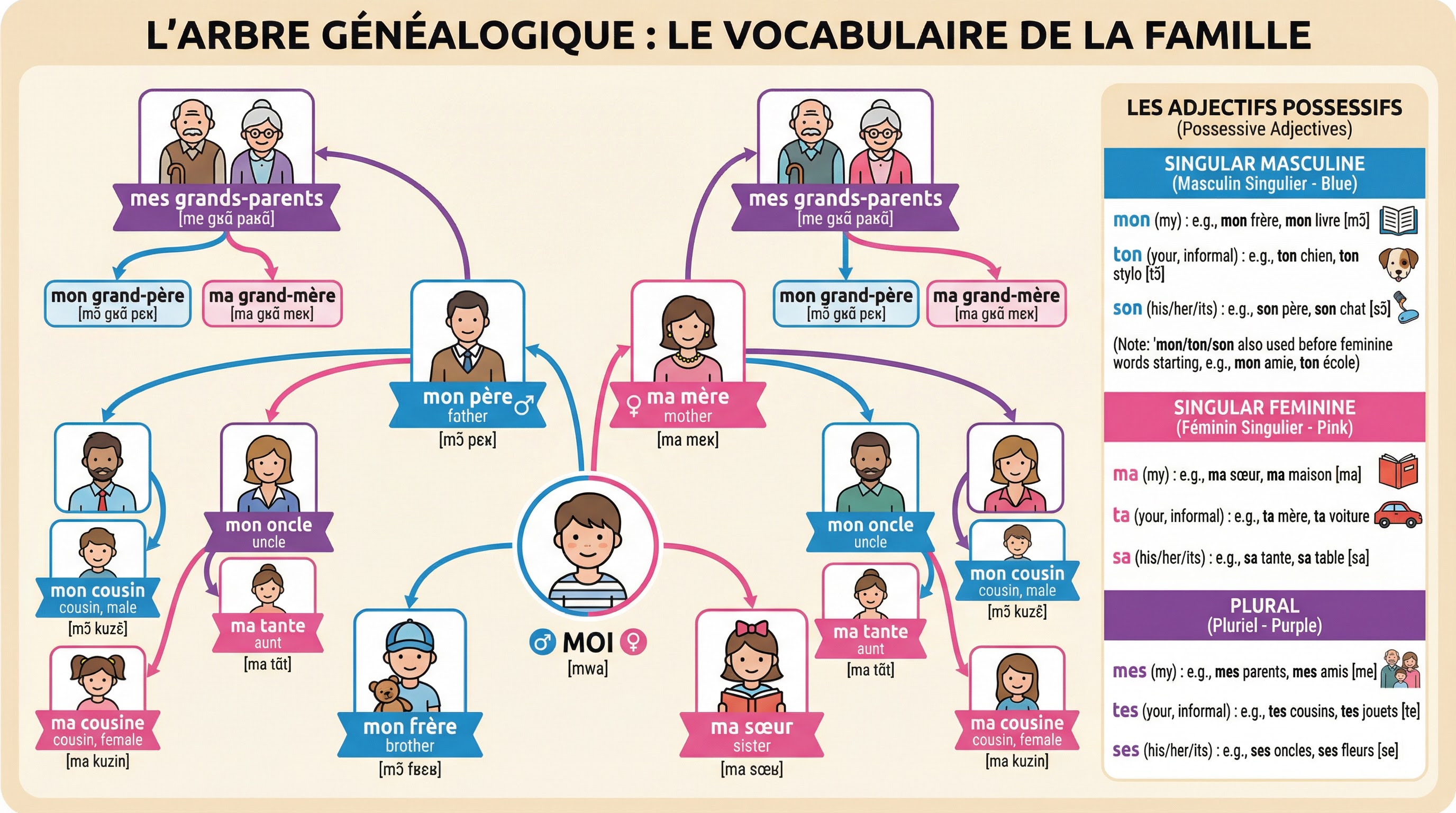
What you need to know: You must be able to name different family members and use the correct possessive adjective (my, your, his/her) to show ownership. The choice of possessive adjective depends on the gender and number of the noun being possessed, not the owner.
Why it matters: Incorrect possessive adjectives are a frequent error. For instance, using 'sa père' instead of 'son père' shows a misunderstanding of the rule. This is a quick way to lose marks for accuracy.
Specific Knowledge:
- Family Members: le père, la mère, le frère, la sœur, les parents, le grand-père, la grand-mère, l'oncle, la tante, le cousin, la cousine.
- Possessive Adjectives: mon/ma/mes (my), ton/ta/tes (your), son/sa/ses (his/her). Use 'mon', 'ton', 'son' before a feminine singular noun that starts with a vowel (e.g., 'mon amie').
Talking About Relationships: Reflexive Verbs
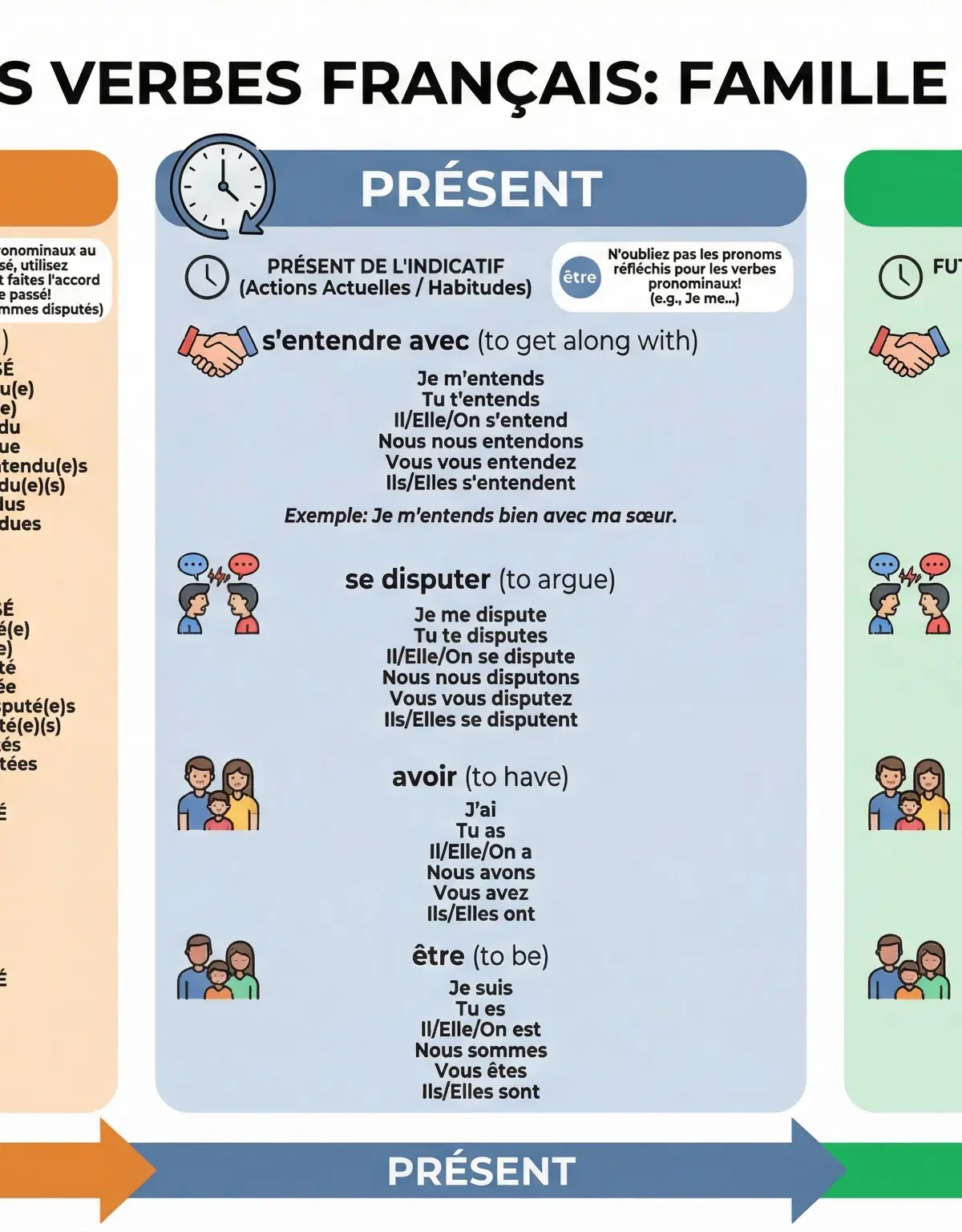
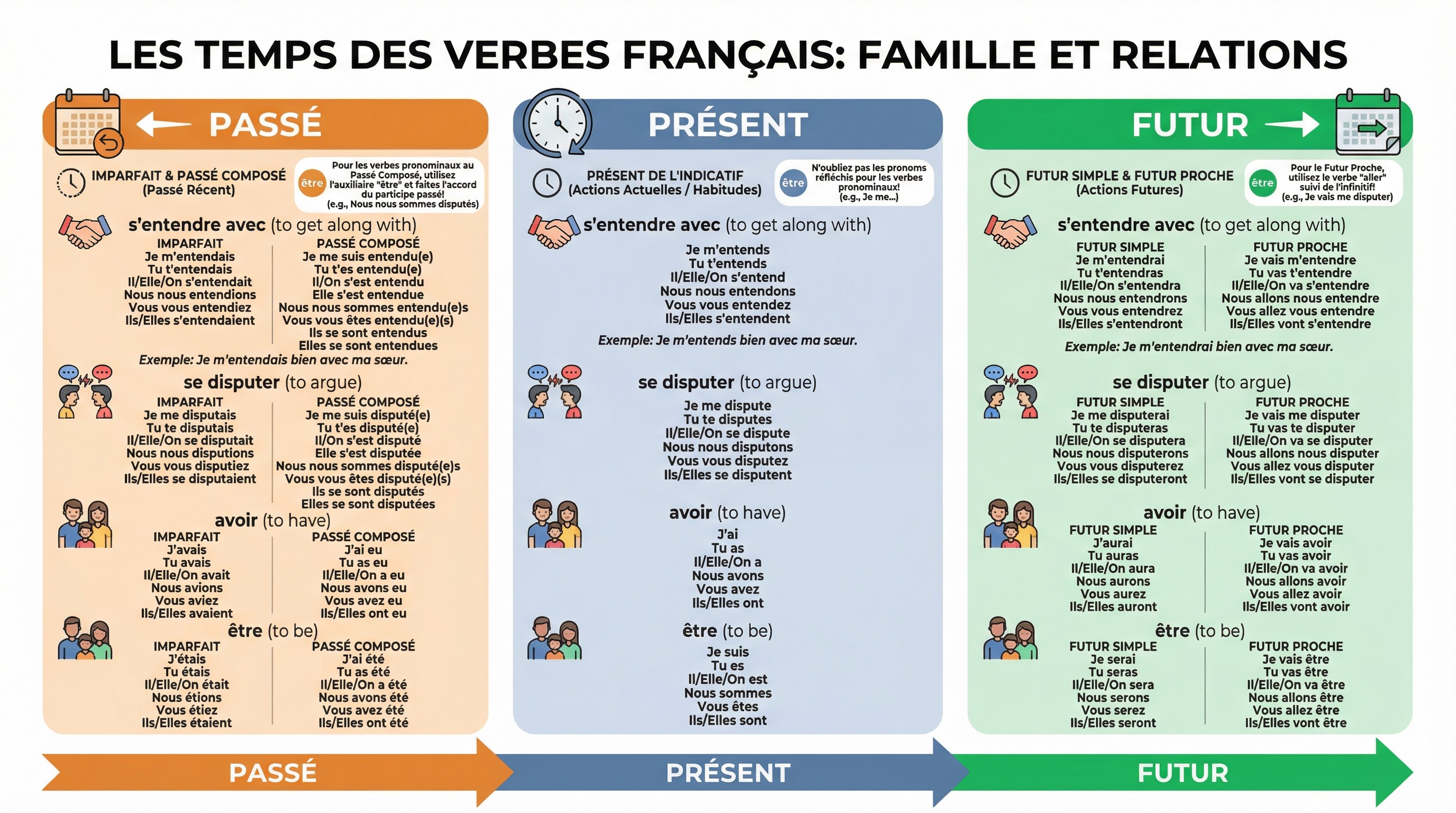
What you need to know: Reflexive verbs are essential for describing relationships. Key examples include 's'entendre avec' (to get along with) and 'se disputer avec' (to argue with). You must use the correct reflexive pronoun (me, te, se, nous, vous, se) and remember that they use 'être' as the auxiliary verb in the perfect tense.
Why it matters: Correctly forming the perfect tense with reflexive verbs is a higher-level skill. Many candidates forget the reflexive pronoun or use 'avoir' instead of 'être'. Mastering this demonstrates grammatical control.
Specific Knowledge:
- Present Tense: Je m'entends bien avec... (I get along well with...)
- Perfect Tense: Je me suis bien entendu(e) avec... (I got along well with...)
- Imperfect Tense: Je m'entendais bien avec... (I used to get along well with...)
- Future Tense: Je m'entendrai bien avec... (I will get along well with...)
Second-Order Concepts
Justification & Development
To move beyond simple statements, you must justify your opinions. This means using a variety of connectives to explain why you think something. Instead of just using 'parce que', try to incorporate 'car', 'puisque', and 'étant donné que'.
Using Three Time Frames
In both speaking and writing exams, demonstrating the ability to use past, present, and future tenses is crucial for accessing the top marks. Plan to include at least one sentence in each time frame in your longer written answers and prepared spoken responses.
Worked Examples
3 worked examples — open one to explore the question and available guidance.
Practice Questions
Test your understanding — click to reveal model answers
Décris ton/ta meilleur(e) ami(e).
Hint: Think about their physical appearance and personality. Use a range of adjectives and make sure they agree correctly.
Qu'est-ce que tu as fait récemment avec ta famille?
Hint: Use the perfect tense (passé composé). Remember to use both 'avoir' and 'être' as auxiliary verbs.
Comment est-ce que tu vas passer le week-end prochain avec tes amis?
Hint: Use the future tense (futur simple or futur proche). Give specific details.
Pourquoi est-il important d'avoir des amis?
Hint: Give your opinion and justify it with multiple reasons. Use connectives like 'parce que', 'car', 'de plus'.
Parle-moi d'une personne que tu admires dans ta famille.
Hint: Choose a family member and explain *why* you admire them. Use descriptive adjectives and give examples of their actions.