OCR · GCSE · French
Using appropriate vocabulary and grammar
Mastering vocabulary and grammar is the key to unlocking top grades in OCR GCSE French. This guide moves beyond basic language, providing the specific tools, complex structures, and idiomatic expressions that examiners reward, turning good answers into outstanding ones.
- 4 min read
- 3 worked examples
- 5 practice questions
- 6 key terms
Study Notes

Overview
Welcome to your deep-dive study guide for OCR GCSE French, focusing on the crucial skills of using appropriate vocabulary and grammar. In any language, but especially in an exam context, your ability to express yourself with precision, variety, and accuracy is what separates the top candidates from the rest. For OCR, this falls under the assessment criteria of ‘Vocabulary and Structures’ and ‘Accuracy’, which together carry significant weight in both the Writing (AO2 & AO4) and Speaking (AO3 & AO4) papers. Examiners are trained to look for evidence that you can deploy a wide range of vocabulary beyond the core lists, including topic-specific lexis and idiomatic expressions. They also want to see you confidently handle complex grammatical structures. This guide is designed to equip you with the high-level vocabulary, sophisticated structures, and exam techniques needed to impress examiners and secure the highest marks. We will break down how to elevate your language, avoid common pitfalls, and apply these skills in exam-style questions.

Key Concepts: Elevating Your Vocabulary
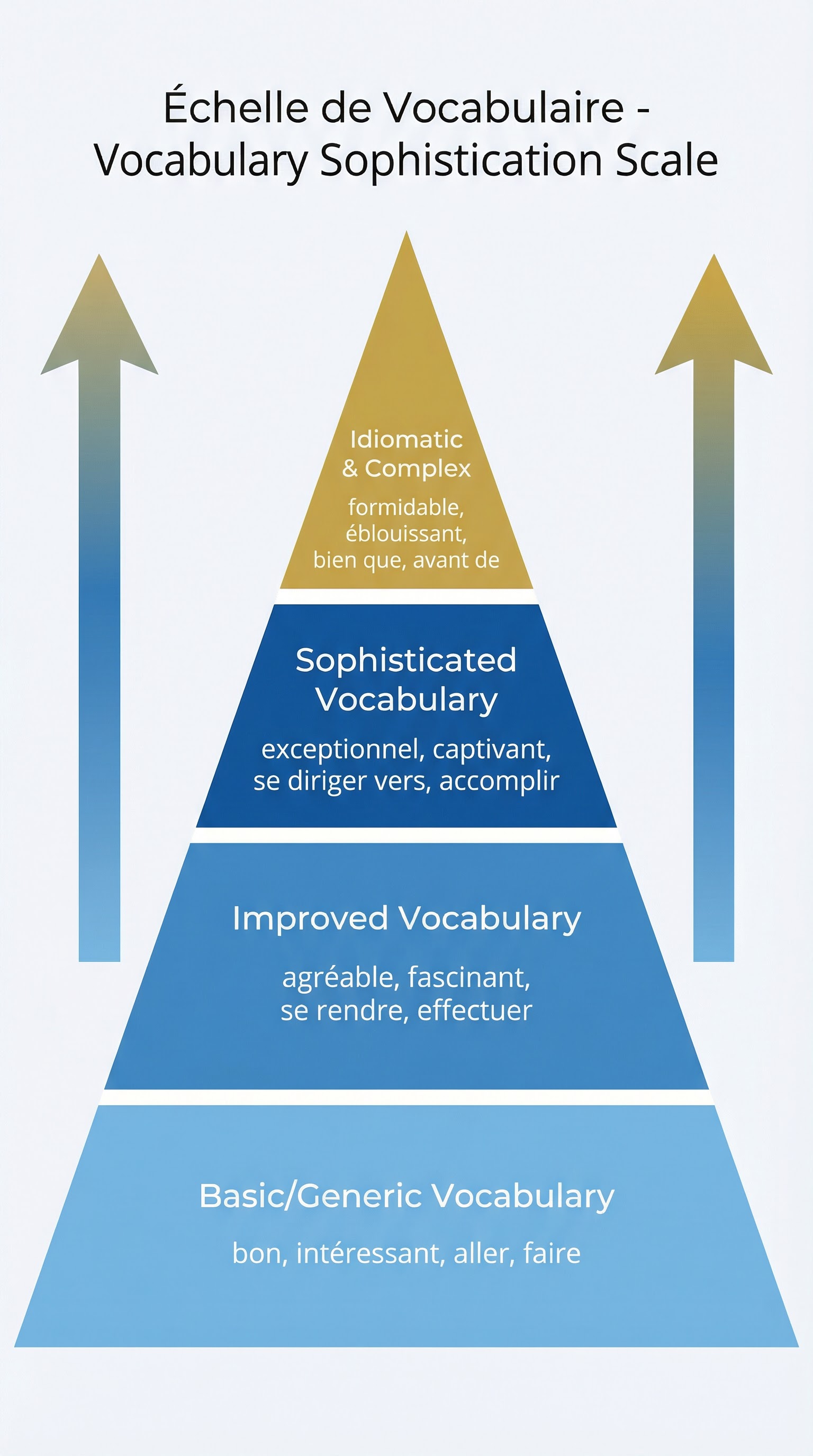
To achieve the top bands in your writing and speaking, you must demonstrate a command of vocabulary that goes beyond the generic. Think of your vocabulary as a pyramid. At the base, you have common, high-frequency words. As you move up, your language becomes more sophisticated, specific, and impressive. Examiners are looking for candidates who can operate at the higher levels of this pyramid.
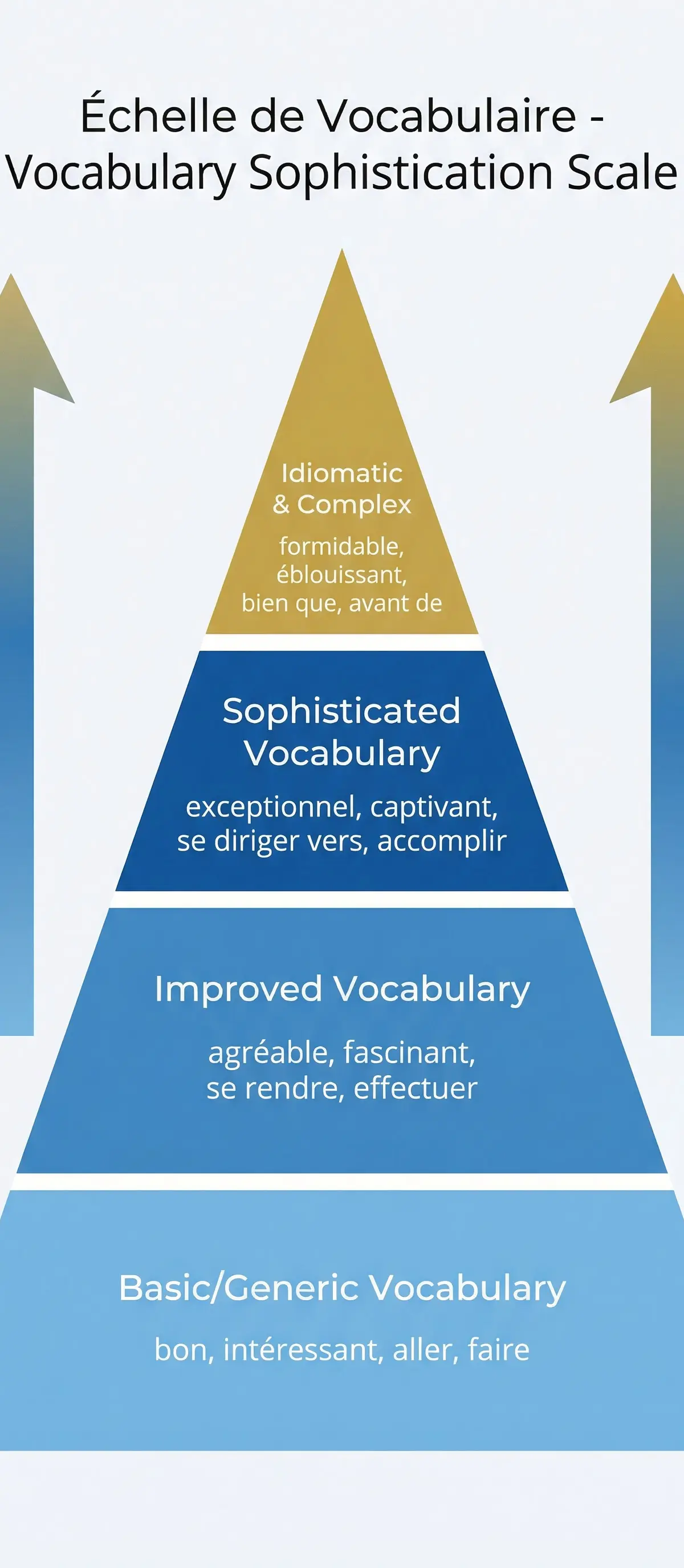
- Level 1: Basic/Generic Vocabulary: Words like bon, intéressant, aller, and faire. While essential, relying solely on these will limit your marks.
- Level 2: Improved Vocabulary: Simple upgrades that show more thought. For example, swapping bon for agréable or fascinant.
- Level 3: Sophisticated Vocabulary: This is where you start to impress. Using words like exceptionnel, captivant, or verbs like accomplir shows a wider lexical range.
- Level 4: Idiomatic & Complex: The peak of the pyramid. This includes idiomatic expressions (coûter les yeux de la tête) and complex conjunctions (bien que, afin que) which demonstrate a near-native flair.
Key Concepts: Mastering Complex Grammar
Alongside sophisticated vocabulary, marks are awarded for the successful use of complex grammatical structures. These are the engine of your sentences, allowing you to express more nuanced and detailed ideas. Candidates who can correctly and confidently use a variety of structures will always score more highly. The key is not just to know them, but to integrate them naturally into your writing and speaking.
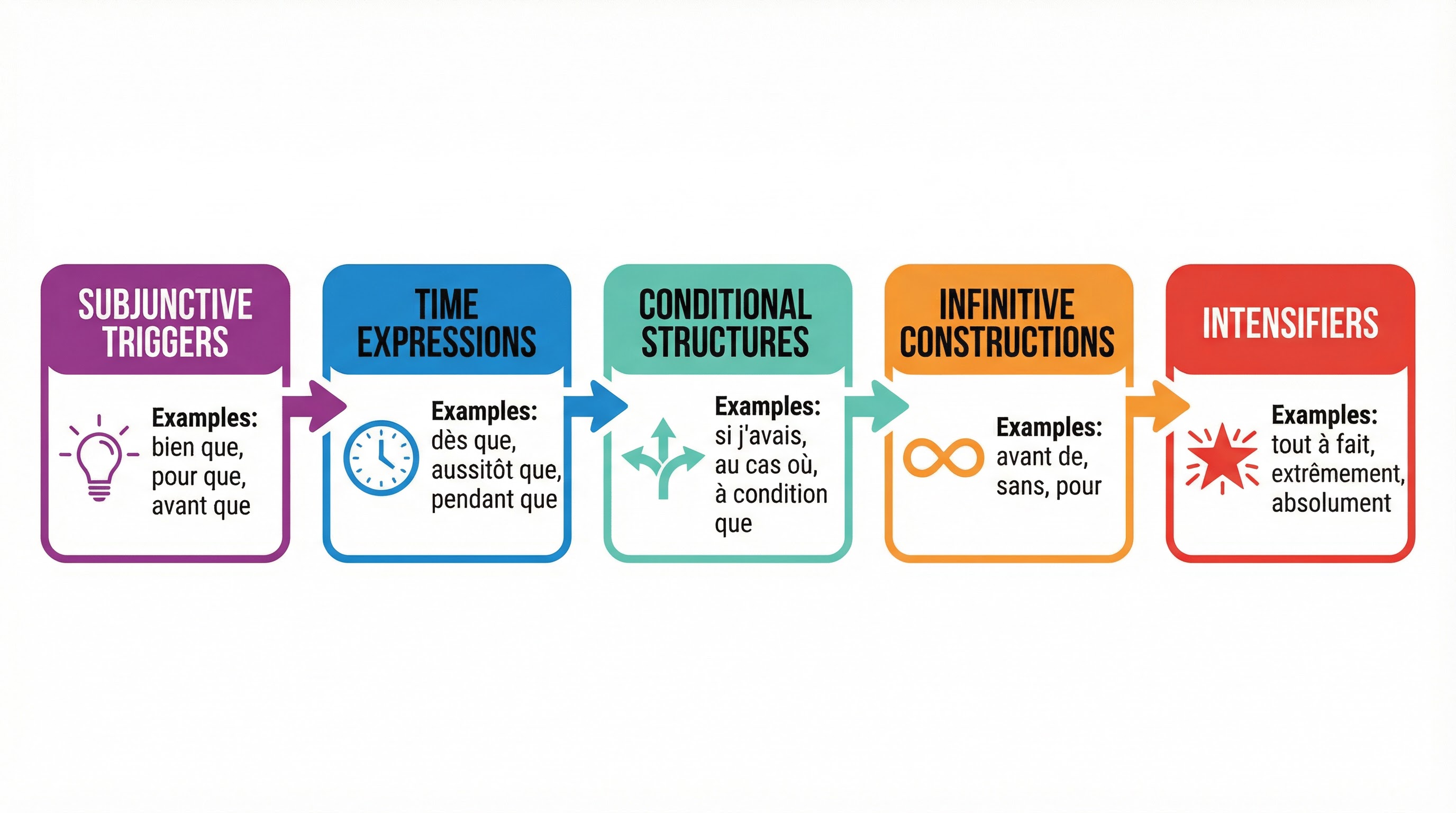
- Subjunctive Triggers: Phrases that require the subjunctive mood, such as bien que (although), pour que (so that), and avant que (before). Correctly using the subjunctive is a hallmark of an advanced learner.
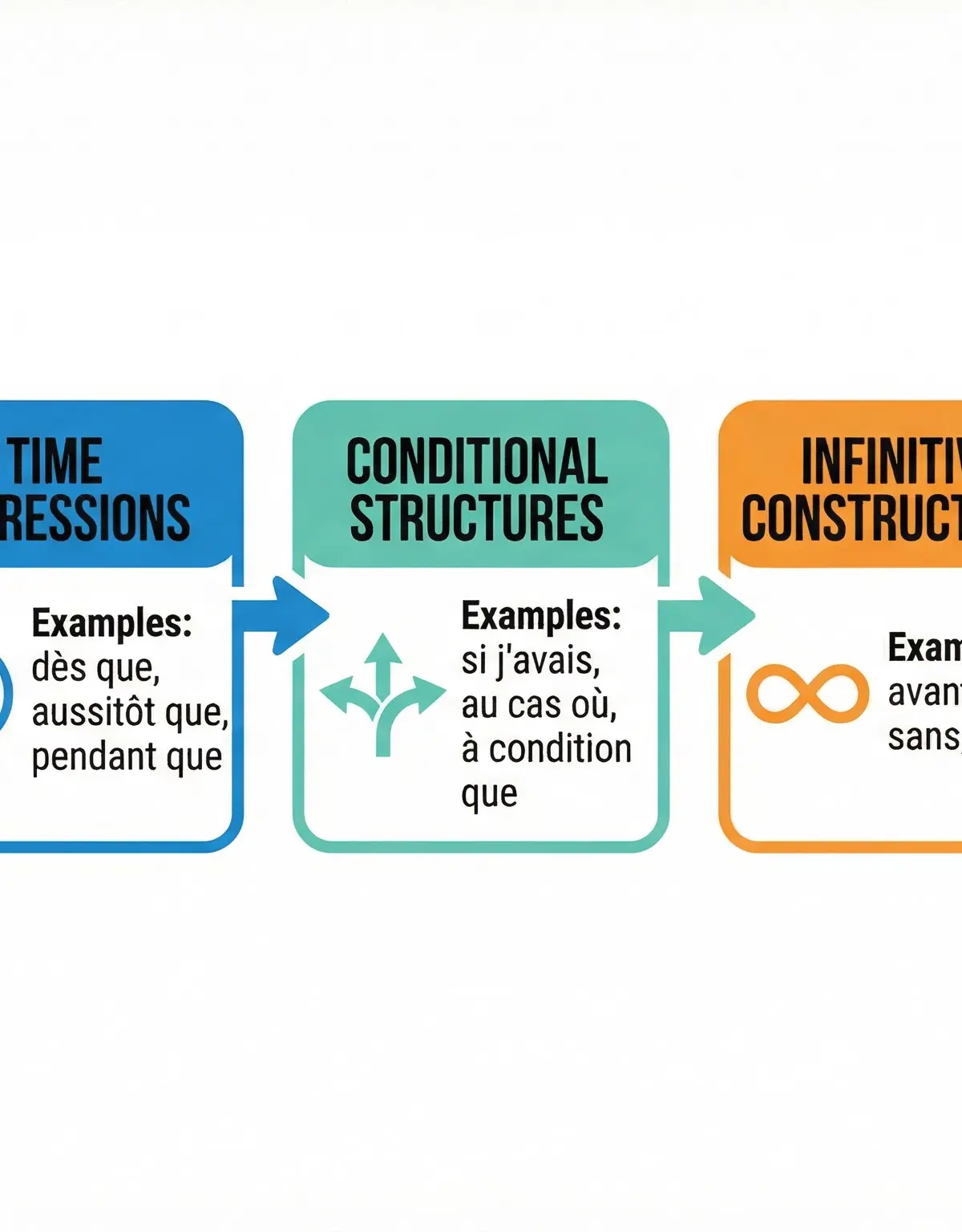
- Conditional Structures: Sentences using si (if), such as the si + imparfait... conditionnel structure to express hypothetical situations (Si j'avais le choix, je voudrais...).
- Infinitive Constructions: Using prepositions like avant de (before doing), après avoir/être (after having done), and pour (in order to) followed by an infinitive. These are efficient and elegant.
- Relative Pronouns: Moving beyond just qui and que to use dont (of which/whom) and lequel/laquelle etc. (which).
- Intensifiers: Adverbs that strengthen your adjectives and opinions, such as tout à fait (completely), extrêmement (extremely), and particulièrement (particularly).
Visual Resources
2 diagrams and illustrations
Interactive Diagrams
1 interactive diagram to visualise key concepts
Conceptual Flow Outline
Flowchart for choosing the correct register (formal vs. informal).
Worked Examples
3 worked examples — open one to explore the question and available guidance.
Practice Questions
Test your understanding — click to reveal model answers
Décris tes dernières vacances. Tu dois mentionner: où tu es allé(e), ce que tu as fait, ton opinion des vacances. (90 mots)
Hint: Remember to use both the passé composé and the imparfait to describe past events and settings. Try to include at least one sophisticated adjective and one complex sentence.
Translate into French: 'My friend, who is very sporty, told me that it is necessary to have a healthy diet.'
Hint: Pay attention to the relative pronoun 'who' and the impersonal structure 'it is necessary'.
Pourquoi est-il important de protéger l'environnement ? (90 mots)
Hint: Use topic-specific vocabulary related to the environment (e.g., pollution, recycling, climate change) and include a future or conditional tense to talk about consequences.
Tu organises une sortie pour tes amis. Écris un email à ton ami français pour l'inviter. (90 mots)
Hint: Remember to use the informal 'tu' register. Include details about the event and try to use a future tense.
'La technologie a amélioré la vie des jeunes.' Es-tu d'accord ? (150 mots)
Hint: This is an opinion essay. Structure your answer with an introduction, a paragraph for the advantages, a paragraph for the disadvantages, and a conclusion.