OCR · GCSE · French
Identifying key information in spoken French
Identifying key information in spoken French is a critical skill that accounts for 25% of your OCR GCSE French grade. This study guide equips you with strategic listening techniques, examiner insights, and practical methods to navigate distractors, interpret complex grammatical structures, and extract precise information from audio sources. Mastering this skill will transform you from a passive listener into an active, analytical candidate who consistently earns top marks.
- 24 min read
- 4 worked examples
- 5 practice questions
- 7 key terms
Study Notes
Overview
The OCR GCSE French Listening examination tests your ability to extract precise information from spoken French across a variety of contexts, including conversations, announcements, interviews, and narratives. This skill represents 25% of your total GCSE grade under Assessment Objective 3 (AO3), which evaluates your comprehension of spoken language. Examiners are looking for candidates who can distinguish between stated and implied meaning, navigate linguistic distractors, and demonstrate accuracy in interpreting grammatical structures such as tense, negation, and mood. Success in this component requires not just passive hearing, but active, strategic listening that combines vocabulary knowledge, grammatical awareness, and exam technique. Candidates who master this skill consistently achieve higher grades by avoiding common traps such as indiscriminate lifting, distractor selection, and tense confusion. This guide provides you with the tools, strategies, and practice needed to approach the listening exam with confidence and precision.

Core Listening Skills
Active Listening vs. Passive Hearing
Active listening is a cognitive process that involves engaging with the audio, anticipating content, and making connections between what you hear and what the question requires. Unlike passive hearing, where information washes over you without retention, active listening demands that you focus on specific linguistic markers, question words, and contextual clues. Examiners reward candidates who demonstrate this skill by accurately locating information, even when it is embedded within longer passages or surrounded by distractors. To develop active listening, practice annotating questions during the reading time, predicting vocabulary fields, and mentally summarising each section of the audio as you listen.
The Two-Listen Strategy
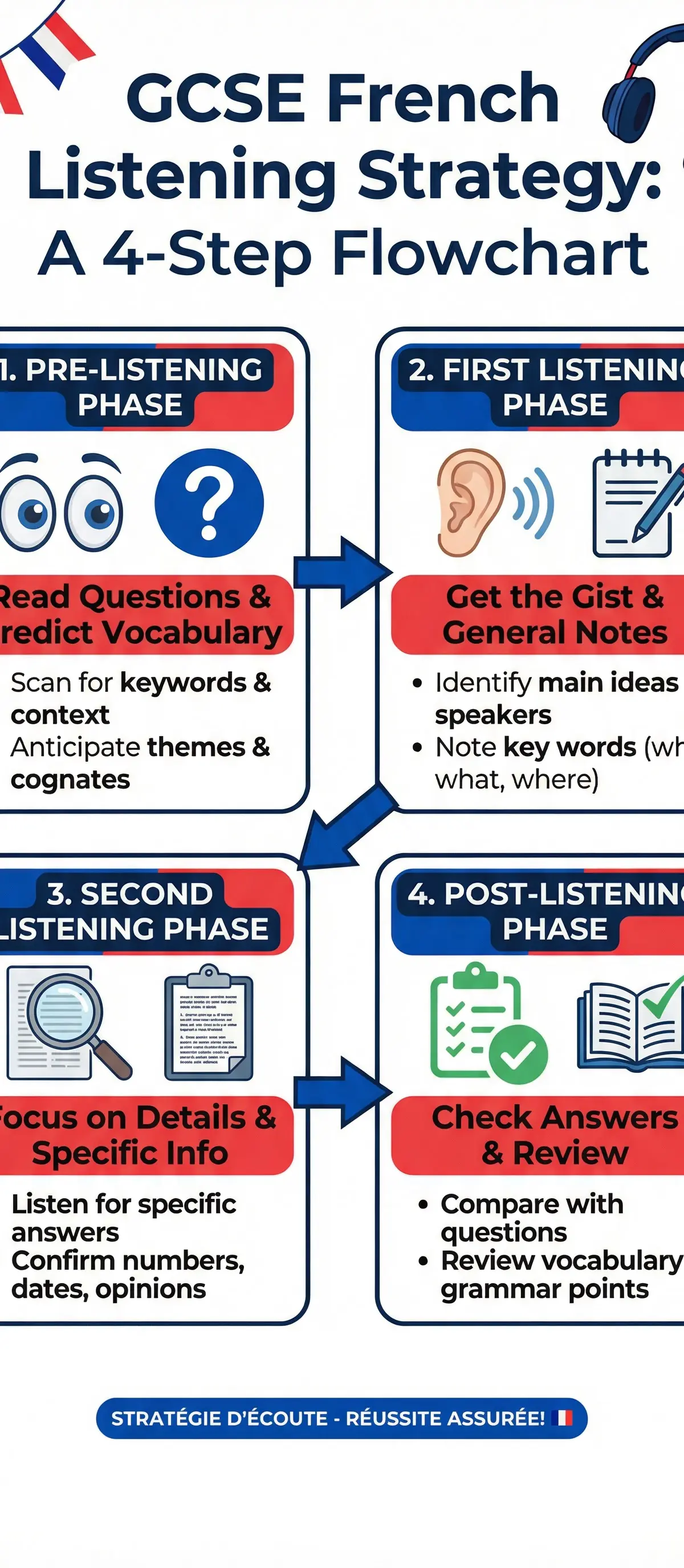
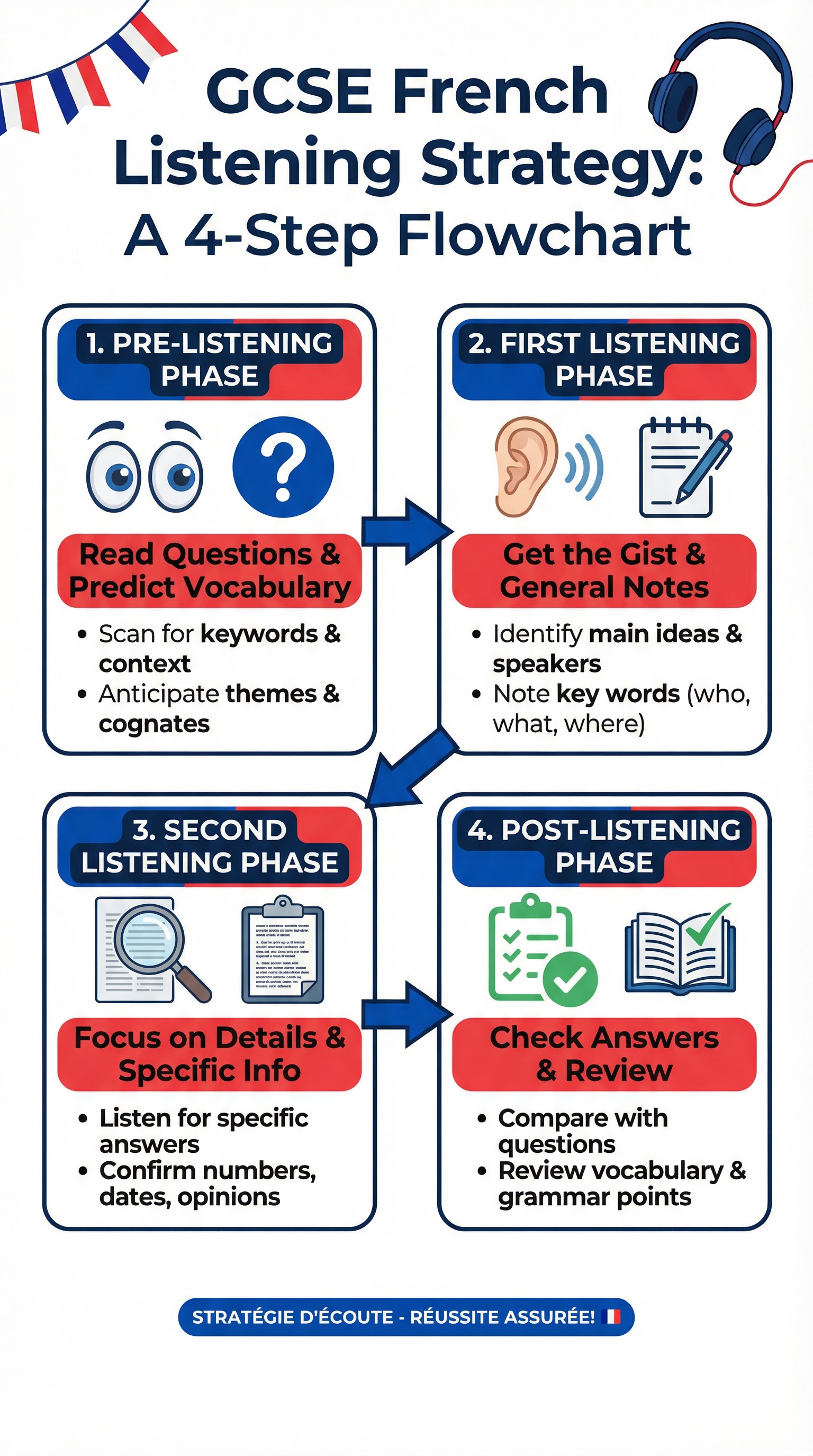
OCR provides candidates with two opportunities to hear each audio extract, and each listening serves a distinct purpose. During the first listening, your goal is to capture the gist: Who is speaking? What is the general topic? What is the overall tone or attitude? Do not panic if you miss specific details; this listening is about orientation and context. During the second listening, shift your focus to precision. Listen for specific keywords, numbers, dates, opinions, and grammatical markers. This is when you confirm your initial answers, fill in gaps, and check for distractors. Candidates who use both listenings strategically score significantly higher than those who attempt to answer all questions during the first listening.
Recognising Synonymy and Paraphrasing
Examiners frequently use synonyms and paraphrasing to test the depth of your vocabulary. For example, the audio might say "se détendre" (to relax), while the question asks about "relaxation." Similarly, "faire du sport" might be paraphrased as "être actif" or "s'entraîner." Candidates who recognise these connections earn marks, while those who search for exact word matches often miss the answer. To prepare, build synonym banks for common topics (family, hobbies, school, travel, health) and practice identifying paraphrased meanings in past papers.
Navigating Distractors
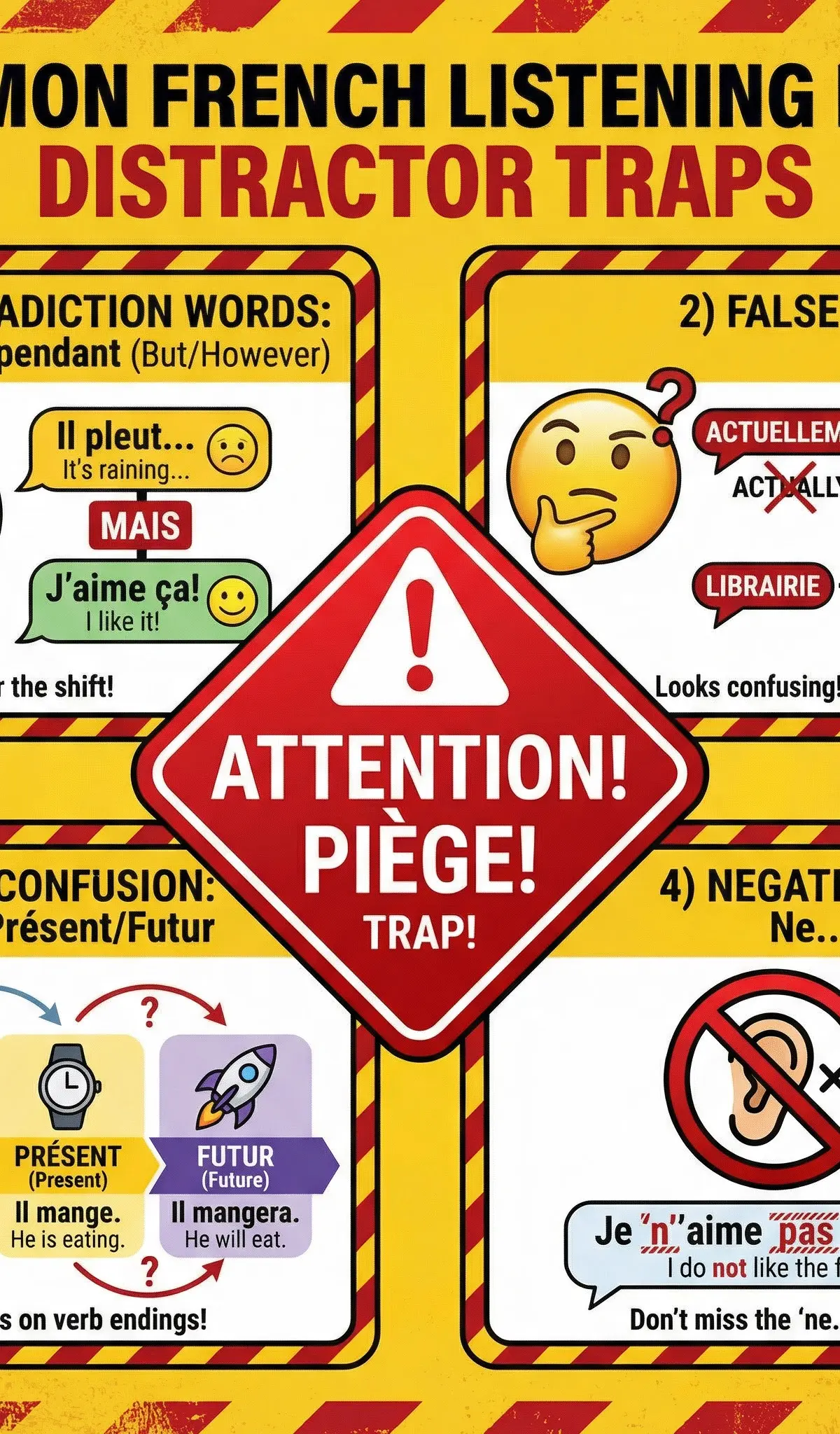
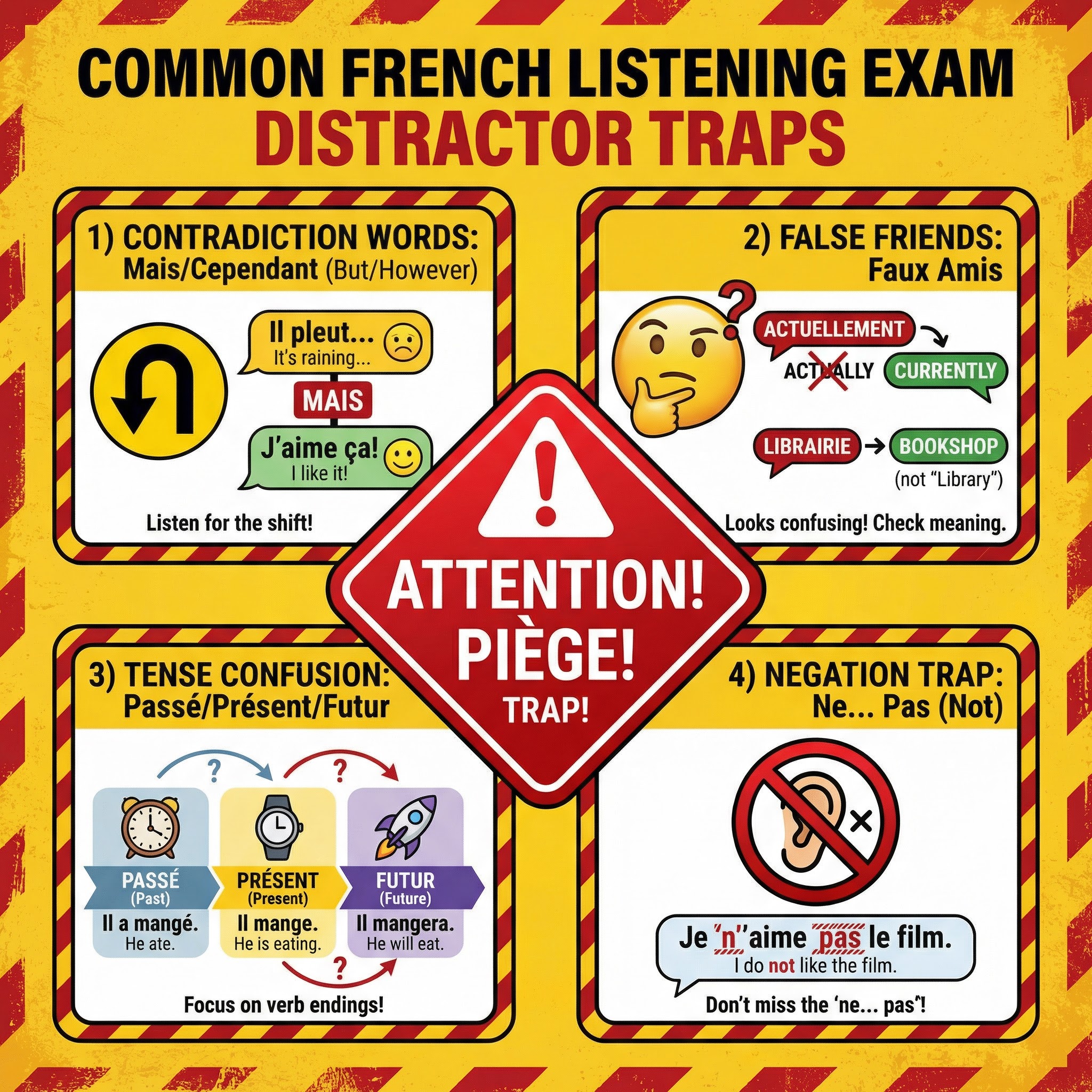
Distractors are deliberately placed incorrect options designed to test your attention and comprehension. The most common distractor trap occurs when the first piece of information you hear seems to answer the question, but is later contradicted or qualified by words such as "mais" (but), "cependant" (however), "pourtant" (yet), or "en fait" (actually). For example, a speaker might say, "J'aime le football... mais je préfère le tennis" (I like football... but I prefer tennis). If the question asks what sport the speaker prefers, the correct answer is tennis, not football. Always listen to the complete sentence before selecting your answer.
Tense and Temporal Markers
Accurate interpretation of tense is essential for distinguishing between past events, present situations, and future plans. Examiners test this by using temporal markers such as:
- Past: hier (yesterday), la semaine dernière (last week), j'ai fait (I did), je suis allé(e) (I went)
- Present: maintenant (now), actuellement (currently), je fais (I do/am doing), je vais (I go/am going)
- Future: demain (tomorrow), la semaine prochaine (next week), je vais faire (I'm going to do), je ferai (I will do)
Candidates who confuse "je vais aller" (I'm going to go) with "je suis allé" (I went) lose marks. Pay close attention to verb endings and auxiliary verbs (avoir, être) to determine tense accurately.
Negation Traps
Negation in French uses a two-part structure: "ne... pas" (not), "ne... jamais" (never), "ne... plus" (no longer), "ne... rien" (nothing). In spoken French, the "ne" is often dropped, so you must listen carefully for the second part of the negation. For example, "J'aime pas le film" (I don't like the film) contains a negation even though "ne" is absent. Candidates who miss the "pas" may interpret the sentence as positive, leading to an incorrect answer. Always listen for both parts of the negation and check whether the statement is affirmative or negative.
Faux Amis (False Friends)
Faux amis are French words that look or sound similar to English words but have different meanings. Common examples include:
- Actuellement = currently (NOT "actually")
- Librairie = bookshop (NOT "library" – bibliothèque)
- Assister à = to attend (NOT "to assist" – aider)
- Sensible = sensitive (NOT "sensible" – raisonnable)
Examiners deliberately include faux amis to test whether candidates rely on superficial similarity or true comprehension. Always verify the meaning of a word in context rather than assuming it matches the English cognate.
Exam Technique and Question Decoding
Using the Reading Time Effectively
Before the audio begins, you are given 5 minutes of reading time to review the questions. Use this time strategically:
- Highlight the 'Wh-' words (Qui, Que, Où, Quand, Pourquoi, Comment) to focus your listening.
- Underline key nouns and verbs in the question to anticipate the vocabulary field.
- Predict possible answers based on the question type (e.g., if the question asks "Où?", expect a place; if it asks "Quand?", expect a time).
- Note the marks allocated to each question to gauge the level of detail required.
Candidates who use the reading time effectively enter the listening phase with a clear focus, reducing cognitive load and improving accuracy.
Question Types and Mark Allocation
OCR uses several question types, each requiring a different approach:
| Question Type | Marks | Approach |
|---|---|---|
| Multiple choice (French) | 1 mark | Eliminate options contradicted by the audio; listen for distractors. |
| Multiple choice (English) | 1 mark | Ensure the English option conveys the full meaning without ambiguity. |
| Gap-fill (French) | 1 mark | Listen for the exact word or phrase; spelling must be accurate. |
| Short answer (English) | 1-2 marks | Provide the precise information required; avoid lifting entire sentences. |
| True/False/Not mentioned | 1 mark | Distinguish between information stated, implied, and absent. |
Higher-mark questions (2-3 marks) often require multiple pieces of information or justification. For example, a 2-mark question might ask, "Why does Marie prefer summer? Give two reasons." You must provide two distinct reasons to earn full marks.
Answering in English vs. French
When questions require answers in English, examiners assess whether you have understood the core meaning. Marks are awarded for accuracy and completeness, not for translation quality. Avoid ambiguous or vague answers. For example, if the audio says "Je vais au cinéma avec mes amis," and the question asks "Where is the speaker going?", the answer "cinema" or "to the cinema" earns the mark, but "out" or "somewhere" does not.
When questions require answers in French (e.g., gap-fill), spelling and grammatical accuracy are essential. Marks are not awarded for answers that contain errors, even if the meaning is clear.
Process of Elimination for Multiple Choice
For multiple-choice questions, use the process of elimination to narrow down options:
- Cross out options contradicted by the audio (e.g., if the speaker says "Je n'aime pas le football," eliminate any option suggesting they like football).
- Identify distractors (options that contain words heard in the audio but are incorrect in context).
- Select the option that matches the core meaning, even if the wording differs from the audio.
Candidates who use this method systematically improve their accuracy, especially on challenging questions.
Common Mistakes to Avoid
Indiscriminate Lifting
One of the most frequent errors is copying an entire sentence from the audio that contains the answer but also includes incorrect or irrelevant information. Examiners penalise this because it demonstrates a lack of precision. For example, if the audio says, "J'aime le football, mais je déteste le rugby," and the question asks "What sport does the speaker dislike?", the correct answer is "rugby," not "football and rugby." Always isolate the exact information required by the question.
Distractor Traps
As discussed earlier, distractor traps occur when the first option heard seems correct but is later contradicted. Candidates who select answers prematurely, without listening to the full sentence, lose marks. Always wait for qualifiers such as "mais," "cependant," or "en fait" before finalising your answer.
Tense Confusion
Misinterpreting tense is a common error that leads to incorrect answers. For example, confusing "je suis allé" (I went) with "je vais aller" (I'm going to go) changes the meaning entirely. Pay close attention to verb endings, auxiliary verbs, and temporal markers to determine whether the speaker is referring to the past, present, or future.
Ignoring Negation
Missing the negation in a sentence can reverse the meaning and lead to an incorrect answer. For example, "Je n'aime pas le cinéma" (I don't like the cinema) is the opposite of "J'aime le cinéma" (I like the cinema). Always listen for "ne... pas," "ne... jamais," "ne... plus," and other negation structures, even if the "ne" is dropped in spoken French.
Relying on Cognates Without Context
While cognates (words that look similar in French and English) can be helpful, relying on them without considering context can lead to errors, especially with faux amis. Always verify the meaning of a word based on how it is used in the sentence, rather than assuming it matches the English equivalent.
Named Example Bank: Key Vocabulary and Phrases
Examiners expect candidates to recognise and interpret a wide range of vocabulary across common GCSE topics. Below is a bank of named examples with specific phrases and their meanings:
Family and Relationships
- Mon frère aîné = my older brother
- Ma petite sœur = my younger sister
- Mes grands-parents = my grandparents
- Je m'entends bien avec... = I get along well with...
- On se dispute souvent = we often argue
Hobbies and Free Time
- Faire du sport = to do sport
- Jouer aux jeux vidéo = to play video games
- Se détendre = to relax
- Sortir avec des amis = to go out with friends
- Regarder des séries = to watch series
School and Education
- Les matières = subjects
- Réussir un examen = to pass an exam
- Échouer à un test = to fail a test
- Le professeur = the teacher
- Les devoirs = homework
Travel and Holidays
- Partir en vacances = to go on holiday
- Prendre l'avion = to take the plane
- Réserver un hôtel = to book a hotel
- Visiter des monuments = to visit monuments
- Se bronzer = to sunbathe
Health and Lifestyle
- Manger sainement = to eat healthily
- Faire de l'exercice = to exercise
- Se sentir fatigué(e) = to feel tired
- Avoir mal à la tête = to have a headache
- Être en forme = to be in good shape
Worked Examples with Examiner Commentary
Example 1: Multiple Choice Question (1 mark)
Audio Transcript:
"J'adore le football, mais mon sport préféré, c'est le tennis. Je joue tous les weekends."
Question:
Quel est le sport préféré de la personne?
A) Le football
B) Le tennis
C) Le rugby
Correct Answer: B) Le tennis
Solution:
The speaker begins by saying "J'adore le football" (I love football), which might tempt candidates to select option A. However, the key phrase is "mais mon sport préféré, c'est le tennis" (but my favourite sport is tennis). The word "mais" signals a contrast, indicating that while the speaker likes football, their true preference is tennis. The additional information "Je joue tous les weekends" (I play every weekend) reinforces that tennis is the preferred sport.
Examiner Commentary:
This question tests the candidate's ability to recognise a distractor trap. The mention of football early in the sentence is designed to mislead. Candidates who listen to the complete sentence and identify the contrasting conjunction "mais" will select the correct answer. Marks are awarded for precision and attention to qualifiers.
Example 2: Short Answer Question in English (2 marks)
Audio Transcript:
"L'année dernière, je suis allée en Espagne avec ma famille. On a visité Barcelone et on a mangé des tapas. C'était génial!"
Question:
Where did the speaker go last year, and what did they do there? (2 marks)
Correct Answer:
The speaker went to Spain (1 mark). They visited Barcelona and ate tapas (1 mark).
Solution:
The question requires two pieces of information: the destination and the activities. The phrase "L'année dernière, je suis allée en Espagne" (Last year, I went to Spain) provides the destination. The phrase "On a visité Barcelone et on a mangé des tapas" (We visited Barcelona and we ate tapas) provides the activities. Candidates must include both elements to earn full marks.
Examiner Commentary:
This is a 2-mark question, so examiners expect two distinct pieces of information. Candidates who write only "Spain" earn 1 mark, but those who also mention the activities (visiting Barcelona and eating tapas) earn the second mark. Precision and completeness are essential for higher-mark questions.
Example 3: True/False/Not Mentioned Question (1 mark)
Audio Transcript:
"Je vais aller au cinéma demain avec mes amis. On va regarder un film d'action."
Question:
The speaker went to the cinema yesterday.
A) True
B) False
C) Not mentioned
Correct Answer: B) False
Solution:
The speaker says "Je vais aller au cinéma demain" (I'm going to go to the cinema tomorrow), which is a future tense statement. The question asks whether the speaker went to the cinema yesterday, which is a past tense statement. Since the speaker is referring to a future event, the statement is false.
Examiner Commentary:
This question tests the candidate's ability to distinguish between tenses. The use of "vais aller" (going to go) and "demain" (tomorrow) clearly indicates a future event, not a past one. Candidates who confuse tenses or misinterpret temporal markers will select "True" or "Not mentioned," losing the mark. Accurate tense recognition is critical for success.
Example 4: Gap-Fill Question in French (1 mark)
Audio Transcript:
"Mon frère aîné s'appelle Thomas. Il a vingt-deux ans et il étudie la médecine à l'université."
Question:
Mon frère s'appelle __________ et il étudie la __________.
Correct Answer:
Mon frère s'appelle Thomas et il étudie la médecine.
Solution:
The audio provides two pieces of information: the brother's name ("Thomas") and his field of study ("la médecine"). Candidates must listen carefully and spell both words correctly. The phrase "Il étudie la médecine" (He studies medicine) provides the second answer.
Examiner Commentary:
Spelling accuracy is essential for gap-fill questions. Candidates who write "Tomas" or "medicine" (in English) will not receive marks. Examiners expect candidates to reproduce the exact French words heard in the audio. This question also tests vocabulary recognition ("médecine" = medicine).
Example 5: Opinion and Justification Question (3 marks)
Audio Transcript:
"Je préfère l'été parce qu'il fait chaud et on peut aller à la plage. En plus, il n'y a pas d'école, donc je peux me détendre et passer du temps avec mes amis."
Question:
Why does the speaker prefer summer? Give three reasons. (3 marks)
Correct Answer:
- It's hot / the weather is hot (1 mark)
- You can go to the beach (1 mark)
- There's no school / they can relax and spend time with friends (1 mark)
Solution:
The speaker provides three distinct reasons for preferring summer:
- "Il fait chaud" (It's hot)
- "On peut aller à la plage" (You can go to the beach)
- "Il n'y a pas d'école, donc je peux me détendre et passer du temps avec mes amis" (There's no school, so I can relax and spend time with my friends)
Candidates must identify and list all three reasons to earn full marks.
Examiner Commentary:
This is a 3-mark question, so examiners expect three separate pieces of information. Candidates who provide only two reasons earn 2 marks. The phrase "En plus" (In addition) signals that a new reason is being introduced, so candidates should listen for such connectors. Precision and completeness are rewarded.
Memory Hooks and Mnemonics
Mnemonic 1: The "WHAM" Strategy for Reading Time
What is the question asking? (Highlight the Wh- word)
Highlight key nouns and verbs
Anticipate the vocabulary field
Mark allocation – how much detail is needed?
This mnemonic helps you structure your reading time effectively, ensuring you enter the listening phase with a clear focus.
Mnemonic 2: "MAIS" – The Distractor Detector
Mais (but)
Actually (en fait)
In contrast (cependant)
Still/yet (pourtant)
Whenever you hear one of these words, a distractor trap is likely present. The first piece of information is often incorrect, and the correct answer follows the contrasting word.
Mnemonic 3: "PPN" – Past, Present, or Next?
Past: j'ai fait, je suis allé(e), hier, la semaine dernière
Present: je fais, je vais, maintenant, actuellement
Next (Future): je vais faire, je ferai, demain, la semaine prochaine
Use this mnemonic to quickly identify the tense of a verb and avoid tense confusion.
Mnemonic 4: "FAUX" – False Friends to Watch For
Faux = actuellement (currently, NOT "actually")
Attend = assister à (to attend, NOT "to assist")
Understand = librairie (bookshop, NOT "library")
X-tra careful = sensible (sensitive, NOT "sensible")
This mnemonic reminds you to verify the meaning of words that look similar to English but have different meanings.
Mnemonic 5: "NEGATION" – Don't Miss the "Ne... Pas"
Ne... pas (not)
Ever = ne... jamais (never)
Gone = ne... plus (no longer)
Anything = ne... rien (nothing)
Time to listen for both parts!
Ignoring negation = wrong answer
Often the "ne" is dropped in spoken French
Note the second part (pas, jamais, plus, rien)
This mnemonic emphasises the importance of listening for negation structures to avoid reversing the meaning of a sentence.
Practice Questions with Model Answers
Practice Question 1: Multiple Choice (1 mark)
Audio Transcript:
"Je voudrais aller en France cet été, mais mes parents préfèrent l'Italie."
Question:
Où est-ce que la famille va aller en vacances?
A) En France
B) En Italie
C) En Espagne
Difficulty: Standard
Hint: Listen for the contrasting word "mais" to identify the correct answer.
Model Answer: B) En Italie
Mark Scheme Breakdown:
- 1 mark: Correct identification of Italy as the destination, recognising that the parents' preference ("mes parents préfèrent l'Italie") determines the family's plans.
- 0 marks: Selecting France (distractor trap) or Spain (not mentioned).
Common Wrong Answers:
Candidates often select "En France" because it is mentioned first. However, the word "mais" signals a contrast, indicating that the family will go to Italy instead.
Practice Question 2: Short Answer in English (2 marks)
Audio Transcript:
"Mon professeur de maths est très strict. Il donne beaucoup de devoirs et il n'aime pas quand on arrive en retard."
Question:
What does the speaker say about their maths teacher? Give two details. (2 marks)
Difficulty: Standard
Hint: Listen for two distinct pieces of information about the teacher's characteristics or behaviour.
Model Answer:
- The teacher is very strict (1 mark)
- The teacher gives a lot of homework / doesn't like it when students arrive late (1 mark)
Mark Scheme Breakdown:
- Level 1 (1 mark): One correct detail provided.
- Level 2 (2 marks): Two correct details provided.
Common Wrong Answers:
Candidates who provide only one detail (e.g., "The teacher is strict") earn 1 mark. To earn full marks, they must also mention the homework or the lateness.
Practice Question 3: True/False/Not Mentioned (1 mark)
Audio Transcript:
"J'aime beaucoup lire des romans. Mon livre préféré, c'est 'Le Petit Prince'."
Question:
The speaker enjoys reading magazines.
A) True
B) False
C) Not mentioned
Difficulty: Standard
Hint: Distinguish between what is stated and what is not mentioned.
Model Answer: C) Not mentioned
Mark Scheme Breakdown:
- 1 mark: Correct identification that magazines are not mentioned in the audio.
- 0 marks: Selecting "True" (incorrect) or "False" (implies the speaker dislikes magazines, which is not stated).
Common Wrong Answers:
Candidates might select "False" because the speaker mentions novels, assuming this means they don't like magazines. However, the audio does not mention magazines at all, so the correct answer is "Not mentioned."
Practice Question 4: Gap-Fill in French (1 mark)
Audio Transcript:
"Ma sœur adore les animaux. Elle a un chien qui s'appelle Max et un chat qui s'appelle Minou."
Question:
Ma sœur a un __________ qui s'appelle Max.
Difficulty: Easy
Hint: Listen for the type of animal mentioned.
Model Answer: chien
Mark Scheme Breakdown:
- 1 mark: Correct spelling of "chien" (dog).
- 0 marks: Incorrect spelling (e.g., "chein") or writing the English word "dog."
Common Wrong Answers:
Candidates who misspell "chien" or write "dog" in English will not receive the mark. Spelling accuracy is essential for gap-fill questions.
Practice Question 5: Opinion and Justification (3 marks)
Audio Transcript:
"Je n'aime pas l'hiver parce qu'il fait trop froid. En plus, il fait nuit très tôt et je ne peux pas sortir avec mes amis. Enfin, je déteste porter des vêtements chauds."
Question:
Why does the speaker dislike winter? Give three reasons. (3 marks)
Difficulty: Standard
Hint: Listen for three distinct reasons introduced by connectors such as "parce que," "en plus," and "enfin."
Model Answer:
- It's too cold (1 mark)
- It gets dark very early / they can't go out with friends (1 mark)
- They hate wearing warm clothes (1 mark)
Mark Scheme Breakdown:
- Level 1 (1 mark): One correct reason provided.
- Level 2 (2 marks): Two correct reasons provided.
- Level 3 (3 marks): Three correct reasons provided.
Common Wrong Answers:
Candidates who provide only two reasons earn 2 marks. To earn full marks, they must identify all three reasons, paying attention to connectors such as "en plus" and "enfin" that signal additional information.
Key Definitions
Active Listening
Definition: A cognitive process that involves engaging with spoken language, anticipating content, and making connections between what is heard and what is required by the question.
Context: Examiners expect candidates to demonstrate active listening by accurately locating information, even when it is embedded within longer passages or surrounded by distractors.
Distractor
Definition: A deliberately placed incorrect option in a multiple-choice question or an early piece of information in an audio extract that seems correct but is later contradicted.
Context: Examiners use distractors to test whether candidates listen to the complete sentence and identify qualifiers such as "mais" or "cependant."
Synonymy
Definition: The use of different words or phrases with the same or similar meanings.
Context: Examiners test synonymy by using one word in the audio (e.g., "se détendre") and a different but related word in the question (e.g., "relaxation"). Candidates must recognise these connections to earn marks.
Temporal Marker
Definition: A word or phrase that indicates when an action takes place (past, present, or future).
Context: Examples include "hier" (yesterday), "maintenant" (now), and "demain" (tomorrow). Examiners use temporal markers to test candidates' ability to distinguish between tenses.
Negation
Definition: A grammatical structure that reverses the meaning of a sentence, typically using "ne... pas," "ne... jamais," "ne... plus," or "ne... rien."
Context: Examiners test negation by including sentences where missing the negation leads to the opposite meaning. Candidates must listen for both parts of the negation, even if "ne" is dropped in spoken French.
Faux Ami (False Friend)
Definition: A French word that looks or sounds similar to an English word but has a different meaning.
Context: Examples include "actuellement" (currently, not "actually") and "librairie" (bookshop, not "library"). Examiners include faux amis to test whether candidates rely on superficial similarity or true comprehension.
Indiscriminate Lifting
Definition: The practice of copying an entire sentence from the audio that contains the correct answer but also includes incorrect or irrelevant information.
Context: Examiners penalise indiscriminate lifting because it demonstrates a lack of precision. Candidates must isolate the exact information required by the question.
Quick Summary
- Active listening is essential: engage with the audio, anticipate content, and focus on question words.
- Use the two-listen strategy: first listening for gist, second listening for detail.
- Watch for distractor traps: words like "mais," "cependant," and "en fait" signal contradictions.
- Recognise synonymy and paraphrasing: examiners use different words with the same meaning.
- Pay attention to tense and temporal markers: distinguish between past, present, and future.
- Listen for negation: "ne... pas," "ne... jamais," "ne... plus," "ne... rien."
- Beware of faux amis: verify the meaning of words that look similar to English.
- Avoid indiscriminate lifting: isolate the exact information required by the question.
- Use the reading time to highlight key words, predict vocabulary, and note mark allocations.
- Practice with past papers to familiarise yourself with question types and examiner expectations.
Worked Examples
4 worked examples — open one to explore the question and available guidance.
Practice Questions
Test your understanding — click to reveal model answers
Audio: 'Je voudrais aller en France cet été, mais mes parents préfèrent l'Italie.' Question: Où est-ce que la famille va aller en vacances? A) En France B) En Italie C) En Espagne
Hint: Listen for the contrasting word 'mais' to identify the correct answer.
Audio: 'Mon professeur de maths est très strict. Il donne beaucoup de devoirs et il n'aime pas quand on arrive en retard.' Question: What does the speaker say about their maths teacher? Give two details. (2 marks)
Hint: Listen for two distinct pieces of information about the teacher's characteristics or behaviour.
Audio: 'J'aime beaucoup lire des romans. Mon livre préféré, c'est 'Le Petit Prince'.' Question: The speaker enjoys reading magazines. A) True B) False C) Not mentioned
Hint: Distinguish between what is stated and what is not mentioned.
Audio: 'Ma sœur adore les animaux. Elle a un chien qui s'appelle Max et un chat qui s'appelle Minou.' Question: Ma sœur a un __________ qui s'appelle Max.
Hint: Listen for the type of animal mentioned.
Audio: 'Je n'aime pas l'hiver parce qu'il fait trop froid. En plus, il fait nuit très tôt et je ne peux pas sortir avec mes amis. Enfin, je déteste porter des vêtements chauds.' Question: Why does the speaker dislike winter? Give three reasons. (3 marks)
Hint: Listen for three distinct reasons introduced by connectors such as 'parce que,' 'en plus,' and 'enfin.'