AQA · A-Level · Geography
Course version: 7037 · Version from Sept 2018
Distinctively arid geomorphological processes: weathering (thermal…
Full specification wording
Hot desert systems and landscapes - 3.1.2.2 Systems and processes: Distinctively arid geomorphological processes: weathering (thermal fracture, exfoliation, chemical weathering, block and granular disintegration).
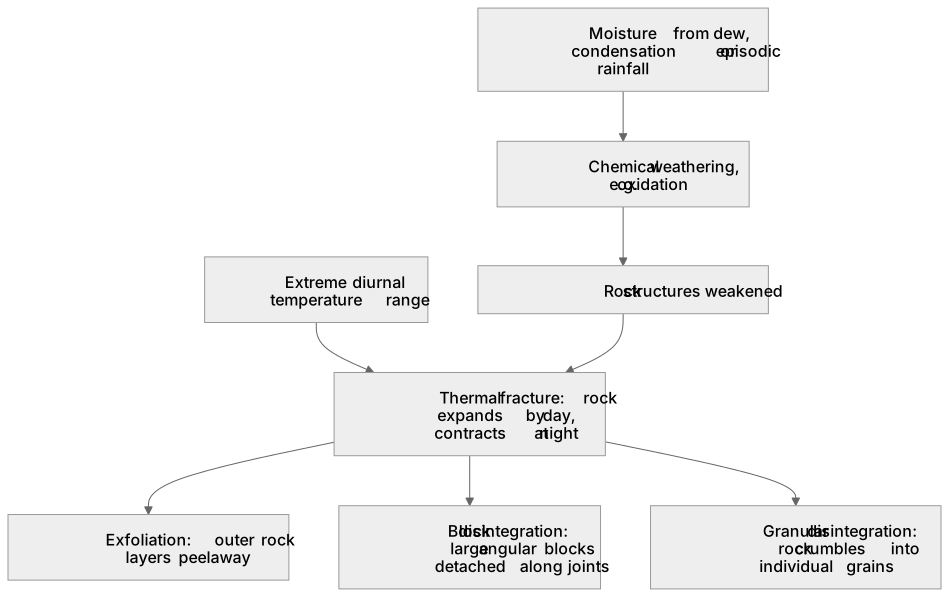
Arid environments experience intense weathering driven by extreme diurnal temperature ranges and limited moisture.
Checked against the AQA 7037 specification (opens in a new tab) on .
- Point 4 of 6
- 4 key terms
Study notes
From the checked teaching notes for this specification point.
The idea
Arid environments experience intense weathering driven by extreme diurnal temperature ranges and limited moisture. Thermal fracture occurs when rocks rapidly expand during hot days and contract at night, creating stress. This causes exfoliation, where outer rock layers peel away, often seen in granite. Block disintegration affects well-jointed rocks like limestone, where thermal stress detaches large angular blocks along joints. Granular disintegration targets heterogeneous rocks like sandstone, where minerals expand at different rates, crumbling the rock into sand. Despite aridity, chemical weathering (like oxidation) still operates, facilitated by dew or seasonal rain, slowly weakening rock structures to aid physical breakdown.
What earns the marks
- Explain thermal fracture as the result of extreme diurnal temperature ranges causing repeated expansion and contraction.
- Distinguish exfoliation (peeling of outer layers) from block disintegration (breakdown along joints) and granular disintegration (crumbling of individual grains).
- Identify the role of rock structure and mineral composition in determining the type of physical weathering.
- Acknowledge that chemical weathering requires moisture, which is supplied by dew, condensation, or episodic rainfall in hot deserts.
Common mistakes and how to put them right
Stating that chemical weathering does not occur in hot deserts.
Put it right: Explain that chemical weathering does occur, albeit slowly, facilitated by dew, coastal fog, or episodic rainfall.
Confusing block and granular disintegration.
Put it right: Specify that block disintegration involves rocks breaking along joints into large chunks, whereas granular disintegration involves the breakdown of individual mineral grains.
Attributing exfoliation solely to freeze-thaw weathering.
Put it right: Attribute exfoliation in hot deserts to thermal fracture caused by extreme diurnal temperature fluctuations.
Exam tips
- Always link the specific weathering process to the rock type and its structural characteristics, such as jointing or mineral composition.
- Use the concept of diurnal temperature range to explain the driving force behind thermal fracture.
- When discussing desert landscapes, mention how chemical weathering works in tandem with physical weathering to weaken rock surfaces.
Try the lesson
The start of the Hot desert systems and landscapes - 3.1.2.2 Systems and processes: Distinctively arid geomorphological processes: weathering (thermal fracture, exfoliation, chemical weathering, block and granular disintegration). lesson, made from checked teaching notes for this specification point.
Have a go first
Which distinctively arid weathering process is characterised by the peeling away of the outer layers of a rock, often resembling the layers of an onion?
Listen
Arid environments experience intense weathering driven by extreme diurnal temperature ranges and limited moisture. Thermal fracture occurs when rocks rapidly expand during hot days and contract at night, creating stress. This causes exfoliation, where outer rock layers peel away, often seen in granite. Block disintegration affects well-jointed rocks like limestone, where thermal stress detaches large angular blocks along joints. Granular disintegration targets heterogeneous rocks like sandstone, where minerals expand at different rates, crumbling the rock into sand. Despite aridity, chemical weathering (like oxidation) still operates, facilitated by dew or seasonal rain, slowly weakening rock structures to aid physical breakdown. A strong answer earns marks for these points. Explain thermal fracture as the result of extreme diurnal temperature ranges causing repeated expansion and contraction. Distinguish exfoliation (peeling of outer layers) from block disintegration (breakdown along joints) and granular disintegration (crumbling of individual grains). Identify the role of rock structure and mineral composition in determining the type of physical weathering. Acknowledge that chemical weathering requires moisture, which is supplied by dew, condensation, or episodic rainfall in hot deserts. A common slip: Stating that chemical weathering does not occur in hot deserts. Instead, Explain that chemical weathering does occur, albeit slowly, facilitated by dew, coastal fog, or episodic rainfall. Exam tip: Always link the specific weathering process to the rock type and its structural characteristics, such as jointing or mineral composition.
See it
Key words
Say what each word means before you turn the card.
Thermal fracture
Try answering aloud or in your head before turning the card.
Exfoliation
Try answering aloud or in your head before turning the card.
Block disintegration
Try answering aloud or in your head before turning the card.
Granular disintegration
Try answering aloud or in your head before turning the card.
See every definition
- Thermal fracture
- Occurs when rocks rapidly expand during hot days and contract at night, creating stress.
- Exfoliation
- Outer rock layers peel away, often seen in granite.
- Block disintegration
- Affects well-jointed rocks like limestone, where thermal stress detaches large angular blocks along joints.
- Granular disintegration
- Targets heterogeneous rocks like sandstone, where minerals expand at different rates, crumbling the rock into sand.
Label the diagram
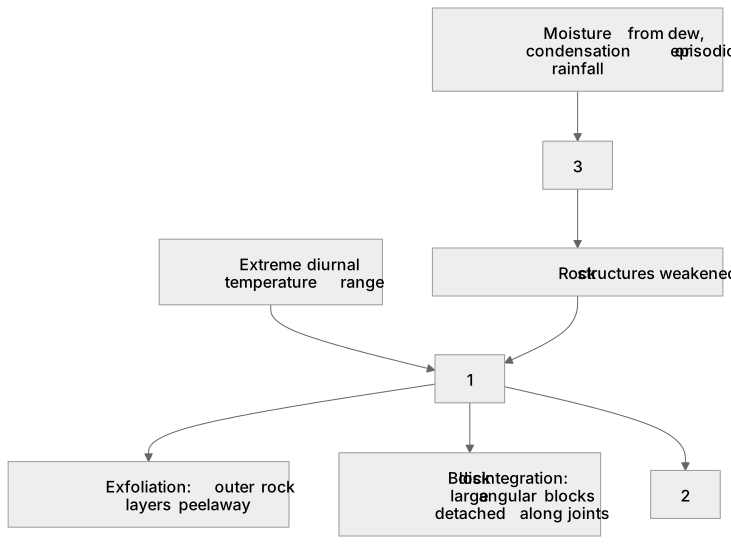
Some boxes have lost their names. Pick the right name for each number.
1Box 1
2Box 2
3Box 3
There is more to this lesson
The full lesson goes on to check your understanding and help you earn the marks. Create a free account to carry on, with your progress saved.
A week of Premium from your first lesson · Then the free plan continues · No card, no charge
Test your understanding of Hot desert systems and landscapes - 3.1.2.2 Systems and processes: Distinctively arid geomorphological processes: weathering (thermal fracture, exfoliation, chemical weathering, block and granular disintegration).
Active recall beats re-reading. Take an instant quiz now to test what you’ve learned and lock it into long-term memory.
A week of Premium from your first lesson · Then the free plan continues · No card, no charge