AQA · A-Level · Geography
Course version: 7037 · Version from Sept 2018
Use of innovative sources of data such as crowd sourcing and ‘big data’.
Full specification wording
ICT skills: Use of innovative sources of data such as crowd sourcing and ‘big data’.
Innovative data sources have transformed geographical research by providing massive, real-time datasets.
Checked against the AQA 7037 specification (opens in a new tab) on .
- Point 3 of 4
- 2 key terms
Study notes
From the checked teaching notes for this specification point.
The idea
Innovative data sources have transformed geographical research by providing massive, real-time datasets. 'Big data' refers to extremely large datasets analysed computationally to reveal patterns and associations. For instance, analysing mobile phone GPS pings or smart card taps reveals complex urban commuting flows. Crowd sourcing involves obtaining information by enlisting a large number of people, typically via the internet. A concrete example is OpenStreetMap, where volunteers map local infrastructure, or using social media geotags to track public responses during a natural hazard. Geographers must evaluate these sources for representativeness, as they often exclude demographics with limited digital access, creating spatial biases.
What earns the marks
- Define and distinguish between big data (massive computational datasets) and crowd-sourced data (user-generated information).
- Apply innovative data sources to geographical contexts, such as using social media sentiment analysis for place perception.
- Assess the ethical implications of using big data, including privacy concerns and data ownership.
- Evaluate the methodological limitations of crowd-sourced data, particularly regarding self-selection bias and digital exclusion.
Common mistakes and how to put them right
Confusing big data with standard secondary data.
Put it right: Specify that big data involves volume, velocity, and variety that require computational analysis, unlike standard spreadsheets.
Assuming crowd-sourced data is perfectly representative.
Put it right: Acknowledge that crowd-sourcing often excludes older or lower-income populations who lack digital access.
Ignoring the ethical issues of big data.
Put it right: Consider privacy, consent, and anonymity when discussing the use of mobile or social media data.
Exam tips
- Provide specific examples of innovative data, such as Strava heatmaps for transport planning or USGS 'Did You Feel It?' for earthquake intensity.
- When evaluating crowd-sourced data, explicitly discuss the digital divide and how it skews spatial representation.
- Link the use of big data to specific geographical concepts, such as using real-time transport data to understand time-space compression.
Try the lesson
The start of the ICT skills: Use of innovative sources of data such as crowd sourcing and ‘big data’. lesson, made from checked teaching notes for this specification point.
Have a go first
In the context of geographical research, which scenario is the clearest example of using crowd-sourced data?
Listen
Innovative data sources have transformed geographical research by providing massive, real-time datasets. Big data' refers to extremely large datasets analysed computationally to reveal patterns and associations. For instance, analysing mobile phone GPS pings or smart card taps reveals complex urban commuting flows. Crowd sourcing involves obtaining information by enlisting a large number of people, typically via the internet. A concrete example is OpenStreetMap, where volunteers map local infrastructure, or using social media geotags to track public responses during a natural hazard. Geographers must evaluate these sources for representativeness, as they often exclude demographics with limited digital access, creating spatial biases. A strong answer earns marks for these points. Define and distinguish between big data (massive computational datasets) and crowd-sourced data (user-generated information). Apply innovative data sources to geographical contexts, such as using social media sentiment analysis for place perception. Assess the ethical implications of using big data, including privacy concerns and data ownership. Evaluate the methodological limitations of crowd-sourced data, particularly regarding self-selection bias and digital exclusion. A common slip: Confusing big data with standard secondary data. Instead, specify that big data involves volume, velocity, and variety that require computational analysis, unlike standard spreadsheets. Exam tip: Provide specific examples of innovative data, such as Strava heatmaps for transport planning or USGS 'Did You Feel It?' for earthquake intensity.
See it
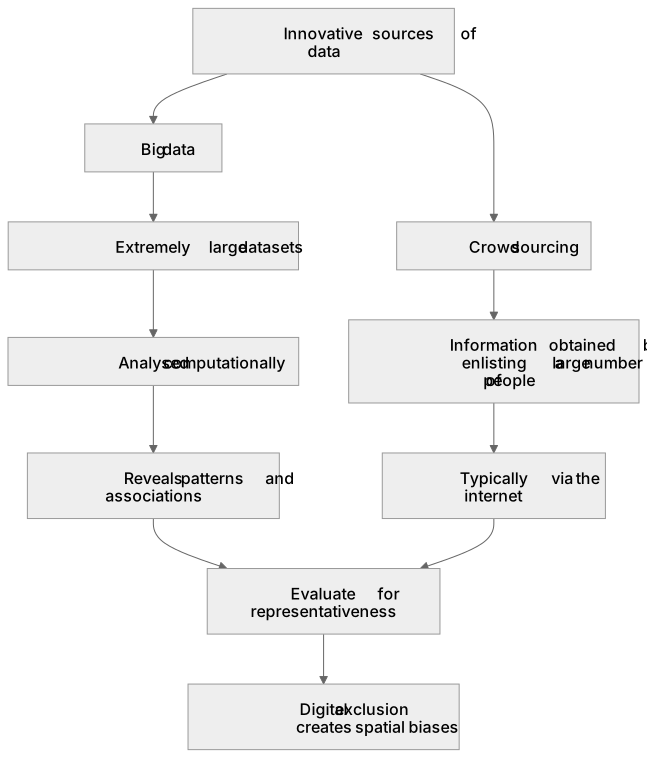
Key words
Say what each word means before you turn the card.
Big data
Try answering aloud or in your head before turning the card.
Crowd sourcing
Try answering aloud or in your head before turning the card.
See every definition
- Big data
- Extremely large datasets analysed computationally to reveal patterns and associations.
- Crowd sourcing
- Obtaining information by enlisting a large number of people, typically via the internet.
Label the diagram
Some boxes have lost their names. Pick the right name for each number.
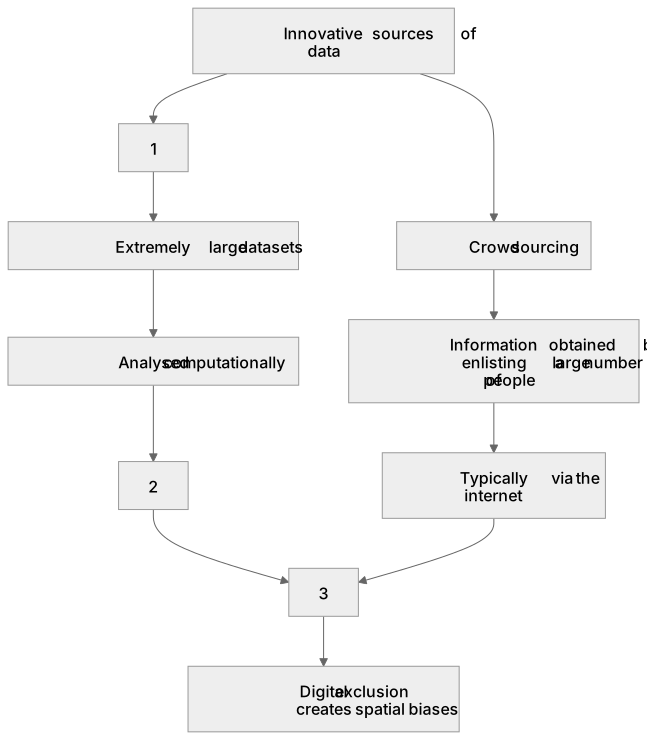
1Box 1
2Box 2
3Box 3
There is more to this lesson
The full lesson goes on to check your understanding and help you earn the marks. Create a free account to carry on, with your progress saved.
A week of Premium from your first lesson · Then the free plan continues · No card, no charge
Test your understanding of ICT skills: Use of innovative sources of data such as crowd sourcing and ‘big data’.
Active recall beats re-reading. Take an instant quiz now to test what you’ve learned and lock it into long-term memory.
A week of Premium from your first lesson · Then the free plan continues · No card, no charge