AQA · A-Level · History
Course version: 7042 · Version from Sept 2017
Economic developments; royal finances, policies and impact of overseas…
Full specification wording
1B Spain in the Age of Discovery, 1469–1598 (A-level only) – The 'Golden Age', 1556–1598 (A-level only): Economic developments; royal finances, policies and impact of overseas empire
Philip II’s reign saw major economic developments driven by silver from the overseas empire.
Checked against the AQA 7042 specification (opens in a new tab) on .
- Point 4 of 6
- 4 key terms
Study notes
From the checked teaching notes for this specification point.
The idea
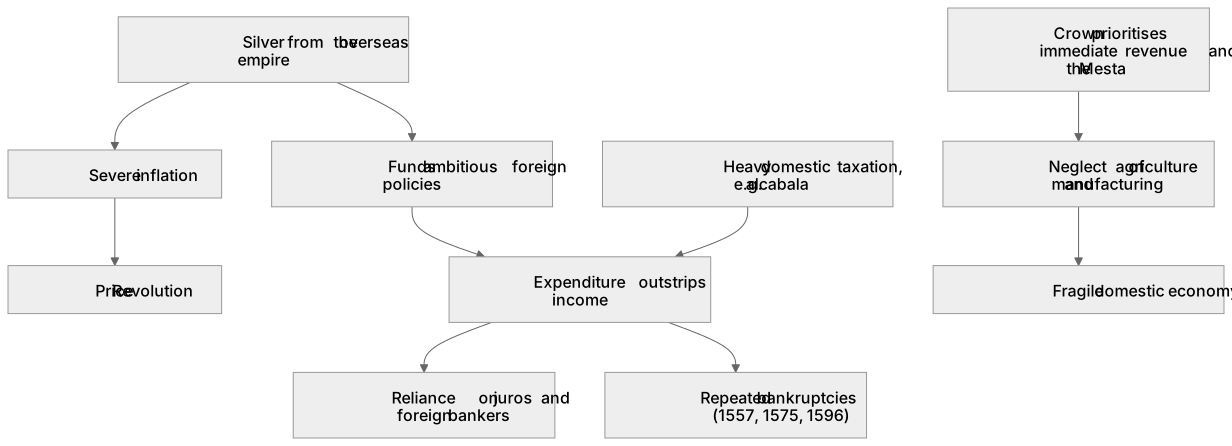
Philip II’s reign saw major economic developments driven by silver from the overseas empire. While this bullion funded ambitious foreign policies, it triggered severe inflation, exacerbating the Price Revolution. Royal finances remained chronically unstable; despite imperial wealth and heavy domestic taxation like the alcabala, expenditure consistently outstripped income. This structural deficit forced the Crown into repeated bankruptcies (1557, 1575, 1596) and reliance on juros (state bonds) and foreign bankers. Economic policies often hindered domestic growth, as the Crown prioritised immediate revenue and the interests of the Mesta over agricultural and manufacturing development, leaving Spain's domestic economy fundamentally fragile.
What earns the marks
- Analyse the causes of royal bankruptcies, focusing on the mismatch between imperial expenditure and domestic revenue.
- Evaluate the impact of American silver on the Spanish economy, specifically its role in driving inflation and the Price Revolution.
- Assess the effectiveness of royal economic policies, including taxation methods like the alcabala and the reliance on juros.
- Examine the negative consequences of the overseas empire on domestic industries, such as the neglect of agriculture in favour of the Mesta.
Common mistakes and how to put them right
Claiming that American silver made Spain universally wealthy.
Put it right by explaining that the bullion largely passed through Spain to pay foreign creditors and fund wars.
Stating that bankruptcies meant Spain had no money.
Put it right by defining them as debt restructurings or suspensions of payments to bankers, not absolute insolvency.
Ignoring the tax burden on Castile.
Put it right by emphasising that Castile bore the brunt of royal taxation compared to the relatively exempt peripheral kingdoms like Aragon.
Exam tips
- Use the dates of the royal bankruptcies (1557, 1575, 1596) as concrete evidence of the structural weaknesses in Philip II's finances.
- Contrast the immense wealth extracted from the overseas empire with the stagnation of domestic agriculture and manufacturing.
- Discuss the role of Genoese bankers to illustrate the Crown's reliance on foreign credit to sustain its foreign policy.
Try the lesson
The start of the 1B Spain in the Age of Discovery, 1469–1598 (A-level only) – The 'Golden Age', 1556–1598 (A-level only): Economic developments; royal finances, policies and impact of overseas empire lesson, made from checked teaching notes for this specification point.
Have a go first
What was a major economic consequence of the influx of silver from the Americas into Spain during the late sixteenth century?
Listen
Philip II’s reign saw major economic developments driven by silver from the overseas empire. While this bullion funded ambitious foreign policies, it triggered severe inflation, exacerbating the Price Revolution. Royal finances remained chronically unstable; despite imperial wealth and heavy domestic taxation like the alcabala, expenditure consistently outstripped income. This structural deficit forced the Crown into repeated bankruptcies (1557, 1575, 1596) and reliance on juros (state bonds) and foreign bankers. Economic policies often hindered domestic growth, as the Crown prioritised immediate revenue and the interests of the Mesta over agricultural and manufacturing development, leaving Spain's domestic economy fundamentally fragile. A strong answer earns marks for these points. Analyse the causes of royal bankruptcies, focusing on the mismatch between imperial expenditure and domestic revenue. Evaluate the impact of American silver on the Spanish economy, specifically its role in driving inflation and the Price Revolution. Assess the effectiveness of royal economic policies, including taxation methods like the alcabala and the reliance on juros. Examine the negative consequences of the overseas empire on domestic industries, such as the neglect of agriculture in favour of the Mesta. A common slip: Claiming that American silver made Spain universally wealthy. Instead, explaining that the bullion largely passed through Spain to pay foreign creditors and fund wars. Exam tip: Use the dates of the royal bankruptcies (1557, 1575, 1596) as concrete evidence of the structural weaknesses in Philip II's finances.
See it
Key words
Say what each word means before you turn the card.
Economic instability and inflation
Try answering aloud or in your head before turning the card.
Imperialism and resource extraction
Try answering aloud or in your head before turning the card.
Taxation and state finance
Try answering aloud or in your head before turning the card.
Domestic economic stagnation
Try answering aloud or in your head before turning the card.
See every definition
- Economic instability and inflation
- Severe inflation triggered by bullion from the overseas empire exacerbated the Price Revolution, while royal finances remained chronically unstable as expenditure consistently outstripped income.
- Imperialism and resource extraction
- Silver from the overseas empire funded ambitious foreign policies, though the bullion largely passed through Spain to pay foreign creditors and fund wars.
- Taxation and state finance
- Heavy domestic taxation like the alcabala failed to cover expenditure, forcing the Crown into repeated bankruptcies and reliance on juros and foreign bankers.
- Domestic economic stagnation
- Economic policies often hindered domestic growth, as the Crown prioritised immediate revenue and the interests of the Mesta over agricultural and manufacturing development, leaving the domestic economy fundamentally fragile.
Label the diagram
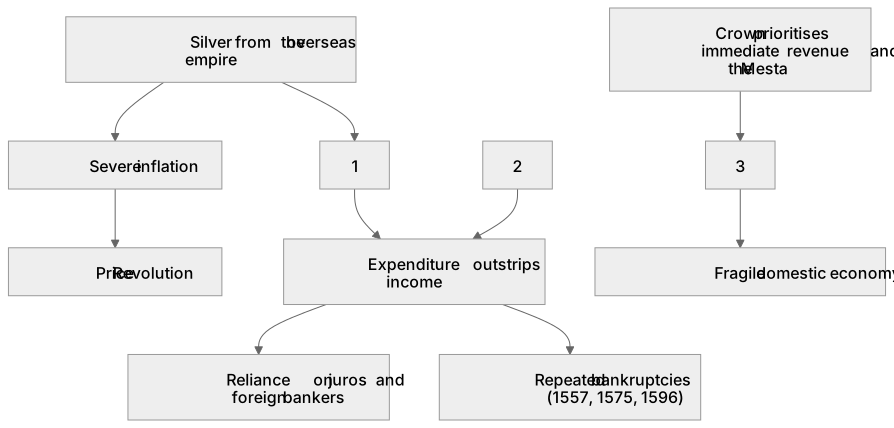
Some boxes have lost their names. Pick the right name for each number.
1Box 1
2Box 2
3Box 3
There is more to this lesson
The full lesson goes on to check your understanding and help you earn the marks. Create a free account to carry on, with your progress saved.
A week of Premium from your first lesson · Then the free plan continues · No card, no charge
Test your understanding of 1B Spain in the Age of Discovery, 1469–1598 (A-level only) – The 'Golden Age', 1556–1598 (A-level only): Economic developments; royal finances, policies and impact of overseas empire
Active recall beats re-reading. Take an instant quiz now to test what you’ve learned and lock it into long-term memory.
A week of Premium from your first lesson · Then the free plan continues · No card, no charge