AQA · A-Level · History
Course version: 7042 · Version from Sept 2017
Religion and society; the Jesuits, Inquisition and relations with the Papacy
Full specification wording
1B Spain in the Age of Discovery, 1469–1598 (A-level only) – The 'Golden Age', 1556–1598 (A-level only): Religion and society; the Jesuits, Inquisition and relations with the Papacy
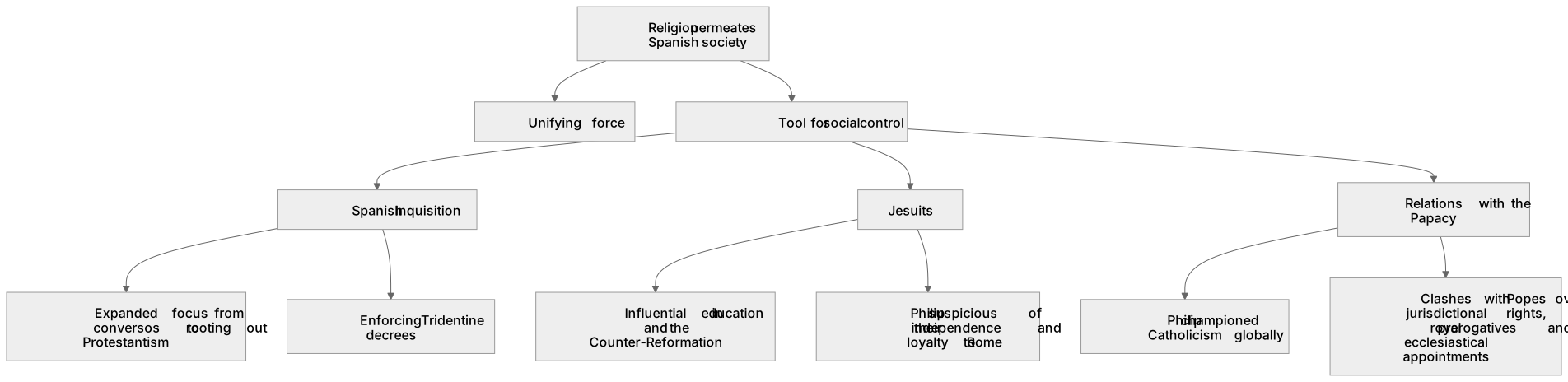
During Philip II’s reign, religion permeated Spanish society, acting as a unifying force but also a tool for social control.
Checked against the AQA 7042 specification (opens in a new tab) on .
- Point 3 of 6
- 4 key terms
Study notes
From the checked teaching notes for this specification point.
The idea
During Philip II’s reign, religion permeated Spanish society, acting as a unifying force but also a tool for social control. The Spanish Inquisition expanded its focus from conversos to rooting out Protestantism, notably in the 1558–1559 autos-da-fé in Valladolid and Seville, and enforcing Tridentine decrees. The Jesuits, founded by Ignatius of Loyola, became highly influential in education and the Counter-Reformation, though Philip remained suspicious of their independence and direct loyalty to Rome. Relations with the Papacy were complex; while Philip championed Catholicism globally, he frequently clashed with Popes like Pius V and Sixtus V over jurisdictional rights, royal prerogatives, and the control of ecclesiastical appointments.
What earns the marks
- Assess the role of the Inquisition in enforcing religious uniformity and social control, including censorship through the Index of Prohibited Books.
- Evaluate the impact of the Jesuits on Spanish education and their role in the broader Catholic Counter-Reformation.
- Analyse the tension between Philip II and the Papacy over royal prerogative, specifically the crown's right to appoint bishops and control church revenues.
- Examine how religious orthodoxy shaped Spanish society, including the emphasis on limpieza de sangre (purity of blood) and its social consequences.
Common mistakes and how to put them right
Assuming Philip II always agreed with the Pope.
Put it right by noting they frequently clashed over jurisdictional power and the pase regio.
Overstating the Protestant threat in Spain.
Put it right by noting that indigenous Protestantism was minimal and swiftly crushed by the Inquisition by 1560.
Confusing the Spanish Inquisition with the Roman Inquisition.
Put it right by emphasising that the Spanish Inquisition was under direct royal control, not papal control.
Exam tips
- Use specific examples of papal conflicts, such as the Carranza affair, to demonstrate the limits of papal authority in Philip's Spain.
- When discussing the Jesuits, highlight the tension between their vow of obedience to the Pope and Philip II's desire for absolute royal control over the Spanish Church.
- Link the concept of limpieza de sangre to social mobility and the pervasive atmosphere of suspicion within Spanish society.
Try the lesson
The start of the 1B Spain in the Age of Discovery, 1469–1598 (A-level only) – The 'Golden Age', 1556–1598 (A-level only): Religion and society; the Jesuits, Inquisition and relations with the Papacy lesson, made from checked teaching notes for this specification point.
Have a go first
What was a primary focus of the Spanish Inquisition during the late 1550s under Philip II?
Listen
During Philip II’s reign, religion permeated Spanish society, acting as a unifying force but also a tool for social control. The Spanish Inquisition expanded its focus from conversos to rooting out Protestantism, notably in the 1558–1559 autos-da-fé in Valladolid and Seville, and enforcing Tridentine decrees. The Jesuits, founded by Ignatius of Loyola, became highly influential in education and the Counter-Reformation, though Philip remained suspicious of their independence and direct loyalty to Rome. Relations with the Papacy were complex; while Philip championed Catholicism globally, he frequently clashed with Popes like Pius V and Sixtus V over jurisdictional rights, royal prerogatives, and the control of ecclesiastical appointments. A strong answer earns marks for these points. Assess the role of the Inquisition in enforcing religious uniformity and social control, including censorship through the Index of Prohibited Books. Evaluate the impact of the Jesuits on Spanish education and their role in the broader Catholic Counter-Reformation. Analyse the tension between Philip II and the Papacy over royal prerogative, specifically the crown's right to appoint bishops and control church revenues. Examine how religious orthodoxy shaped Spanish society, including the emphasis on limpieza de sangre (purity of blood) and its social consequences. A common slip: Assuming Philip II always agreed with the Pope. Instead, noting they frequently clashed over jurisdictional power and the pase regio. Exam tip: Use specific examples of papal conflicts, such as the Carranza affair, to demonstrate the limits of papal authority in Philip's Spain.
See it
Key words
Say what each word means before you turn the card.
Religious uniformity and orthodoxy
Try answering aloud or in your head before turning the card.
The Counter-Reformation
Try answering aloud or in your head before turning the card.
Church and State relations
Try answering aloud or in your head before turning the card.
Social control and censorship
Try answering aloud or in your head before turning the card.
See every definition
- Religious uniformity and orthodoxy
- Religion permeated Spanish society, acting as a unifying force but also a tool for social control, with the Inquisition enforcing Tridentine decrees.
- The Counter-Reformation
- The Jesuits became highly influential in education and in this movement, though Philip remained suspicious of their independence and direct loyalty to Rome.
- Church and State relations
- Relations with the Papacy were complex; Philip championed Catholicism globally but frequently clashed with Popes over jurisdictional rights, royal prerogatives and control of ecclesiastical appointments.
- Social control and censorship
- The Inquisition expanded its focus from conversos to rooting out Protestantism and enforced Tridentine decrees, with censorship through the Index of Prohibited Books.
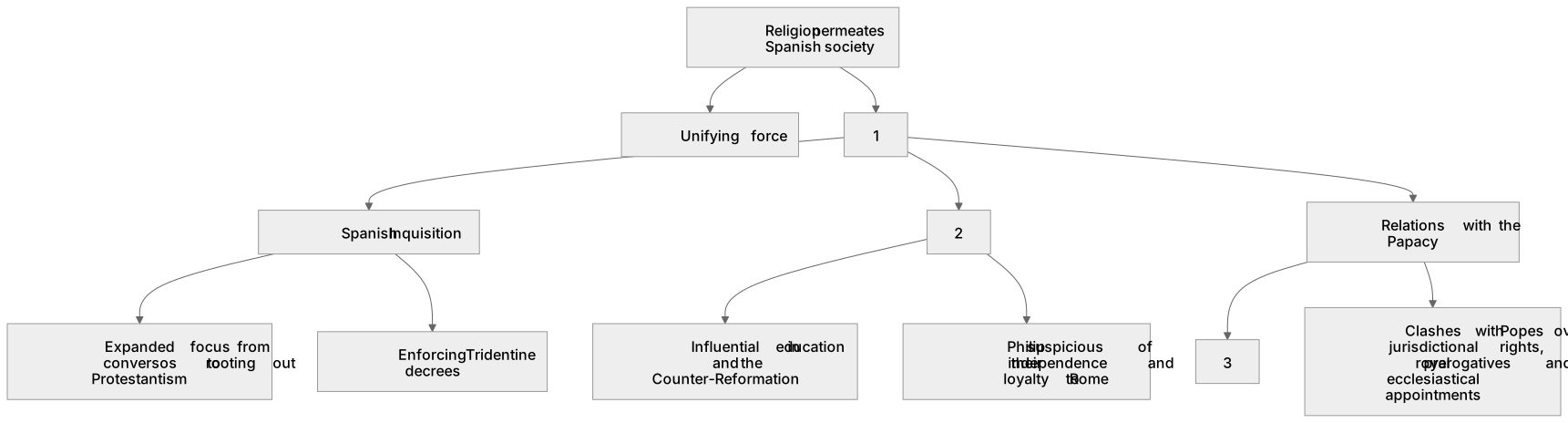
Label the diagram
Some boxes have lost their names. Pick the right name for each number.
1Box 1
2Box 2
3Box 3
There is more to this lesson
The full lesson goes on to check your understanding and help you earn the marks. Create a free account to carry on, with your progress saved.
A week of Premium from your first lesson · Then the free plan continues · No card, no charge
Test your understanding of 1B Spain in the Age of Discovery, 1469–1598 (A-level only) – The 'Golden Age', 1556–1598 (A-level only): Religion and society; the Jesuits, Inquisition and relations with the Papacy
Active recall beats re-reading. Take an instant quiz now to test what you’ve learned and lock it into long-term memory.
A week of Premium from your first lesson · Then the free plan continues · No card, no charge