AQA · A-Level · History
Course version: 7042 · Version from Sept 2017
England, 1485–1603 – consequence in this period through the following key…
Full specification wording
1C The Tudors: England, 1485–1603 – consequence in this period through the following key questions:: How did English society and economy change and with what effects?
The Tudor period witnessed profound social and economic transformations, driven primarily by significant population growth and persistent inflation.
Checked against the AQA 7042 specification (opens in a new tab) on .
- Point 4 of 6
- 4 key terms
Study notes
From the checked teaching notes for this specification point.
The idea
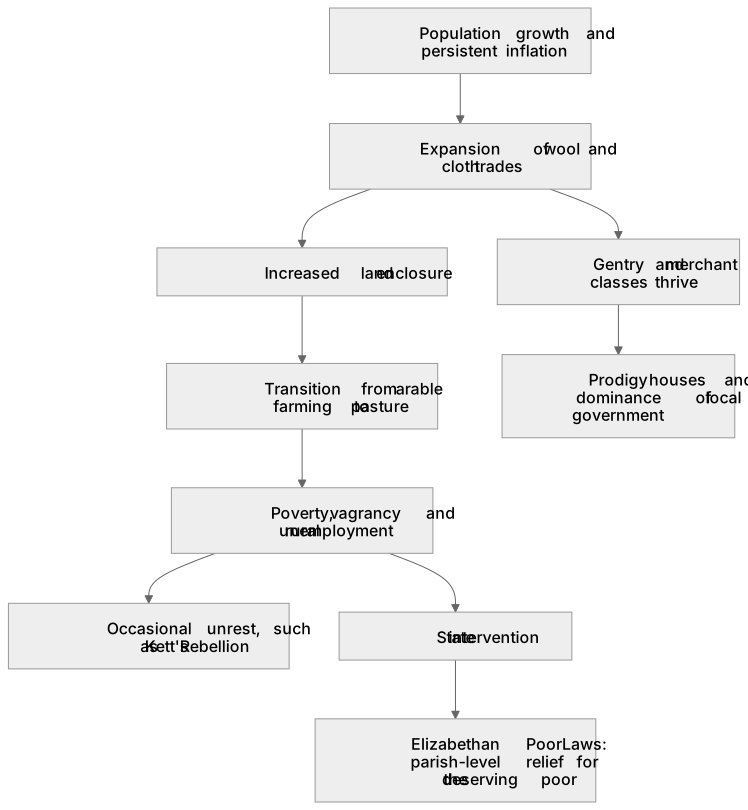
The Tudor period witnessed profound social and economic transformations, driven primarily by significant population growth and persistent inflation. The economy shifted as the lucrative wool and cloth trades expanded, leading to increased land enclosure and a transition from arable farming to pasture. These changes had severe effects on the lower classes, exacerbating poverty, vagrancy, and rural unemployment, which occasionally erupted into unrest like Kett’s Rebellion. Conversely, the gentry and merchant classes thrived, building grand prodigy houses and dominating local government. To manage these effects, the state increasingly intervened, culminating in the Elizabethan Poor Laws which formalised parish-level relief for the deserving poor.
What earns the marks
- Analyse the causes and consequences of demographic changes, particularly the sustained population growth across the sixteenth century.
- Evaluate the economic impact of enclosure and the expansion of the broadcloth industry on different social strata.
- Assess the effectiveness of government responses to social crises, including legislation against vagrancy and the development of the Poor Laws.
- Examine the changing social hierarchy, focusing on the rise of the gentry and the relative decline in the independent military power of the traditional nobility.
Common mistakes and how to put them right
Claiming that enclosure affected the majority of English agricultural land.
Put it right: Specify that while enclosure caused significant localised distress and unrest, it actually affected a relatively small percentage of total arable land.
Viewing Tudor society as entirely static and feudal.
Put it right: Highlight the increasing social mobility, particularly the growing wealth and political influence of the gentry and merchant classes.
Assuming all poverty was treated identically by the authorities.
Put it right: Distinguish between the Tudor government's harsh punitive measures for the 'undeserving' vagrants and their gradual provision of relief for the 'deserving' poor.
Exam tips
- Use specific legislation, such as the Statute of Artificers or the 1601 Poor Law, to demonstrate government attempts to regulate economic and social change.
- Connect economic grievances directly to political instability, showing how inflation and enclosure acted as catalysts for major rebellions.
- Avoid generalisations about 'the people'; instead, differentiate the effects of economic change on the nobility, gentry, yeomen, and landless labourers.
Try the lesson
The start of the 1C The Tudors: England, 1485–1603 – consequence in this period through the following key questions:: How did English society and economy change and with what effects? lesson, made from checked teaching notes for this specification point.
Have a go first
Which significant economic change in Tudor England involved landlords fencing off common land for sheep farming, and what was its primary social effect?
Listen
The Tudor period witnessed profound social and economic transformations, driven primarily by significant population growth and persistent inflation. The economy shifted as the lucrative wool and cloth trades expanded, leading to increased land enclosure and a transition from arable farming to pasture. These changes had severe effects on the lower classes, exacerbating poverty, vagrancy, and rural unemployment, which occasionally erupted into unrest like Kett’s Rebellion. Conversely, the gentry and merchant classes thrived, building grand prodigy houses and dominating local government. To manage these effects, the state increasingly intervened, culminating in the Elizabethan Poor Laws which formalised parish-level relief for the deserving poor. A strong answer earns marks for these points. Analyse the causes and consequences of demographic changes, particularly the sustained population growth across the sixteenth century. Evaluate the economic impact of enclosure and the expansion of the broadcloth industry on different social strata. Assess the effectiveness of government responses to social crises, including legislation against vagrancy and the development of the Poor Laws. Examine the changing social hierarchy, focusing on the rise of the gentry and the relative decline in the independent military power of the traditional nobility. A common slip: Claiming that enclosure affected the majority of English agricultural land. Instead, Specify that while enclosure caused significant localised distress and unrest, it actually affected a relatively small percentage of total arable land. Exam tip: Use specific legislation, such as the Statute of Artificers or the 1601 Poor Law, to demonstrate government attempts to regulate economic and social change.
See it
Key words
Say what each word means before you turn the card.
Demographic growth and inflation
Try answering aloud or in your head before turning the card.
Poverty and vagrancy
Try answering aloud or in your head before turning the card.
Social mobility and the gentry
Try answering aloud or in your head before turning the card.
Trade, exploration and enclosure
Try answering aloud or in your head before turning the card.
See every definition
- Demographic growth and inflation
- Significant population growth and persistent inflation drove profound social and economic transformations during the Tudor period.
- Poverty and vagrancy
- Changes in the economy exacerbated poverty, vagrancy and rural unemployment among the lower classes, occasionally erupting into unrest.
- Social mobility and the gentry
- The gentry and merchant classes thrived, building grand prodigy houses and dominating local government, showing increasing social mobility.
- Trade, exploration and enclosure
- The lucrative wool and cloth trades expanded, leading to increased land enclosure and a transition from arable farming to pasture.
Label the diagram
Some boxes have lost their names. Pick the right name for each number.
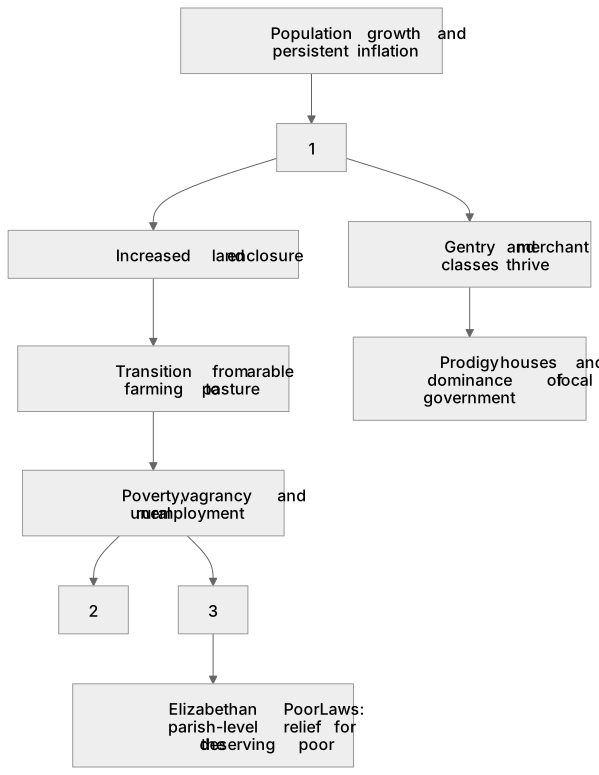
1Box 1
2Box 2
3Box 3
There is more to this lesson
The full lesson goes on to check your understanding and help you earn the marks. Create a free account to carry on, with your progress saved.
A week of Premium from your first lesson · Then the free plan continues · No card, no charge
Test your understanding of 1C The Tudors: England, 1485–1603 – consequence in this period through the following key questions:: How did English society and economy change and with what effects?
Active recall beats re-reading. Take an instant quiz now to test what you’ve learned and lock it into long-term memory.
A week of Premium from your first lesson · Then the free plan continues · No card, no charge