AQA · A-Level · History
Course version: 7042 · Version from Sept 2017
England, 1485–1603 – consequence in this period through the following key…
Full specification wording
1C The Tudors: England, 1485–1603 – consequence in this period through the following key questions:: How did relations with foreign powers change and how was the succession secured?
Tudor foreign policy shifted dramatically from Henry VII’s defensive alliances, such as the Treaty of Medina del Campo, to Henry VIII’s aggressive campaigns and subsequent isolation following the…
Checked against the AQA 7042 specification (opens in a new tab) on .
- Point 3 of 6
- 4 key terms
Study notes
From the checked teaching notes for this specification point.
The idea
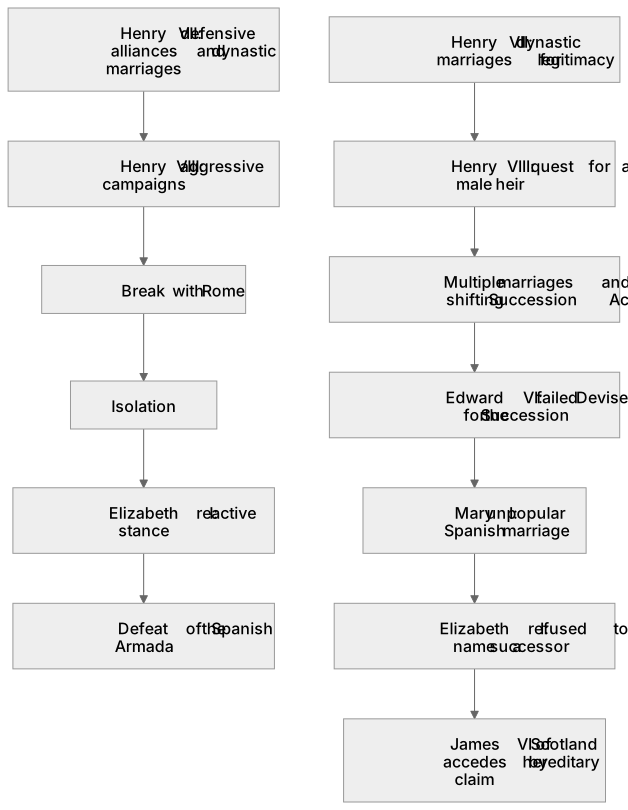
Tudor foreign policy shifted dramatically from Henry VII’s defensive alliances, such as the Treaty of Medina del Campo, to Henry VIII’s aggressive campaigns and subsequent isolation following the Break with Rome. Elizabeth I later adopted a reactive stance, culminating in the defeat of the Spanish Armada. Securing the succession was equally volatile. Henry VII used dynastic marriages to cement his legitimacy, whereas Henry VIII’s desperate quest for a male heir led to multiple marriages and shifting Succession Acts. The crisis deepened with Edward VI’s failed Devise for the Succession and Mary I’s unpopular Spanish marriage. Ultimately, Elizabeth I refused to name a successor, and the succession was only secured upon her death when James VI of Scotland acceded by hereditary claim.
What earns the marks
- Evaluate the shifting aims of Tudor monarchs in foreign policy, contrasting Henry VII's pursuit of security with Henry VIII's desire for glory.
- Assess the impact of the Reformation on England's diplomatic isolation and alliances, particularly under Elizabeth I.
- Analyse the methods used to secure the Tudor dynasty, including dynastic marriages, treaties, and parliamentary Succession Acts.
- Examine the succession crises of the mid-Tudor period, including Edward VI's attempt to alter the succession and Mary I's lack of an heir.
Common mistakes and how to put them right
Treating Tudor foreign policy as a single, consistent strategy.
Put it right: Differentiate between the distinct aims of each monarch, such as Henry VII's financial caution versus Henry VIII's expensive military campaigns.
Assuming the succession was only a problem for Henry VIII.
Put it right: Acknowledge that succession remained a critical vulnerability throughout the period, including Edward VI's minority and Elizabeth I's refusal to marry.
Confusing the terms of various treaties.
Put it right: Accurately attribute specific treaties to the correct monarch, such as linking the Treaty of Etaples to Henry VII and the Treaty of Nonsuch to Elizabeth I.
Exam tips
- Link foreign policy directly to domestic stability and the succession, showing how external threats often exacerbated internal dynastic insecurities.
- Use specific treaties and marriage agreements as concrete evidence when evaluating the success or failure of a monarch's foreign relations.
- When assessing change over time, explicitly compare the beginning and end of the period, noting both turning points and underlying continuities.
Try the lesson
The start of the 1C The Tudors: England, 1485–1603 – consequence in this period through the following key questions:: How did relations with foreign powers change and how was the succession secured? lesson, made from checked teaching notes for this specification point.
Have a go first
How did the Treaty of Medina del Campo (1489) help to secure the Tudor succession for Henry VII?
Listen
Tudor foreign policy shifted dramatically from Henry VII’s defensive alliances, such as the Treaty of Medina del Campo, to Henry VIII’s aggressive campaigns and subsequent isolation following the Break with Rome. Elizabeth I later adopted a reactive stance, culminating in the defeat of the Spanish Armada. Securing the succession was equally volatile. Henry VII used dynastic marriages to cement his legitimacy, whereas Henry VIII’s desperate quest for a male heir led to multiple marriages and shifting Succession Acts. The crisis deepened with Edward VI’s failed Devise for the Succession and Mary I’s unpopular Spanish marriage. Ultimately, Elizabeth I refused to name a successor, and the succession was only secured upon her death when James VI of Scotland acceded by hereditary claim. A strong answer earns marks for these points. Evaluate the shifting aims of Tudor monarchs in foreign policy, contrasting Henry VII's pursuit of security with Henry VIII's desire for glory. Assess the impact of the Reformation on England's diplomatic isolation and alliances, particularly under Elizabeth I. Analyse the methods used to secure the Tudor dynasty, including dynastic marriages, treaties, and parliamentary Succession Acts. Examine the succession crises of the mid-Tudor period, including Edward VI's attempt to alter the succession and Mary I's lack of an heir. A common slip: Treating Tudor foreign policy as a single, consistent strategy. Instead, Differentiate between the distinct aims of each monarch, such as Henry VII's financial caution versus Henry VIII's expensive military campaigns. Exam tip: Link foreign policy directly to domestic stability and the succession, showing how external threats often exacerbated internal dynastic insecurities.
See it
Key words
Say what each word means before you turn the card.
Dynastic security
Try answering aloud or in your head before turning the card.
Diplomacy and warfare
Try answering aloud or in your head before turning the card.
The impact of religion on foreign affairs
Try answering aloud or in your head before turning the card.
Continuity and change
Try answering aloud or in your head before turning the card.
See every definition
- Dynastic security
- The aim of securing the royal succession, pursued through methods such as dynastic marriages, treaties and parliamentary Succession Acts.
- Diplomacy and warfare
- The conduct of relations with foreign powers, ranging from defensive alliances and marriage agreements to aggressive military campaigns.
- The impact of religion on foreign affairs
- The effect of the Reformation on England's diplomatic isolation and alliances, particularly under Elizabeth I.
- Continuity and change
- The extent to which foreign relations shifted or stayed the same, assessed by comparing the beginning and end of the period.
Label the diagram
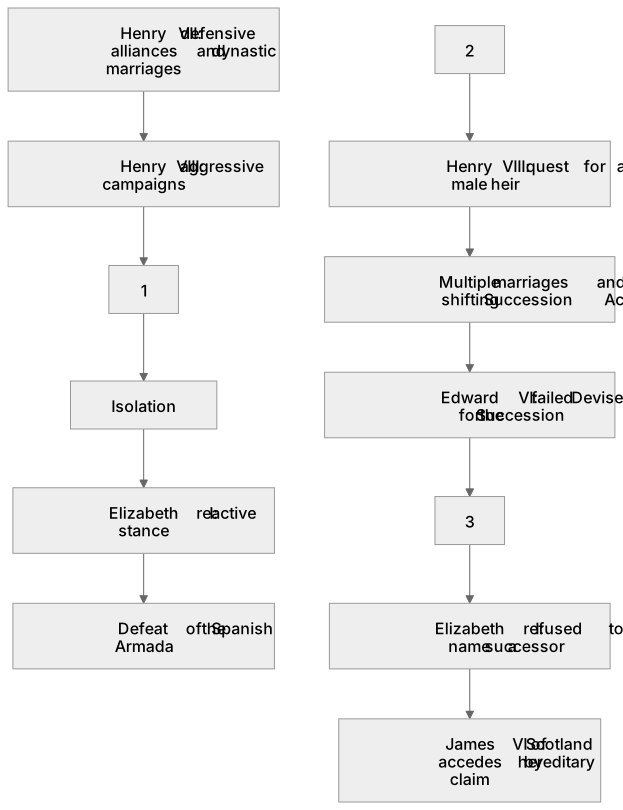
Some boxes have lost their names. Pick the right name for each number.
1Box 1
2Box 2
3Box 3
There is more to this lesson
The full lesson goes on to check your understanding and help you earn the marks. Create a free account to carry on, with your progress saved.
A week of Premium from your first lesson · Then the free plan continues · No card, no charge
Test your understanding of 1C The Tudors: England, 1485–1603 – consequence in this period through the following key questions:: How did relations with foreign powers change and how was the succession secured?
Active recall beats re-reading. Take an instant quiz now to test what you’ve learned and lock it into long-term memory.
A week of Premium from your first lesson · Then the free plan continues · No card, no charge