AQA · A-Level · History
Course version: 7042 · Version from Sept 2017
England, 1485–1603 – Instability and consolidation: 'the Mid-Tudor…
Full specification wording
1C The Tudors: England, 1485–1603 – Instability and consolidation: 'the Mid-Tudor Crisis', 1547–1563 (A-level only): The social impact of religious and economic changes under Mary I; rebellion; intellectual developments; humanist and religious thought
Mary I’s reign saw significant social upheaval driven by religious and economic changes.
Checked against the AQA 7042 specification (opens in a new tab) on .
- Point 4 of 6
- 4 key terms
Study notes
From the checked teaching notes for this specification point.
The idea
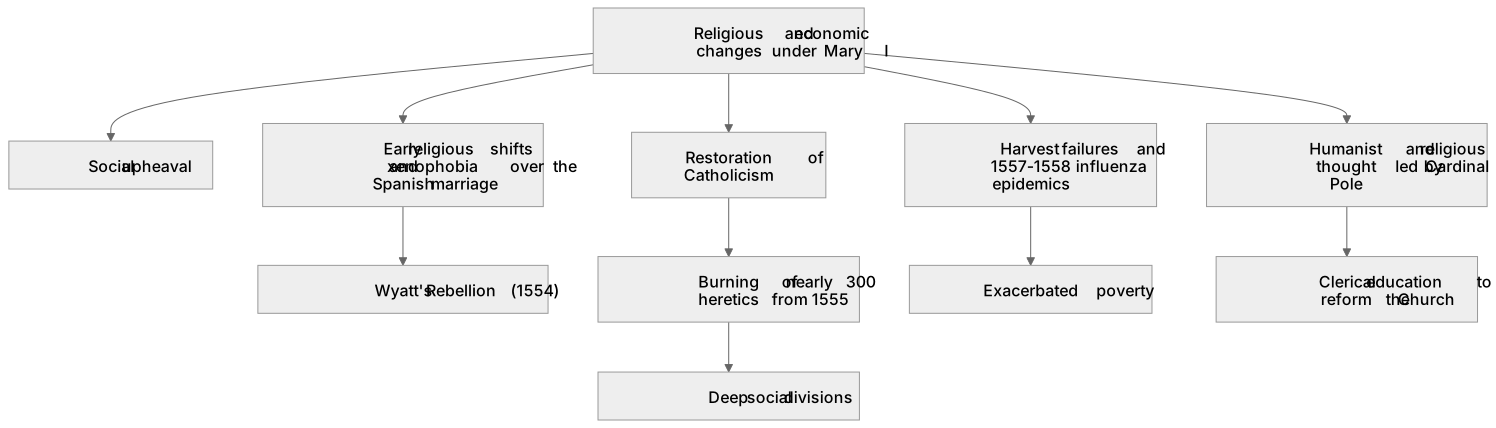
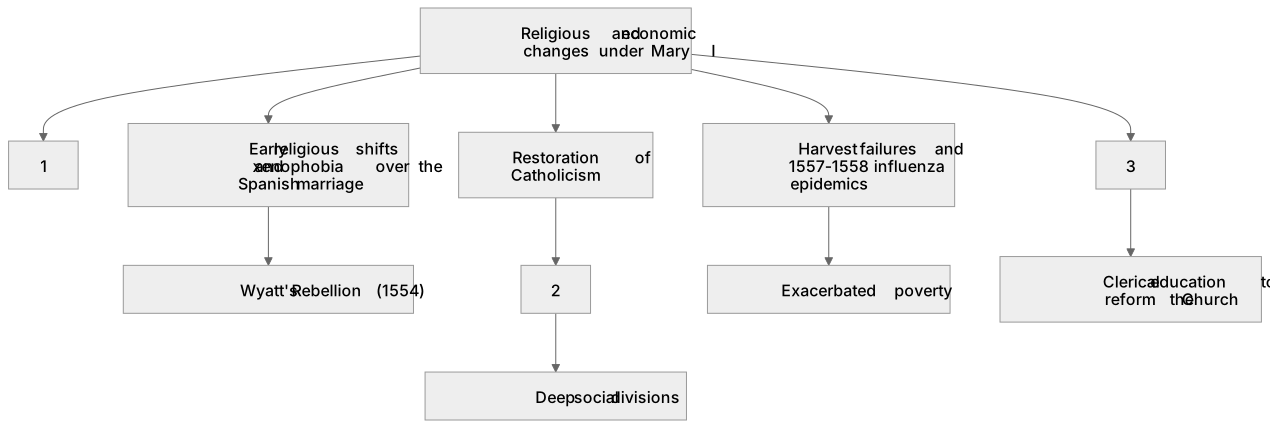
Mary I’s reign saw significant social upheaval driven by religious and economic changes. Early religious shifts and xenophobia surrounding the Spanish marriage culminated in Wyatt’s Rebellion (1554). Later, the restoration of Catholicism, including the burning of nearly 300 heretics from 1555, created deep social divisions. Economically, severe harvest failures and the 1557–1558 influenza epidemics exacerbated poverty, though Mary initiated crucial financial reforms like the Book of Rates. Intellectually, Marian Catholicism was not merely reactionary; it featured humanist and religious thought led by Cardinal Pole, who promoted clerical education to reform the Church.
What earns the marks
- Assess the social impact of religious changes, including the Marian persecutions from 1555, noting how burnings affected public sympathy.
- Evaluate the economic changes and challenges, including the devastating impact of the 1557–1558 influenza epidemic and harvest failures.
- Analyse the causes of Wyatt's Rebellion (1554), weighing the relative importance of early religious discontent and opposition to the Spanish marriage.
- Examine intellectual developments and humanist and religious thought under Cardinal Pole, specifically his efforts to improve clerical education.
Common mistakes and how to put them right
Assuming Wyatt's Rebellion was caused by the Marian burnings.
Put it right: Note the chronology; the rebellion occurred in early 1554, before the burnings began in 1555.
Describing Marian religious policy as purely destructive.
Put it right: Highlight the positive intellectual developments and humanist reforms initiated by Cardinal Pole.
Blaming all economic hardship on Mary's policies.
Put it right: Acknowledge that much of the economic distress was caused by external factors like consecutive harvest failures and the 1557–1558 influenza epidemic.
Exam tips
- When discussing economic changes, credit the Marian government for laying the groundwork for later Elizabethan financial stability, such as the new Book of Rates.
- Use Wyatt's Rebellion as a case study to link social and early religious grievances together in an essay on mid-Tudor instability.
- Challenge the traditional Foxe's Book of Martyrs narrative by incorporating evidence of Catholic humanist thought and administrative reform.
Try the lesson
The start of the 1C The Tudors: England, 1485–1603 – Instability and consolidation: 'the Mid-Tudor Crisis', 1547–1563 (A-level only): The social impact of religious and economic changes under Mary I; rebellion; intellectual developments; humanist and religious thought lesson, made from checked teaching notes for this specification point.
Have a go first
Which rebellion broke out in 1554 primarily in response to Mary I's planned marriage to Philip of Spain?
Listen
Mary I’s reign saw significant social upheaval driven by religious and economic changes. Early religious shifts and xenophobia surrounding the Spanish marriage culminated in Wyatt’s Rebellion (1554). Later, the restoration of Catholicism, including the burning of nearly 300 heretics from 1555, created deep social divisions. Economically, severe harvest failures and the 1557–1558 influenza epidemics exacerbated poverty, though Mary initiated crucial financial reforms like the Book of Rates. Intellectually, Marian Catholicism was not merely reactionary; it featured humanist and religious thought led by Cardinal Pole, who promoted clerical education to reform the Church. A strong answer earns marks for these points. Assess the social impact of religious changes, including the Marian persecutions from 1555, noting how burnings affected public sympathy. Evaluate the economic changes and challenges, including the devastating impact of the 1557–1558 influenza epidemic and harvest failures. Analyse the causes of Wyatt's Rebellion (1554), weighing the relative importance of early religious discontent and opposition to the Spanish marriage. Examine intellectual developments and humanist and religious thought under Cardinal Pole, specifically his efforts to improve clerical education. A common slip: Assuming Wyatt's Rebellion was caused by the Marian burnings. Instead, Note the chronology; the rebellion occurred in early 1554, before the burnings began in 1555. Exam tip: When discussing economic changes, credit the Marian government for laying the groundwork for later Elizabethan financial stability, such as the new Book of Rates.
See it
Key words
Say what each word means before you turn the card.
Marian persecutions
Try answering aloud or in your head before turning the card.
Wyatt's Rebellion
Try answering aloud or in your head before turning the card.
Cardinal Pole
Try answering aloud or in your head before turning the card.
Book of Rates
Try answering aloud or in your head before turning the card.
See every definition
- Marian persecutions
- The burnings of nearly 300 heretics from 1555, which created deep social divisions and affected public sympathy.
- Wyatt's Rebellion
- A rebellion in 1554 caused by early religious discontent and opposition to the Spanish marriage.
- Cardinal Pole
- The figure who led humanist and religious thought and promoted clerical education to reform the Church.
- Book of Rates
- A financial reform initiated by Mary that laid the groundwork for later Elizabethan financial stability.
Label the diagram
Some boxes have lost their names. Pick the right name for each number.
1Box 1
2Box 2
3Box 3
There is more to this lesson
The full lesson goes on to check your understanding and help you earn the marks. Create a free account to carry on, with your progress saved.
A week of Premium from your first lesson · Then the free plan continues · No card, no charge
Test your understanding of 1C The Tudors: England, 1485–1603 – Instability and consolidation: 'the Mid-Tudor Crisis', 1547–1563 (A-level only): The social impact of religious and economic changes under Mary I; rebellion; intellectual developments; humanist and religious thought
Active recall beats re-reading. Take an instant quiz now to test what you’ve learned and lock it into long-term memory.
A week of Premium from your first lesson · Then the free plan continues · No card, no charge