AQA · A-Level · History
Course version: 7042 · Version from Sept 2017
Charles II and the nature of restored monarchy; rule through parliament…
Full specification wording
1D Stuart Britain and the Crisis of Monarchy, 1603–1702 – From Republic to restored and limited monarchy, 1649–1678 (A-level only): Charles II and the nature of restored monarchy; rule through parliament and ministers; Clarendon; the Cabal and Danby
The restored monarchy of Charles II was theoretically absolute but practically limited by financial dependence on the Cavalier Parliament.
Checked against the AQA 7042 specification (opens in a new tab) on .
- Point 4 of 6
- 4 key terms
Study notes
From the checked teaching notes for this specification point.
The idea
The restored monarchy of Charles II was theoretically absolute but practically limited by financial dependence on the Cavalier Parliament. Charles ruled through key ministers to manage this relationship. The Earl of Clarendon dominated early policy but was scapegoated for the Second Anglo-Dutch War and the restrictive Clarendon Code. After his fall in 1667, Charles relied on the Cabal, a group of ministers whose religious toleration and pro-French policies aroused parliamentary suspicion. From 1674, the Earl of Danby restored Anglican and anti-French policies, using crown patronage to build a 'Court' party in parliament. Danby's impeachment highlighted the ongoing tension between royal prerogative and parliamentary control over the king's ministers.
What earns the marks
- Assess the nature of the Restoration settlement and how financial limitations forced Charles II to rely on parliament.
- Evaluate the reasons for Clarendon's downfall, including his failure to manage parliament and the fallout from the Second Anglo-Dutch War.
- Analyse the composition and policies of the Cabal, focusing on how their pro-Catholic and pro-French leanings created conflict with parliament.
- Examine Danby's use of patronage and bribery to construct a 'Court' party, and how his foreign policy ultimately led to his impeachment.
Common mistakes and how to put them right
Assuming the Cabal was a unified, modern cabinet.
Put it right: They were actually a disparate group of individuals who often worked against each other.
Stating that Charles II fully supported the Clarendon Code.
Put it right: He actually favoured religious toleration but was forced to accept the restrictive legislation by the Cavalier Parliament.
Believing the Restoration returned the monarchy to its exact pre-1640 power.
Put it right: The abolition of prerogative courts and financial dependence on parliament significantly altered the nature of the monarchy.
Exam tips
- Trace the evolution of Charles II's ministers (Clarendon to Cabal to Danby) to demonstrate how his methods of managing parliament changed over time.
- Use the Secret Treaty of Dover (1670) as a key piece of evidence when discussing the parliamentary suspicion surrounding the Cabal.
- Highlight Danby's use of crown patronage as a precursor to the development of early political parties (Tories and the Court party).
Try the lesson
The start of the 1D Stuart Britain and the Crisis of Monarchy, 1603–1702 – From Republic to restored and limited monarchy, 1649–1678 (A-level only): Charles II and the nature of restored monarchy; rule through parliament and ministers; Clarendon; the Cabal and Danby lesson, made from checked teaching notes for this specification point.
Have a go first
Which document, issued by Charles II in 1660, outlined his initial promises for the nature of the restored monarchy, including a general pardon and religious toleration?
Listen
The restored monarchy of Charles II was theoretically absolute but practically limited by financial dependence on the Cavalier Parliament. Charles ruled through key ministers to manage this relationship. The Earl of Clarendon dominated early policy but was scapegoated for the Second Anglo-Dutch War and the restrictive Clarendon Code. After his fall in 1667, Charles relied on the Cabal, a group of ministers whose religious toleration and pro-French policies aroused parliamentary suspicion. From 1674, the Earl of Danby restored Anglican and anti-French policies, using crown patronage to build a 'Court' party in parliament. Danby's impeachment highlighted the ongoing tension between royal prerogative and parliamentary control over the king's ministers. A strong answer earns marks for these points. Assess the nature of the Restoration settlement and how financial limitations forced Charles II to rely on parliament. Evaluate the reasons for Clarendon's downfall, including his failure to manage parliament and the fallout from the Second Anglo-Dutch War. Analyse the composition and policies of the Cabal, focusing on how their pro-Catholic and pro-French leanings created conflict with parliament. Examine Danby's use of patronage and bribery to construct a 'Court' party, and how his foreign policy ultimately led to his impeachment. Exam tip: Trace the evolution of Charles II's ministers (Clarendon to Cabal to Danby) to demonstrate how his methods of managing parliament changed over time.
See it
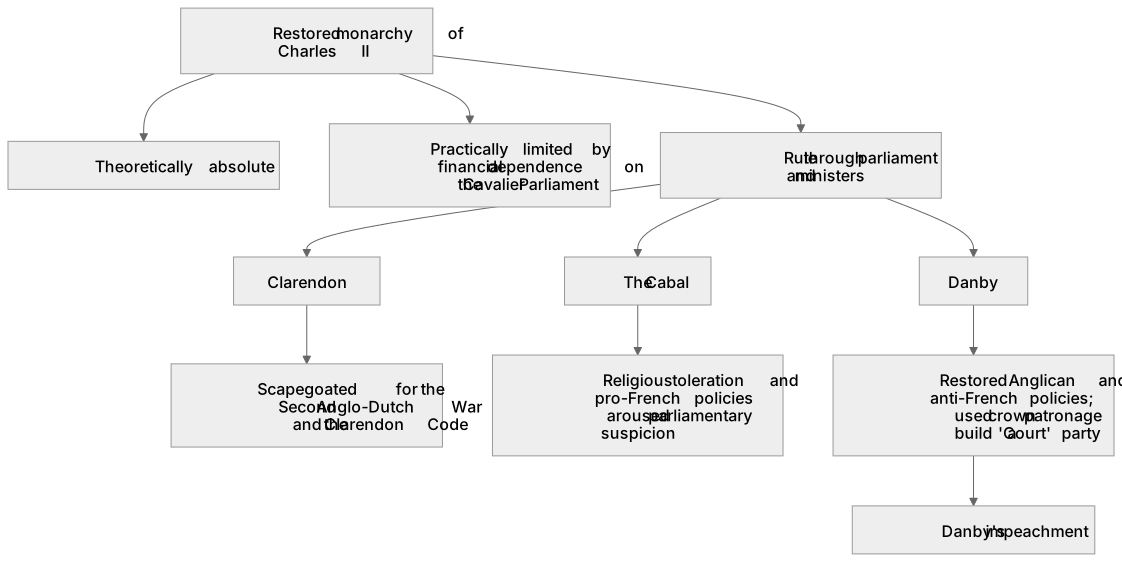
Key words
Say what each word means before you turn the card.
Crown and Parliament relations
Try answering aloud or in your head before turning the card.
The development of political parties
Try answering aloud or in your head before turning the card.
Religious settlement and toleration
Try answering aloud or in your head before turning the card.
Foreign policy and domestic politics
Try answering aloud or in your head before turning the card.
See every definition
- Crown and Parliament relations
- Theoretically absolute but practically limited by financial dependence on the Cavalier Parliament, with ongoing tension between royal prerogative and parliamentary control over the king's ministers.
- The development of political parties
- Danby used crown patronage to build a 'Court' party in parliament, a precursor to the development of early political parties.
- Religious settlement and toleration
- The Cabal's religious toleration aroused parliamentary suspicion, while Charles II favoured religious toleration but was forced to accept the restrictive Clarendon Code.
- Foreign policy and domestic politics
- The Cabal's pro-French policies aroused parliamentary suspicion, and Danby restored anti-French policies before his foreign policy ultimately led to his impeachment.
Label the diagram
Some boxes have lost their names. Pick the right name for each number.
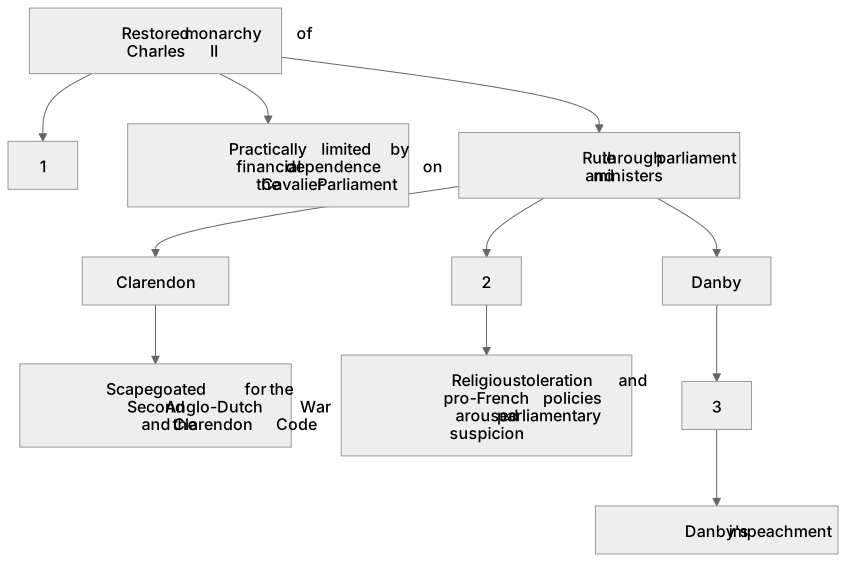
1Box 1
2Box 2
3Box 3
There is more to this lesson
The full lesson goes on to check your understanding and help you earn the marks. Create a free account to carry on, with your progress saved.
A week of Premium from your first lesson · Then the free plan continues · No card, no charge
Test your understanding of 1D Stuart Britain and the Crisis of Monarchy, 1603–1702 – From Republic to restored and limited monarchy, 1649–1678 (A-level only): Charles II and the nature of restored monarchy; rule through parliament and ministers; Clarendon; the Cabal and Danby
Active recall beats re-reading. Take an instant quiz now to test what you’ve learned and lock it into long-term memory.
A week of Premium from your first lesson · Then the free plan continues · No card, no charge