AQA · A-Level · History
Course version: 7042 · Version from Sept 2017
Disputed successions and the role of the Supreme State Council and the…
Full specification wording
1E Russia in the Age of Absolutism and Enlightenment, 1682–1796 (A-level only) – The epoch of palace coups, 1725–1762: Disputed successions and the role of the Supreme State Council and the Preobrazhensky Regiment
Peter the Great’s failure to name an heir under his 1722 succession law triggered the 'Epoch of Palace Coups' (1725–1762), characterised by chronic instability and disputed successions.
Checked against the AQA 7042 specification (opens in a new tab) on .
- Point 2 of 6
- 4 key terms
Study notes
From the checked teaching notes for this specification point.
The idea
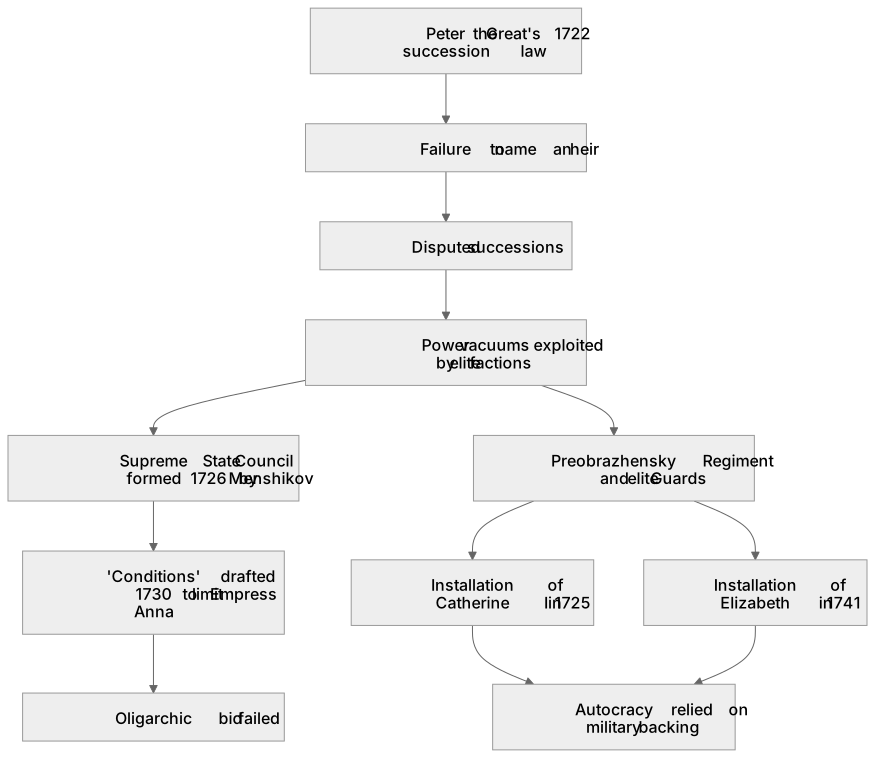
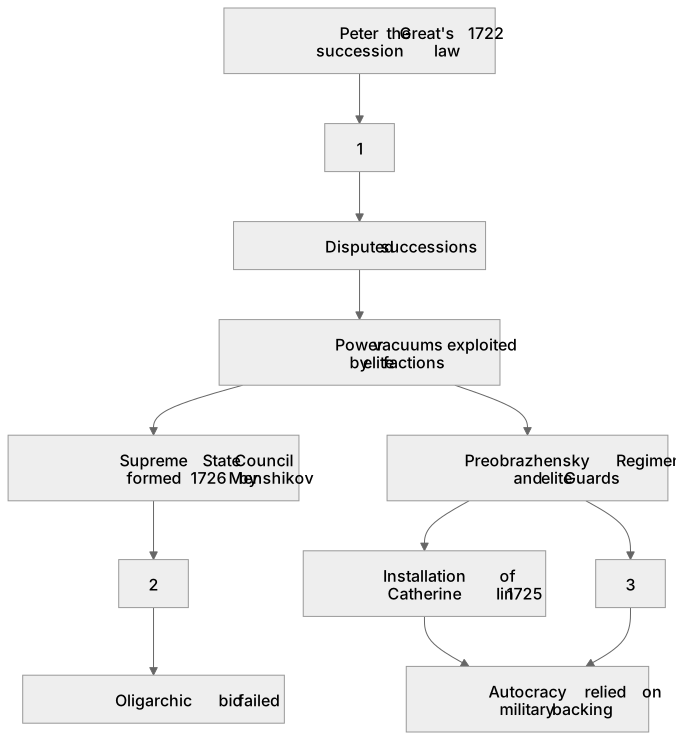
Peter the Great’s failure to name an heir under his 1722 succession law triggered the 'Epoch of Palace Coups' (1725–1762), characterised by chronic instability and disputed successions. Power vacuums were frequently exploited by elite factions. The Supreme State Council, formed in 1726 by Menshikov, attempted to monopolise power, most notably by drafting the 'Conditions' in 1730 to limit Empress Anna’s autocratic authority, though this oligarchic bid ultimately failed. Crucially, the Preobrazhensky Regiment and other elite Guards units became the ultimate arbiters of power. Composed of nobles, these regiments orchestrated coups, such as the installation of Catherine I in 1725 and Elizabeth in 1741, demonstrating that autocracy relied heavily on military backing.
What earns the marks
- Explain how Peter the Great's 1722 Law of Succession, which allowed the monarch to choose their heir, inadvertently caused decades of disputed successions.
- Analyse the formation and function of the Supreme State Council as an oligarchic body attempting to control the monarch, particularly during the reigns of Catherine I and Peter II.
- Evaluate the significance of the 1730 'Conditions' as a failed constitutional attempt by the Supreme State Council to limit autocratic power.
- Assess the role of the Preobrazhensky Regiment and other Guards regiments as 'kingmakers' who used military force to resolve succession crises, such as in 1725 and 1741.
Common mistakes and how to put them right
Confusing the Supreme State Council with the Senate.
Put it right: The Council was a small, elite advisory body created in 1726 that temporarily overshadowed the Senate.
Assuming the Preobrazhensky Regiment was a standard army unit.
Put it right: It was an elite Guards regiment composed largely of nobles with significant political influence.
Claiming the 'Conditions' of 1730 successfully established a constitutional monarchy.
Put it right: Empress Anna tore them up once she secured the support of the Guards and lesser nobility.
Exam tips
- Use the 1730 succession crisis as a primary case study to contrast the oligarchic ambitions of the Supreme State Council with the autocratic preferences of the wider nobility.
- Highlight the paradox of the era: while the monarch held absolute theoretical power, their practical survival depended entirely on the loyalty of the Preobrazhensky Regiment.
- Connect the disputed successions back to Peter the Great's legacy, specifically his failure to secure a clear, legitimate line of succession before his death.
Try the lesson
The start of the 1E Russia in the Age of Absolutism and Enlightenment, 1682–1796 (A-level only) – The epoch of palace coups, 1725–1762: Disputed successions and the role of the Supreme State Council and the Preobrazhensky Regiment lesson, made from checked teaching notes for this specification point.
Have a go first
During the epoch of palace coups (1725–1762), what was the primary political role of the Preobrazhensky Regiment?
Listen
Peter the Great’s failure to name an heir under his 1722 succession law triggered the 'Epoch of Palace Coups' (1725–1762), characterised by chronic instability and disputed successions. Power vacuums were frequently exploited by elite factions. The Supreme State Council, formed in 1726 by Menshikov, attempted to monopolise power, most notably by drafting the 'Conditions' in 1730 to limit Empress Anna’s autocratic authority, though this oligarchic bid ultimately failed. Crucially, the Preobrazhensky Regiment and other elite Guards units became the ultimate arbiters of power. Composed of nobles, these regiments orchestrated coups, such as the installation of Catherine I in 1725 and Elizabeth in 1741, demonstrating that autocracy relied heavily on military backing. A strong answer earns marks for these points. Explain how Peter the Great's 1722 Law of Succession, which allowed the monarch to choose their heir, inadvertently caused decades of disputed successions. Analyse the formation and function of the Supreme State Council as an oligarchic body attempting to control the monarch, particularly during the reigns of Catherine I and Peter II. Evaluate the significance of the 1730 'Conditions' as a failed constitutional attempt by the Supreme State Council to limit autocratic power. Assess the role of the Preobrazhensky Regiment and other Guards regiments as 'kingmakers' who used military force to resolve succession crises, such as in 1725 and 1741. Exam tip: Use the 1730 succession crisis as a primary case study to contrast the oligarchic ambitions of the Supreme State Council with the autocratic preferences of the wider nobility.
See it
Put the events in order
Put these events in the order they happened, earliest first.
- 1. The Preobrazhensky Regiment orchestrated the installation of Catherine I
- 2. Peter the Great's Law of Succession allowed the monarch to choose their heir
- 3. The Preobrazhensky Regiment orchestrated the installation of Elizabeth
- 4. Menshikov formed the Supreme State Council
- 5. The Supreme State Council drafted the Conditions to limit Empress Anna's authority
Key words
Say what each word means before you turn the card.
Disputed successions
Try answering aloud or in your head before turning the card.
Supreme State Council
Try answering aloud or in your head before turning the card.
Preobrazhensky Regiment
Try answering aloud or in your head before turning the card.
Elite factionalism
Try answering aloud or in your head before turning the card.
See every definition
- Disputed successions
- Peter the Great's failure to name an heir under his 1722 succession law triggered these, causing chronic instability during the Epoch of Palace Coups.
- Supreme State Council
- Formed in 1726 by Menshikov, it attempted to monopolise power, most notably by drafting the 'Conditions' in 1730 to limit Empress Anna's autocratic authority.
- Preobrazhensky Regiment
- An elite Guards unit composed of nobles that became the ultimate arbiter of power, orchestrating coups such as the installation of Catherine I in 1725 and Elizabeth in 1741.
- Elite factionalism
- Power vacuums were frequently exploited by elite factions during the chronic instability of the Epoch of Palace Coups.
Label the diagram
Some boxes have lost their names. Pick the right name for each number.
1Box 1
2Box 2
3Box 3
There is more to this lesson
The full lesson goes on to check your understanding and help you earn the marks. Create a free account to carry on, with your progress saved.
A week of Premium from your first lesson · Then the free plan continues · No card, no charge
Test your understanding of 1E Russia in the Age of Absolutism and Enlightenment, 1682–1796 (A-level only) – The epoch of palace coups, 1725–1762: Disputed successions and the role of the Supreme State Council and the Preobrazhensky Regiment
Active recall beats re-reading. Take an instant quiz now to test what you’ve learned and lock it into long-term memory.
A week of Premium from your first lesson · Then the free plan continues · No card, no charge