AQA · A-Level · History
Course version: 7042 · Version from Sept 2017
Tsarina Elizabeth: accession to the throne; education and Westernisation;…
Full specification wording
1E Russia in the Age of Absolutism and Enlightenment, 1682–1796 (A-level only) – The epoch of palace coups, 1725–1762: Tsarina Elizabeth: accession to the throne; education and Westernisation; legal reforms; taxation
Tsarina Elizabeth seized power in 1741 through a bloodless palace coup supported by the Preobrazhensky Guards, ending the turbulent rule of Anna Leopoldovna.
Checked against the AQA 7042 specification (opens in a new tab) on .
- Point 3 of 6
- 4 key terms
Study notes
From the checked teaching notes for this specification point.
The idea
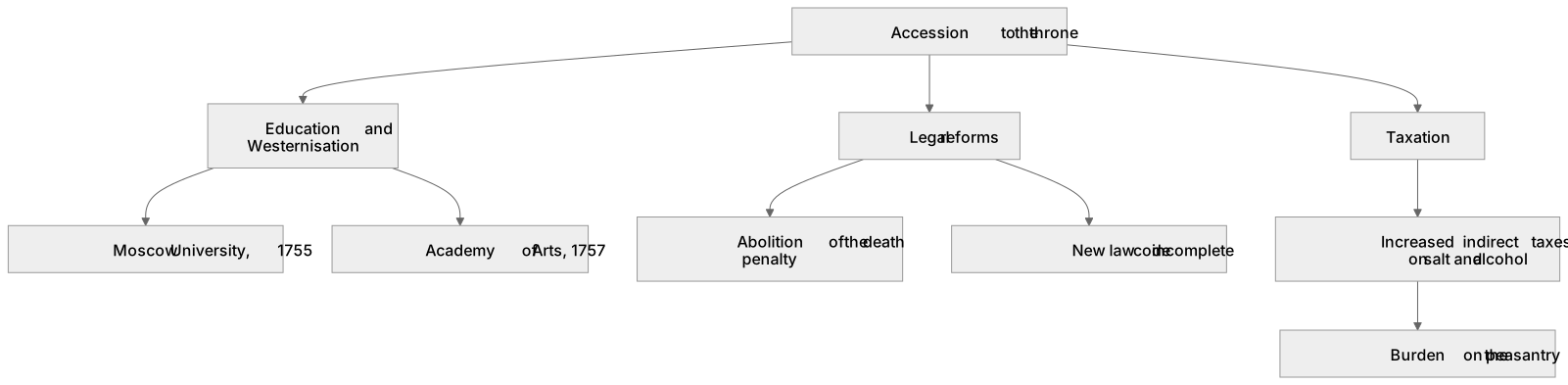
Tsarina Elizabeth seized power in 1741 through a bloodless palace coup supported by the Preobrazhensky Guards, ending the turbulent rule of Anna Leopoldovna. Her reign accelerated Westernisation, notably through the founding of Moscow University in 1755 and the Academy of Arts in 1757, which fostered a new educated Russian elite. Elizabeth initiated significant legal reforms, most famously abolishing the death penalty, though her new law code remained incomplete. To fund her lavish court and military campaigns like the Seven Years' War, she reformed taxation by increasing indirect taxes on everyday goods such as salt and alcohol, which disproportionately burdened the peasantry while protecting noble wealth.
What earns the marks
- Explain the role of the Preobrazhensky Guards and anti-German sentiment in Elizabeth's 1741 accession to the throne.
- Assess the impact of Moscow University (1755) and the Academy of Arts (1757) on Russian education and cultural Westernisation.
- Evaluate the significance and limitations of her legal reforms, particularly the abolition of capital punishment.
- Analyse the shift towards indirect taxation on salt and alcohol and its socio-economic impact on the peasantry.
Common mistakes and how to put them right
Confusing Elizabeth's accession with Catherine the Great's.
Put it right: Elizabeth overthrew Ivan VI and Anna Leopoldovna in 1741, not Peter III.
Assuming her legal reforms created a complete, modern legal code.
Put it right: Her legislative commission failed to finalise a new code despite abolishing the death penalty.
Claiming taxation reforms relieved the peasantry.
Put it right: Indirect taxes on essentials like salt actually increased the financial burden on the lower classes.
Exam tips
- Link Elizabeth's educational reforms directly to the broader theme of Westernisation initiated by Peter the Great.
- Use the abolition of the death penalty as a specific example of early Enlightenment influence on Russian autocracy.
- When discussing taxation, contrast the growing financial burden on the peasantry with the increasing privileges of the nobility.
Try the lesson
The start of the 1E Russia in the Age of Absolutism and Enlightenment, 1682–1796 (A-level only) – The epoch of palace coups, 1725–1762: Tsarina Elizabeth: accession to the throne; education and Westernisation; legal reforms; taxation lesson, made from checked teaching notes for this specification point.
Have a go first
How did Tsarina Elizabeth secure her accession to the Russian throne in 1741?
Listen
Tsarina Elizabeth seized power in 1741 through a bloodless palace coup supported by the Preobrazhensky Guards, ending the turbulent rule of Anna Leopoldovna. Her reign accelerated Westernisation, notably through the founding of Moscow University in 1755 and the Academy of Arts in 1757, which fostered a new educated Russian elite. Elizabeth initiated significant legal reforms, most famously abolishing the death penalty, though her new law code remained incomplete. To fund her lavish court and military campaigns like the Seven Years' War, she reformed taxation by increasing indirect taxes on everyday goods such as salt and alcohol, which disproportionately burdened the peasantry while protecting noble wealth. A strong answer earns marks for these points. Explain the role of the Preobrazhensky Guards and anti-German sentiment in Elizabeth's 1741 accession to the throne. Assess the impact of Moscow University (1755) and the Academy of Arts (1757) on Russian education and cultural Westernisation. Evaluate the significance and limitations of her legal reforms, particularly the abolition of capital punishment. Analyse the shift towards indirect taxation on salt and alcohol and its socio-economic impact on the peasantry. Exam tip: Link Elizabeth's educational reforms directly to the broader theme of Westernisation initiated by Peter the Great.
See it
Put the events in order
Put these events in the order they happened, earliest first.
- 1. Elizabeth seizes power through a palace coup
- 2. Founding of the Academy of Arts
- 3. Founding of Moscow University
Key words
Say what each word means before you turn the card.
Autocracy and succession
Try answering aloud or in your head before turning the card.
Westernisation and Enlightenment
Try answering aloud or in your head before turning the card.
Institutional reform
Try answering aloud or in your head before turning the card.
Socio-economic inequality
Try answering aloud or in your head before turning the card.
See every definition
- Autocracy and succession
- Elizabeth seized power in 1741 through a bloodless palace coup supported by the Preobrazhensky Guards, ending the turbulent rule of Anna Leopoldovna.
- Westernisation and Enlightenment
- Her reign accelerated Westernisation through the founding of Moscow University in 1755 and the Academy of Arts in 1757, fostering a new educated Russian elite.
- Institutional reform
- Elizabeth initiated significant legal reforms, most famously abolishing the death penalty, though her new law code remained incomplete.
- Socio-economic inequality
- She reformed taxation by increasing indirect taxes on everyday goods such as salt and alcohol, which disproportionately burdened the peasantry while protecting noble wealth.
Label the diagram
Some boxes have lost their names. Pick the right name for each number.
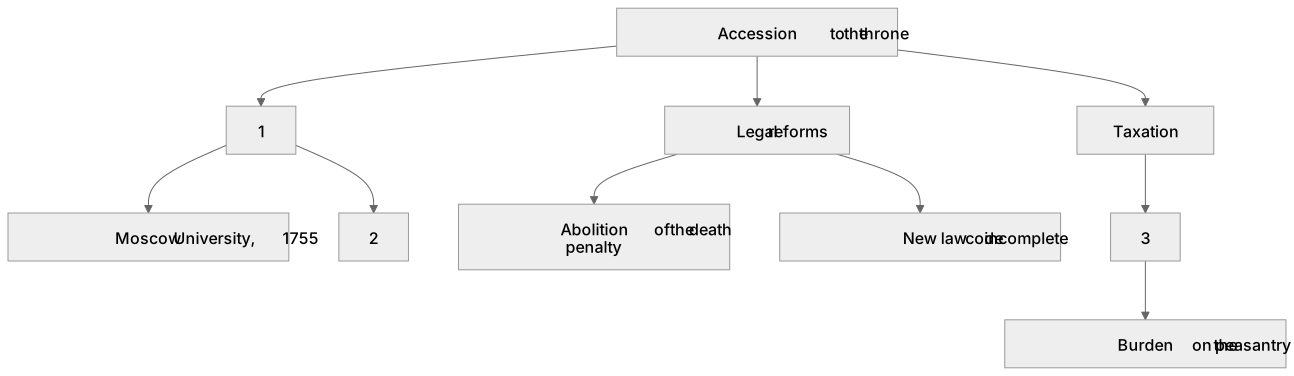
1Box 1
2Box 2
3Box 3
There is more to this lesson
The full lesson goes on to check your understanding and help you earn the marks. Create a free account to carry on, with your progress saved.
A week of Premium from your first lesson · Then the free plan continues · No card, no charge
Test your understanding of 1E Russia in the Age of Absolutism and Enlightenment, 1682–1796 (A-level only) – The epoch of palace coups, 1725–1762: Tsarina Elizabeth: accession to the throne; education and Westernisation; legal reforms; taxation
Active recall beats re-reading. Take an instant quiz now to test what you’ve learned and lock it into long-term memory.
A week of Premium from your first lesson · Then the free plan continues · No card, no charge