AQA · A-Level · History
Course version: 7042 · Version from Sept 2017
Russia by 1762: the extent to which Petrine reforms survived; the…
Full specification wording
1E Russia in the Age of Absolutism and Enlightenment, 1682–1796 (A-level only) – The epoch of palace coups, 1725–1762: Russia by 1762: the extent to which Petrine reforms survived; the accession of Catherine the Great
By 1762, Peter the Great's legacy remained the foundation of the Russian state, though his reforms experienced varying survival.
Checked against the AQA 7042 specification (opens in a new tab) on .
- Point 6 of 6
Study notes
From the checked teaching notes for this specification point.
The idea
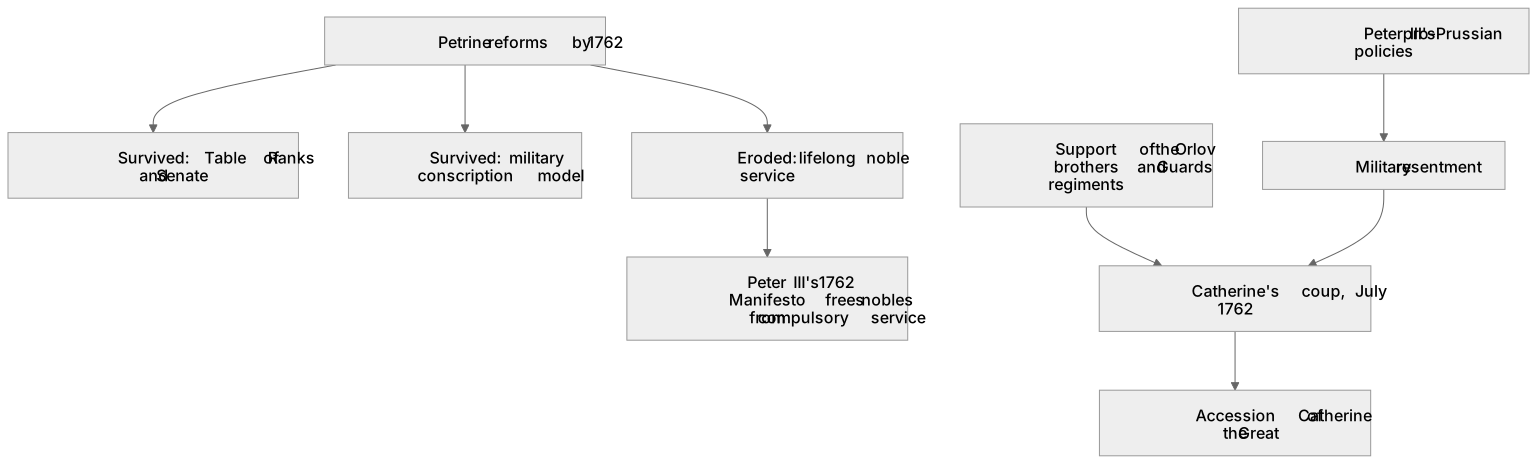
By 1762, Peter the Great's legacy remained the foundation of the Russian state, though his reforms experienced varying survival. The Table of Ranks and the Senate endured, cementing bureaucratic administration, while the military retained its conscription model. However, the obligation of lifelong noble service was eroded, culminating in Peter III's 1762 Manifesto freeing nobles from compulsory service. The epoch of palace coups concluded with the accession of Catherine the Great in July 1762. Capitalising on the military's resentment towards Peter III's pro-Prussian policies, Catherine orchestrated a coup with the support of the Orlov brothers and the Guards regiments, securing the throne and ending decades of political instability.
What earns the marks
- Assess the continuity of Petrine administrative structures, such as the Senate and the Holy Synod, during the era of palace coups.
- Evaluate the changing relationship between the autocracy and the nobility, focusing on the gradual dismantling of compulsory state service by 1762.
- Analyse the role of the Guards regiments as kingmakers in 18th-century Russian politics, culminating in the 1762 coup.
- Examine the immediate causes of Catherine the Great's accession, including Peter III's alienation of the army, the Church, and the nobility.
Common mistakes and how to put them right
Stating that all of Peter the Great's reforms were reversed by his successors.
Put it right: Emphasise that core structural reforms, like the Table of Ranks and the Holy Synod, survived and became entrenched, even as noble service obligations relaxed.
Assuming Catherine the Great had a strong hereditary claim to the throne.
Put it right: Clarify that Catherine was a German princess with no Russian blood; she seized power through a military coup against her husband, the legitimate Romanov heir.
Ignoring Peter III's role in his own downfall.
Put it right: Detail how Peter III's specific actions, such as the alliance with Prussia and threats to the Orthodox Church, directly provoked the coup that installed Catherine.
Exam tips
- When evaluating the survival of Petrine reforms, distinguish between institutional continuity (which remained strong) and social policies regarding the nobility (which shifted significantly).
- Use Peter III's 1762 Manifesto on the Freedom of the Nobility as a key turning point in the evolution of the Russian social structure.
- Connect foreign policy failures (like the withdrawal from the Seven Years War) directly to domestic instability and Catherine's successful coup.
Try the lesson
The start of the 1E Russia in the Age of Absolutism and Enlightenment, 1682–1796 (A-level only) – The epoch of palace coups, 1725–1762: Russia by 1762: the extent to which Petrine reforms survived; the accession of Catherine the Great lesson, made from checked teaching notes for this specification point.
Have a go first
How did Catherine the Great come to power in Russia in 1762?
Listen
By 1762, Peter the Great's legacy remained the foundation of the Russian state, though his reforms experienced varying survival. The Table of Ranks and the Senate endured, cementing bureaucratic administration, while the military retained its conscription model. However, the obligation of lifelong noble service was eroded, culminating in Peter III's 1762 Manifesto freeing nobles from compulsory service. The epoch of palace coups concluded with the accession of Catherine the Great in July 1762. Capitalising on the military's resentment towards Peter III's pro-Prussian policies, Catherine orchestrated a coup with the support of the Orlov brothers and the Guards regiments, securing the throne and ending decades of political instability. A strong answer earns marks for these points. Assess the continuity of Petrine administrative structures, such as the Senate and the Holy Synod, during the era of palace coups. Evaluate the changing relationship between the autocracy and the nobility, focusing on the gradual dismantling of compulsory state service by 1762. Analyse the role of the Guards regiments as kingmakers in 18th-century Russian politics, culminating in the 1762 coup. Examine the immediate causes of Catherine the Great's accession, including Peter III's alienation of the army, the Church, and the nobility. A common slip: Stating that all of Peter the Great's reforms were reversed by his successors. Instead, Emphasise that core structural reforms, like the Table of Ranks and the Holy Synod, survived and became entrenched, even as noble service obligations relaxed. Exam tip: When evaluating the survival of Petrine reforms, distinguish between institutional continuity (which remained strong) and social policies regarding the nobility (which shifted significantly).
See it
Label the diagram
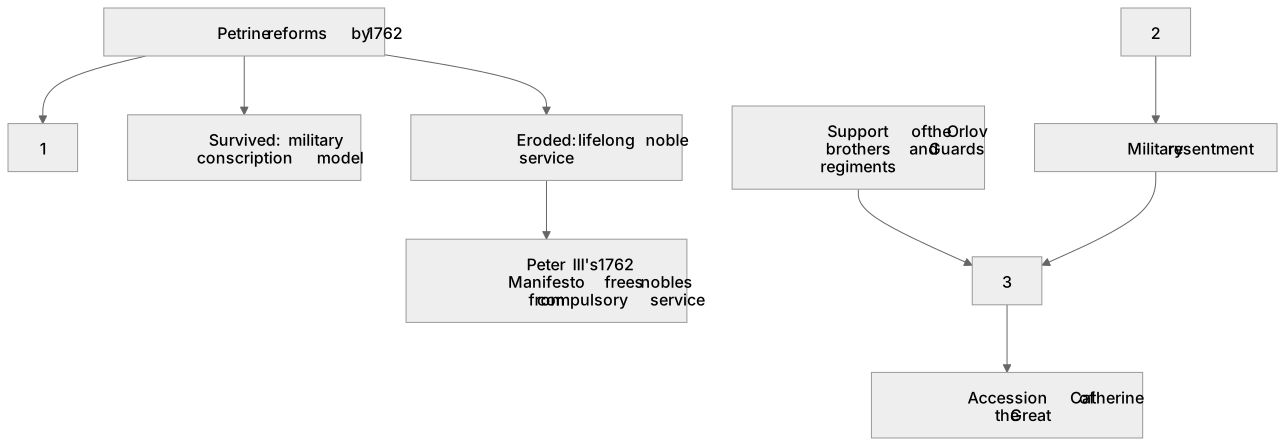
Some boxes have lost their names. Pick the right name for each number.
1Box 1
2Box 2
3Box 3
There is more to this lesson
The full lesson goes on to check your understanding and help you earn the marks. Create a free account to carry on, with your progress saved.
A week of Premium from your first lesson · Then the free plan continues · No card, no charge
Test your understanding of 1E Russia in the Age of Absolutism and Enlightenment, 1682–1796 (A-level only) – The epoch of palace coups, 1725–1762: Russia by 1762: the extent to which Petrine reforms survived; the accession of Catherine the Great
Active recall beats re-reading. Take an instant quiz now to test what you’ve learned and lock it into long-term memory.
A week of Premium from your first lesson · Then the free plan continues · No card, no charge